Portuguese
  Spanish


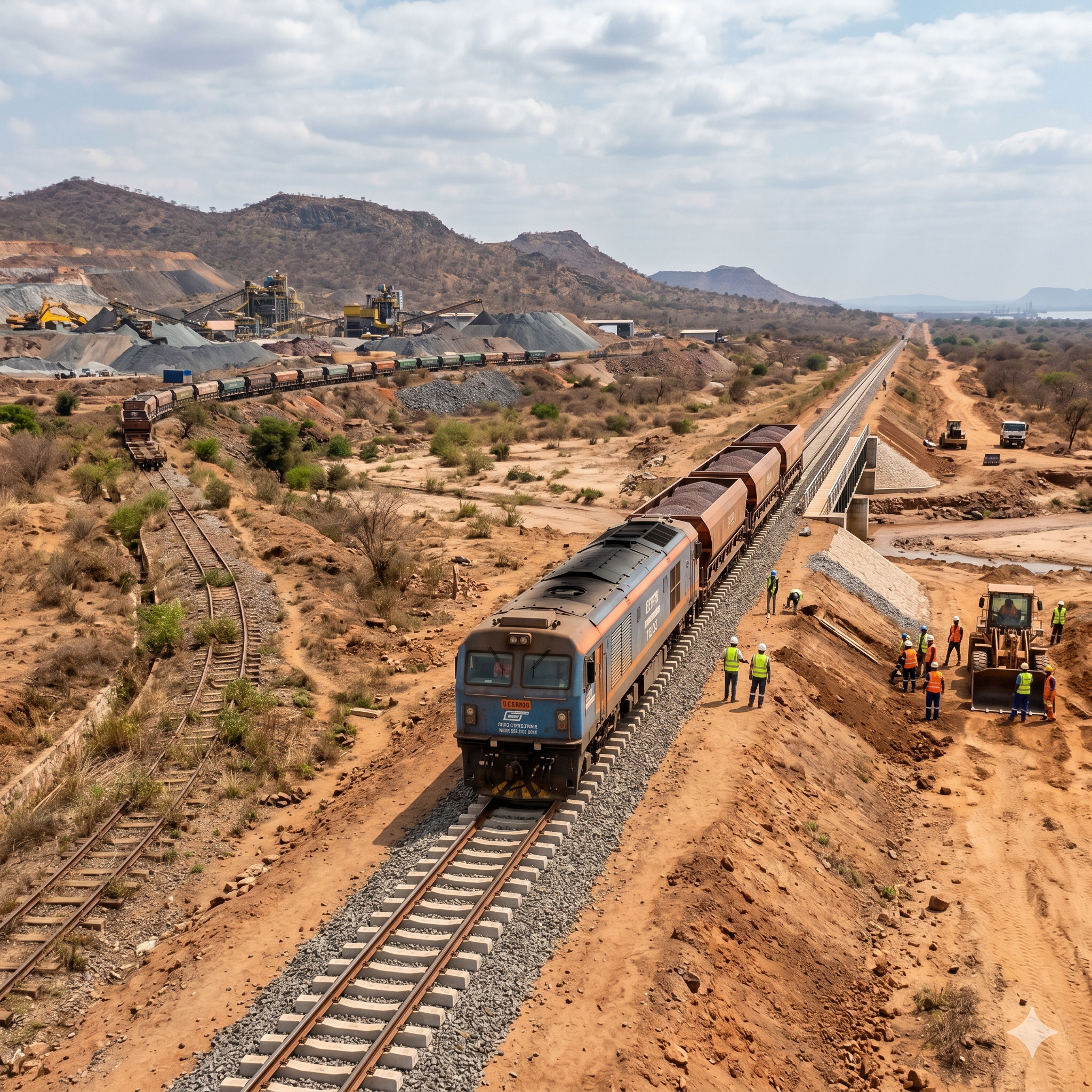

The US and the European Union invest over $10 billion in the Lobito Corridor to compete with China for control of critical minerals used in batteries.
According to an analysis by the Atlantic Council, the Lobito Corridor is one of the most ambitious initiatives supported by the West to reposition the logistical routes of critical minerals that come from the interior of Africa to the global market. The physical basis of this project is the Benguela Railway, whose construction began in 1902, still during the Portuguese colonial period. After decades of degradation exacerbated by the Angolan civil war, the line was mainly rebuilt between 2007 and 2014 with Chinese funding of about $1.83 billion, a figure often rounded to $2 billion.
Today, the United States, the European Union, multilateral banks, and private partners are trying to transform this axis into one of the main Atlantic routes for the export of copper and other critical minerals from the Democratic Republic of the Congo and Zambia. Here, however, the financial data needs adjustment: the official sources found indicate about $4 billion in American commitment, over €2 billion mobilized by the European Union and its member states, and approximately $6 billion in total investment from the main actors by the end of 2024.
The most symbolic move so far occurred in August 2024, when the first shipment of Congolese copper destined for the United States arrived in Lobito on August 19 and was shipped a few days later towards Baltimore. The episode transformed the railway into more than just a commercial corridor: it began to represent, on rails, a geopolitical contest for influence over the exit of critical minerals from a region where China still maintains a strong presence in the mining sector.
-
The Arctic is no longer just a frozen region and is becoming a new military board with the opening of maritime routes, expansion of bases, nuclear icebreakers, and competition among Russia, NATO, the United States, and China.

-
U.S. Dismisses Brazilian Foreign Ministry’s Military Risk Warning as “Absurd,” Cites Brazilian Criminal Gangs Operating in the U.S. Since May 2026
-
Ukraine War Impacts Brazilian Fuel Supply: Russian Diesel Imports Drop 65% in June, Brazil Turns to US and India Amid Market Concerns

-
Chinese Nuclear Submarine Launches Simulated Warhead Missile in Pacific, Heightening Regional Tensions Amid Naval Drills with Russia Near Qingdao; New Zealand and Papua New Guinea Warn of Persistent Chinese Military Presence



The Copperbelt region concentrates the largest global production of cobalt and copper essential for batteries and energy
The region known as the Copperbelt, which extends from the south of the Democratic Republic of the Congo to the north of Zambia, contains one of the largest strategic mineral reserves on the planet.
The Congo accounts for approximately 73% of global cobalt production, while also holding a large part of the copper reserves, a metal essential for the electrification of vehicles and the expansion of renewable energy networks.


These minerals are fundamental for lithium-ion batteries, used in electric cars, energy storage systems, and electronic devices. The global energy transition directly depends on the availability and logistical control of these resources.
Chinese dominance in African mining and logistics places the West in a position of strategic dependence
Currently, China exerts strong control over the value chain of these minerals. Chinese companies like CMOC and Zijin lead the extraction in Congo, while most of the global processing of copper and cobalt occurs on Chinese territory.
The minerals are transported through long and complex routes to ports like Dar es Salaam in Tanzania or Durban in South Africa, from where they mainly head to Asia.
This model places the United States and Europe in a position of dependence on a chain they do not control.
The Benguela Railway connects the African mineral interior to the Atlantic in the shortest logistical route in the world
The Benguela Railway is approximately 1,344 kilometers long and connects the port of Lobito on Angola’s Atlantic coast to the border with the Democratic Republic of the Congo.
From this point, the railway network connects to the Congolese system, reaching the city of Kolwezi, considered the mineral hub of the Copperbelt.
This route represents the shortest path between African mines and the Atlantic Ocean, offering a significant logistical advantage over traditional routes.
Infrastructure was destroyed during the Angolan civil war and rebuilt with Chinese funding
During the Angolan civil war, between 1975 and 2002, the railway was a constant target of sabotage, with bridges destroyed and tracks removed.
Reconstruction took place between 2006 and 2014, led by Chinese companies with financing guaranteed by Angolan oil, generating over 25,000 local jobs.
This investment consolidated the Chinese presence in African logistics infrastructure before the effective entry of the West.
International investments exceed US$ 10 billion and involve governments, banks, and private companies
As of 2023, the Lobito Corridor began receiving coordinated investments from multiple international actors.
United States, European Union, Angola, Congo, Zambia, African Development Bank, and Africa Finance Corporation formalized agreements for the joint development of the corridor.
The consortium formed by Trafigura, Mota-Engil, and Vecturis took over the 30-year concession of the Angolan railway, with direct investments of hundreds of millions of dollars.
The U.S. Development Finance Corporation approved US$ 553 million in financing, while the European Union mobilized over €2 billion. The total committed exceeds US$ 10 billion.
Lobito Corridor reduces mineral transport time from over 30 days to less than a week
Logistical efficiency is one of the main factors that make the corridor strategic. Transporting copper from the Kolwezi region to traditional ports can take over 30 days. Via the Lobito Corridor, this time was reduced to about six days in the first shipment carried out in 2024.
This reduction completely transforms the route’s competitiveness and reduces operational costs. Despite advances in Angolan infrastructure, the railway section within the Democratic Republic of Congo remains one of the main challenges.
Operated by the state-owned SNCC, the segment between Dilolo and Kolwezi presents precarious conditions, with average speeds between 10 and 15 km/h and utilization below 5% of capacity.
The Congolese government is seeking US$ 500 million in financing from the World Bank to rehabilitate this section.
Railway expansion to Zambia has not yet begun and is expected to take years to complete
Another critical point is the absence of a direct connection with Zambia. The Zambia-Lobito Railway project foresees the construction of approximately 800 kilometers of railway to integrate the corridor into the Zambian Copperbelt.
Works are scheduled to begin in 2026, but full completion is expected to take several years. In response to Western investments, China signed a US$ 1.4 billion agreement in 2025 to modernize the TAZARA railway, which connects Zambia to the port of Dar es Salaam.

The goal is to increase transport capacity from 400,000 to 2.4 million tons annually. This move establishes a direct dispute between two competing logistics corridors that connect the same mineral hub to different global markets.
Global dispute over critical minerals intensifies with competition between Atlantic and Indian routes
The dispute between the Lobito Corridor and the TAZARA railway represents a new phase of global competition for strategic resources.
On one side, the Atlantic corridor supported by the United States and Europe. On the other, the Indian route sustained by China. Both compete for the transport of the same minerals, originating from the same regions.

Angola, Congo, and Zambia do not act merely as transit territories. The existence of multiple corridors increases these countries’ negotiating power, allowing for better commercial conditions and diversification of partners.
For Angola, the corridor represents an opportunity to establish itself as a logistics hub. For Congo, it maintains exploration dominated by foreign companies. For Zambia, it expands export alternatives.
Now we want to know: which corridor should dominate global logistics of critical minerals in the coming years?
The competition between the United States, Europe, and China for African logistics infrastructure is redefining the global balance of power over strategic resources.
In your view, will the Lobito Corridor be able to reduce dependence on the West, or will China continue to dominate the global supply chain of critical minerals?