






 Portuguese
  Spanish


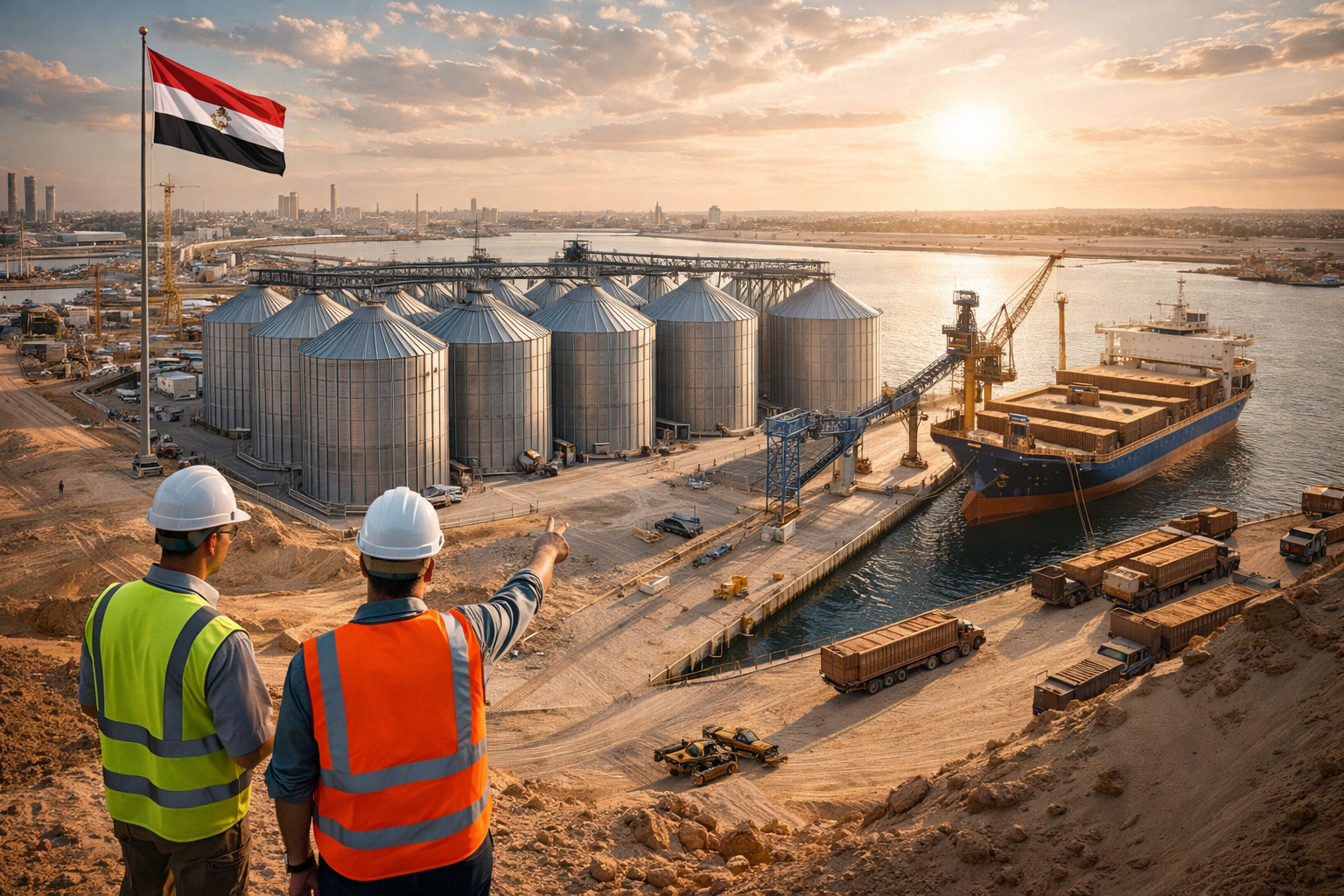
Egypt advances with the National Silos Project, gathering €90 million from Europe, €100 million in grants, and support from the World Bank to create a mega logistics network for grains in the Mediterranean.
In 2025, the government of the Arab Republic of Egypt, through the Ministry of Planning, Economic Development and International Cooperation, formalized a new phase of support for the National Silos Project by announcing a financing package to modernize the country’s grain storage and logistics infrastructure. The initiative brings together resources from the European Investment Bank (EIB), the European Union, and the World Bank, focusing on enhancing the resilience of the Egyptian food system, reducing losses, and strengthening the strategic storage capacity of wheat and other cereals.
The advancement of the project occurs in a context of strong pressure on global supply chains, marked by geopolitical conflicts, price shocks, and climate risks. According to the World Bank, the war in Ukraine has raised costs and increased food vulnerability in the country, while the EIB highlights that the modernization of silos is part of Egypt’s response to potential shortages and price fluctuations. Egypt remains one of the largest wheat importers in the world, making its dependence on international flows a central factor for domestic supply.
In practice, the expansion of this national network of silos represents a structural change in how the country manages its food security. World Bank documents show that the program was designed to replace more vulnerable structures with modern and digitally operated silos, increasing logistical efficiency, reducing waste, and creating a more robust foundation to face global supply crises.
-
Bolivian Female Construction Workers Form Association to Combat Discrimination and 38% Pay Gap in the Industry

-
Near Amsterdam, residents buy land and discover they must also build streets, manage drainage, handle waste, and grow food on half their plot.
-
Without a mansion, without high investment, and without a traditional classroom, a teacher living in a 22 m² house taught students to build a 9 m² studio apartment with the equivalent of R$10,000.
-
Without her own home and pressured by rent, a 25-year-old bought a small 15-meter boat, gradually renovated the interior by herself, transformed the interior with paint, new flooring, a larger bathroom, and started living on the canals, paying much less per month.


European and multilateral investments drive the expansion of grain infrastructure in Egypt
The financing of the project involves multiple fronts. In 2025, the European Investment Bank approved €90 million, while the European Union added €100 million in grants, complemented by €110 million from the World Bank. This financial package supports the construction and modernization of silos, as well as the logistical integration with ports and distribution centers.
This level of investment reflects the strategic importance of Egypt not only for its own population but also for the food stability of the North African and Middle Eastern region.
The entry of international capital indicates that Egyptian food security is treated as a global interest topic, especially considering the country’s position as one of the largest wheat buyers in the world.
Port Said consolidates as the central axis of the new logistical fortress for grains in the Mediterranean
Within the National Silos Project, the port of West Port Said plays a central role. Located at the entrance of the Suez Canal, the port directly connects trade routes between Europe, Asia, and Africa.
One of the most relevant silos in the new structure has an approximate capacity of 100,000 tons, functioning as a strategic point for receiving and redistributing imported grains. The location allows for:
- Rapid receipt of international cargo
- Integration with internal transport networks
- Efficient redistribution to different regions of the country
Transforming Port Said into a logistics hub for grains significantly expands Egypt’s capacity to operate as a regional storage and distribution center, reducing costs and increasing efficiency.
Egypt is one of the largest wheat importers in the world and depends on robust infrastructure
The need for a project of this scale is directly linked to Egypt’s position in the global market. The country ranks among the largest wheat importers on the planet, with volumes that frequently exceed tens of millions of tons per year. This dependence makes the country highly vulnerable to price fluctuations, logistical disruptions, and conflicts in producing regions.
Without adequate storage infrastructure, the impact of any disruption can be immediate and severe, directly affecting internal supply and economic stability. The National Silos Project aims to mitigate this risk by creating greater absorption capacity in the face of external shocks.
Post-harvest losses and inadequate storage motivated the modernization of silos
Before the implementation of the project, a significant portion of the grains stored in Egypt was kept in open or inadequate structures, such as makeshift warehouses known as “shounas.” This model resulted in significant losses due to exposure to moisture, contamination, and natural deterioration.
With the introduction of modern silos, these losses can be drastically reduced. The transition to controlled storage represents a direct gain in efficiency, equivalent to millions of tons preserved over time, without the need to increase imports.
Capacity of 3.6 million tons positions Egypt as a regional hub for grains
The expansion of capacity to around 3.6 million tons not only meets domestic demand. This volume allows Egypt to play a more active role in regional food logistics. The infrastructure created enables:
- Storage of surpluses
- Redistribution to neighboring countries
- Greater commercial flexibility
This scale transforms the country into a potential strategic grain hub in the Mediterranean, especially in times of global crisis, when the ability to store and redistribute food becomes a critical differentiator.
Logistics integration between ports, silos, and internal transport increases system efficiency
The National Silos Project is not limited to the construction of isolated structures. It is part of an integrated system that connects ports, railways, highways, and distribution centers. This integration allows for reduced logistical costs, increased transport speed, and better inventory management.
The operational efficiency generated by this integration reduces waste and improves the country’s responsiveness, especially in emergency scenarios.
Project strengthens food security strategy in unstable global scenario
In recent years, the global food market has been marked by instability, with events such as the war in Ukraine directly affecting the supply of wheat and other grains.
For countries highly dependent on imports, such as Egypt, these changes represent significant risks. The National Silos Project emerges as a strategic response to this scenario.
The ability to store large volumes of grains allows the country to mitigate the impacts of crises and maintain internal supply even in the face of global disruptions, reducing exposure to external shocks.
National Silos Project shows how infrastructure can redefine food security in the 21st century
The case of Egypt illustrates a growing trend: the transformation of logistical infrastructure into one of the main pillars of food security. Instead of relying solely on local production, countries are investing in storage and distribution capacity. This model allows for:
- Greater control over inventories
- Reduction of external vulnerabilities
- Adaptation to crisis scenarios
The scale and complexity of the National Silos Project place Egypt among the countries that have advanced the most in this strategy, creating a system capable of sustaining the supply for one of the largest populations in the Arab world.
The National Silos Project shows that food security has ceased to be just an agricultural issue and has also become an issue of engineering, logistics, and geopolitics. With billions invested and a capacity of millions of tons, Egypt is redefining its relationship with global supply.
In your view, will this type of infrastructure be sufficient to face future food crises, or will new challenges still test these systems?




Be the first to react!