Portuguese
  Spanish


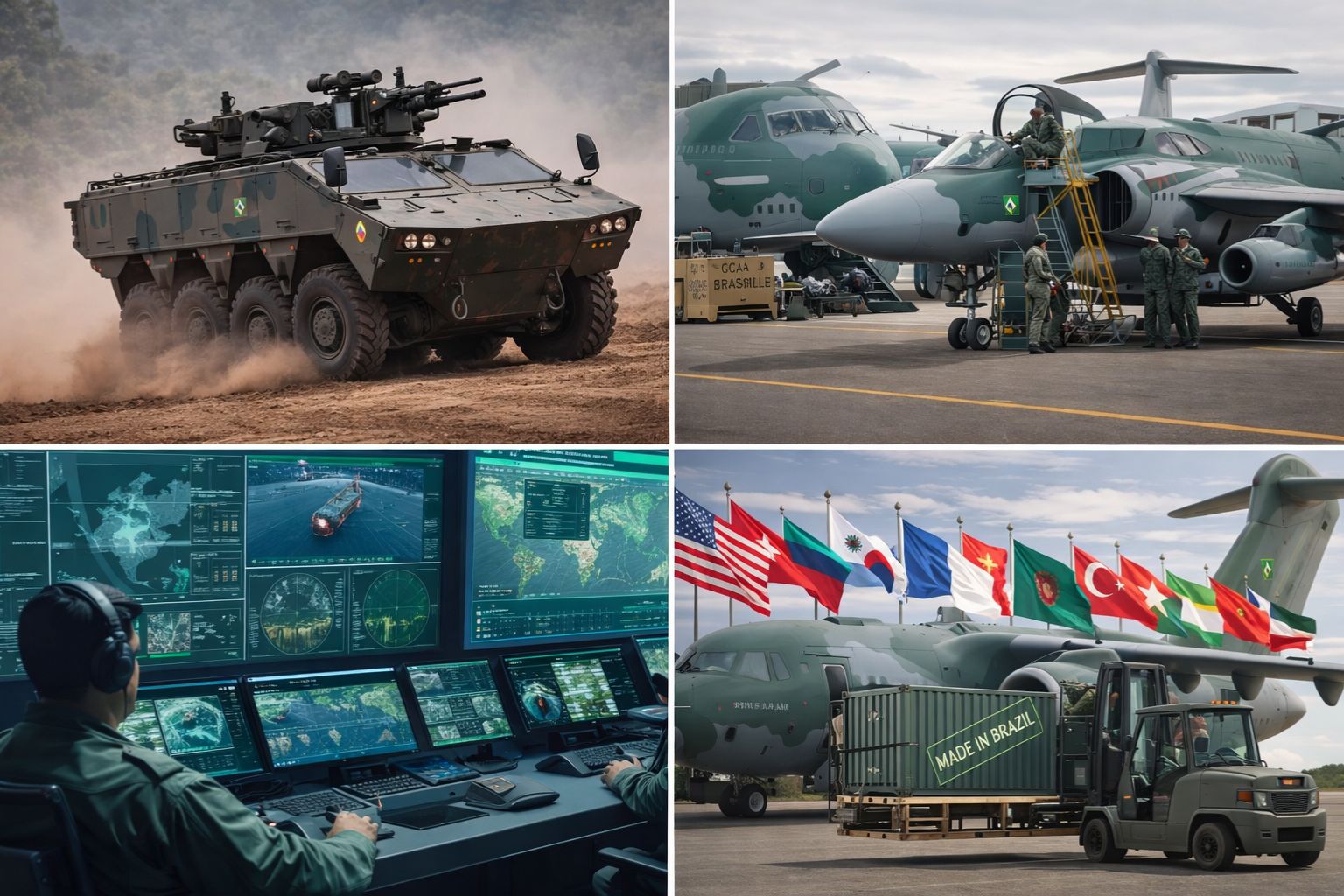

The defense industry of Brazil exported US$ 1.02 billion in the first quarter of 2026, more than double the US$ 457 million of the same period in 2025. About 93 Brazilian companies sell armored vehicles, aircraft, and monitoring systems to 148 countries, and the Ministry of Defense expects a new annual record after the US$ 3.4 billion reached in 2025.
The defense industry of Brazil has just recorded the most profitable first quarter in its history. Between January and March 2026, Brazilian exports of military products totaled US$ 1.02 billion, more than double the US$ 457 million recorded in the same period of 2025. The data, released by the Ministry of Defense, confirms a trajectory of accelerated growth that took exports from US$ 1.45 billion in 2023 to US$ 1.78 billion in 2024 and US$ 3.4 billion in 2025. If the pace of the first quarter is maintained, 2026 will be the year Brazil surpasses the mark of US$ 4 billion in defense exports.
Currently, about 93 Brazilian companies operate in the international defense market, with a presence in 148 countries. Germany, Bulgaria, United Arab Emirates, United States, and Portugal are among the main destinations for national products, which include everything from vessels and armored vehicles to aircraft, avionics, and monitoring systems. The Secretary of Defense Products, Heraldo Luiz Rodrigues, stated that the result “is the result of a very strong defense industrial base, but also of intense and strategic commercial promotion work by the Ministry of Defense” of Brazil.
The numbers that show the explosion of Brazilian defense exports

The scale of growth is hard to exaggerate. According to information from the portal rtbrasil, in just three years, Brazil’s defense exports have nearly tripled, jumping from US$ 1.45 billion in 2023 to US$ 3.4 billion in 2025, and the first quarter of 2026 already represents almost a third of the total for the entire previous year. This performance places Brazil among the largest exporters of military equipment in the world in terms of growth rate, proportionally surpassing traditional powers in the sector such as France, the United Kingdom, and Israel.
-
After selling only 264 SUVs in five months, Jaguar Land Rover closes factory in Brazil after nearly 10 years, exposing 371 jobs to uncertainty and may see the R$ 750 million unit shift from premium luxury to become a base for the Chinese company Chery.

-
He was born in Rio, arrived in Rio Grande at the age of 3, started in the naval industry, and today leads the company that is doubling in size for the second consecutive year, building steel warehouses for “agro giants,” with a new factory four times larger and a goal of R$ 600 million.
-
He went bankrupt with the first app, started over with $40,000 and 2 employees, bought 50 “forgotten” internet brands like Evernote and AOL, and debuted on the stock market valued at R$ 130 billion, with shares rising 40% in one day.

-
Almost 4 in 10 Brazilians have already experienced fraud or attempted fraud, and the company that “sells trust” for 30 years uses biometrics and 3D proof of life to expose deepfakes, aiming for R$ 350 million in 2026.


The most significant aspect is not just the volume, but the diversification. The 93 Brazilian companies that sell to 148 countries offer a portfolio that ranges from naval vessels and armored vehicles to military aircraft, avionic systems, and electronic monitoring platforms. This breadth of products means that Brazil does not rely on a single item to sustain its exports, as is the case with countries that predominantly sell one type of equipment. The Brazilian defense industrial base is diverse enough to meet different demands across five continents.
The government strategy that boosts Brazil’s defense exports
The growth did not happen by chance. The Ministry of Defense implemented a commercial promotion strategy that includes regular dialogues with the industry, meetings with foreign delegations, and visits from ambassadors to Brazilian factories, an approach that treats the sale of military equipment with the same commercial aggressiveness that Brazil applies to the export of agricultural commodities. Secretary Rodrigues detailed that the ministry “held several defense industry dialogues, took ambassadors to visit companies in the industrial base, among other activities to strengthen the sale of products abroad”.
The expansion of Brazil’s external defense sales is supported by an interministerial network. In addition to the Ministry of Defense, the Ministries of Foreign Affairs and Industry, Trade, and Services actively participate, along with Apex (the export promotion agency), Camex, and BNDES, which can finance the purchase of Brazilian equipment by foreign governments. This coordination among different federal agencies allows Brazil to offer not only the product but the complete package of financing and technical support that many defense buyers require.
The catalog and the new regulation that facilitate Brazil’s defense sales
As part of the strategy to expand exports, the Ministry of Defense launched the Defense Industrial Base Product Catalog, bringing together 154 companies and 364 items in a publication that serves as the official showcase of what Brazil produces and sells. The catalog includes vessels, armored vehicles, aircraft, avionics, and monitoring systems, organized in a way that international buyers can quickly identify which Brazilian companies offer the products they are looking for.
The government also published Ordinance No. 1,456/2026, which regulates the Ministry of Defense’s actions in exports conducted directly between governments. “This was a long-standing request from the industries and will facilitate trade with partner countries”, stated Secretary Rodrigues. The regulation allows Brazil to formally participate in government-to-government negotiations, a sales format that many purchasing countries prefer as it offers political and legal guarantees that transactions between private companies do not provide. For Brazil’s defense industry, this ordinance removes a bureaucratic obstacle that limited billion-dollar deals.
What are the main products that Brazil exports to 148 countries
The Brazilian defense export portfolio is more diversified than most people imagine. Armored vehicles like the Guarani, manufactured by Iveco Defence Vehicles in partnership with the Army, are sold to dozens of countries seeking protection for their troops at a lower cost than their European and American counterparts. In aviation, Embraer’s KC-390 and the Super Tucano (A-29) light attack aircraft continue to be successful products in the international market.
Monitoring and electronic surveillance systems complement the offering. Brazilian companies have developed radars, secure communication systems, and command and control platforms that meet the demands of countries needing to modernize their armed forces without the prohibitive cost of equipment from traditional manufacturers like Lockheed Martin, BAE Systems, or Thales. Brazil occupies a strategic niche in the global defense market: it offers quality technology at competitive prices, with accessible financing and without the political conditions that powers like the United States and France often impose on their buyers.
What the growth of defense exports means for Brazil
The US$ 1.02 billion exported in the first quarter of 2026 is not just a foreign trade statistic. Every dollar exported in defense products represents high-skilled industrial jobs, technological development that spills over into civilian sectors, and tax revenue that funds public services. The defense industry is one of the few sectors where Brazil competes globally with high value-added products, unlike agricultural and mineral commodities that dominate the national export agenda.
The Ministry of Defense expects a new record in 2026, and the numbers from the first quarter support this expectation. If Brazil maintains the growth rate of the last three years, the country could establish itself among the ten largest defense exporters in the world by the end of the decade, an achievement that would place the Brazilian military industry at a level of international recognition comparable to what the agribusiness has already achieved. The path is set, and the numbers show that Brazil is traversing it faster than any forecast suggested.
The Brazilian defense industry has doubled exports and has already earned US$ 1 billion in three months. Did you know that 93 Brazilian companies sell to 148 countries? Do you think Brazil should invest more in this sector? Leave your opinion in the comments.