Portuguese
  Spanish


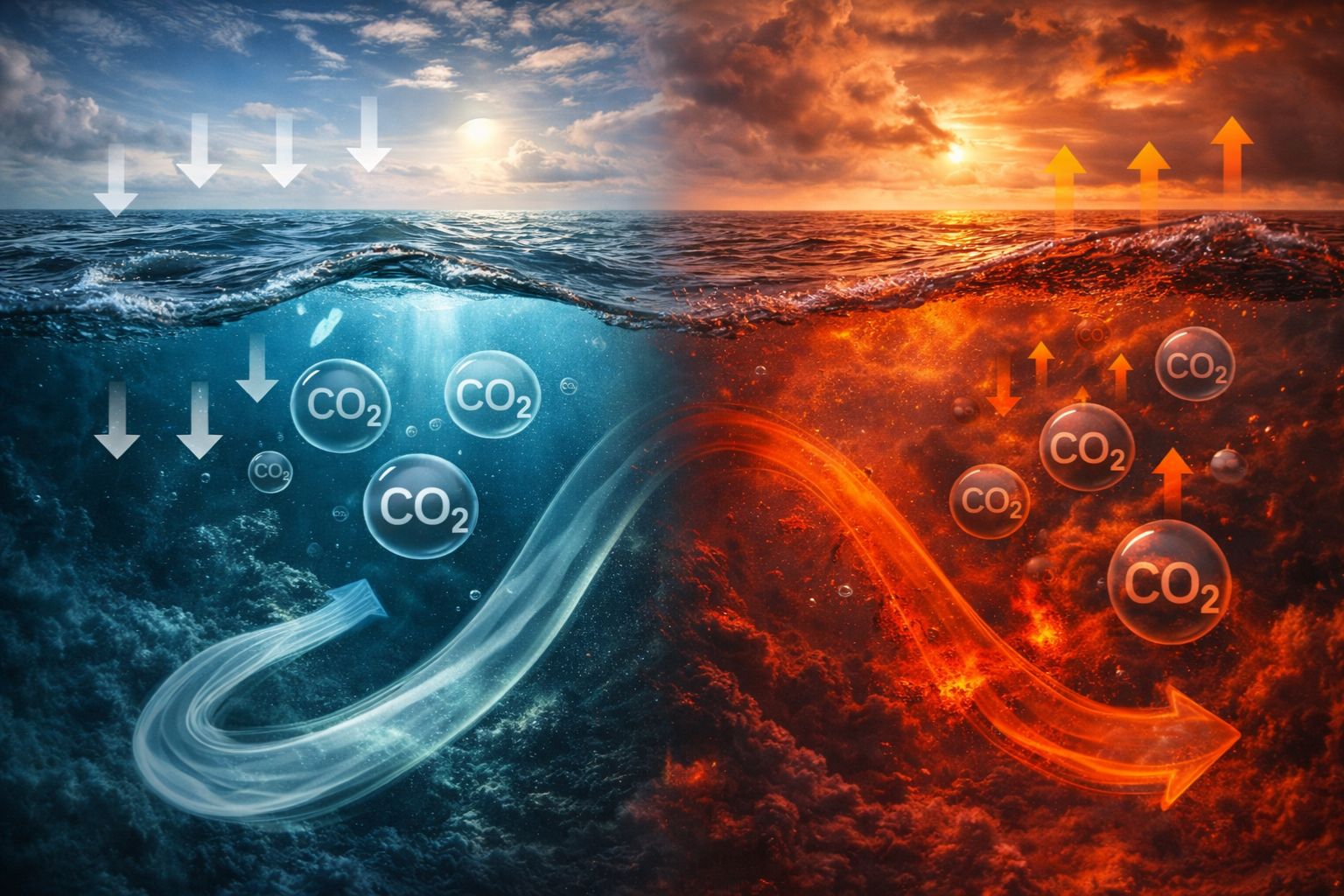

A study published in Communications Earth & Environment reveals that the collapse of the AMOC, the current that includes the Gulf Stream, could transform the Southern Ocean from a sink into a source of carbon, releasing CO₂ and adding up to 0.27°C of extra global warming. With current atmospheric CO₂ at 430 ppm, the current may not recover after a collapse.
The ocean has been humanity’s greatest ally against global warming, absorbing about a quarter of all the carbon dioxide emissions we produce. But new research published in Communications Earth & Environment shows that this role could catastrophically reverse. Scientists from the Potsdam Institute for Climate Impact Research (PIK) simulated what would happen if the Atlantic Meridional Overturning Circulation (AMOC) were to collapse, and the results are concerning: the Southern Ocean would stop absorbing carbon and start releasing it, adding between 0.17°C and 0.27°C of global warming on top of what is already underway.
The AMOC is the system of deep currents in the Atlantic Ocean that includes the famous Gulf Stream, responsible for the relatively mild temperatures in Northern Europe. In the last century, this circulation has weakened due to glacier melting, reduced polar ice, and increased ocean temperatures, all effects of the climate crisis. The PIK study not only confirms the weakening but also demonstrates that, at current atmospheric CO₂ levels, a collapse of the AMOC could be irreversible, transforming the ocean that protects us from global warming into yet another factor that accelerates it.
What is the AMOC and why does it matter for global warming
The Atlantic Meridional Overturning Circulation functions like an oceanic conveyor belt that moves warm surface waters of the Atlantic northward and cold, deep waters back south. This movement is driven by the difference in salinity and temperature between water masses, and plays a crucial role in regulating the planet’s climate. Without the AMOC, Northern Europe would lose the moderating effect of the Gulf Stream, and rainfall and temperature patterns across the globe would be altered.
-
This Mars rover may finally reveal if life ever existed on Mars.

-
A nearly 70-year-old Chinese inventor has registered 90 patents and created a device that stores water in the roots, helping seedlings survive drought while trying to transform the arid slopes of the Loess Plateau into green areas without relying on heavy irrigation.

-
Researchers want to change the way of producing rare earth magnets, reducing purification steps and making better use of the elements found in Swedish deposits.
-
5.5 tons pulled from the seabed: a ‘living carpet’ of invasive coral was suffocating the Baía de Todos-os-Santos until the Brazilian Navy descended with divers, steel brushes, and acid salt to carry out the largest eradication operation of the species ever conducted in the country.



For global warming, the AMOC has a function that goes beyond thermal regulation. The circulation helps transport carbon from the surface to the depths of the ocean, where it remains stored for centuries, away from the atmosphere. When the AMOC is functioning normally, the ocean efficiently absorbs CO₂. When it weakens or collapses, this carbon sequestration mechanism fails, and the carbon-rich deep waters that are normally isolated can rise to the surface and release CO₂ back into the atmosphere, intensifying global warming.
What simulations revealed about collapse and global warming
Researchers at PIK simulated different scenarios forcing the collapse of the AMOC by adding freshwater to the ocean, which alters salinity and disrupts circulation. At the pre-industrial level of CO₂ at 280 parts per million (ppm), the AMOC recovered when the addition of freshwater stopped, demonstrating that under low carbon concentration conditions, the system is resilient. The current can temporarily collapse but can restart when the disturbance ceases.
The scenario changes dramatically when CO₂ levels increase. At concentrations of 350 ppm, which correspond to the atmospheric level last recorded in 1988, the AMOC collapsed and did not recover. Today, the atmospheric concentration of CO₂ is at 430 ppm, well above the threshold identified by the study. Lead author Da Nian explained that “higher CO₂ concentrations fundamentally alter the stability of the AMOC, pushing the system into a bi-stable regime where the AMOC could weaken over hundreds of years before shifting to, and remaining in, a collapsed state.” Once the current stops, it does not return, and global warming intensifies.
How the collapse of the AMOC transforms the ocean into a source of global warming
The mechanism by which the collapse of the AMOC accelerates global warming is indirect but powerful. When circulation stops functioning, the mixing of waters in the Southern Ocean intensifies, bringing carbon-rich deep waters to the surface. This carbon, which had been stored in the depths for centuries, is then released into the atmosphere in the form of CO₂. Co-author Matteo Willeit explained that “this change in temperatures is caused by a large release of carbon from the Southern Ocean, due to the intensified mixing that brings carbon-rich deep waters to the surface.”
The result is a dangerous feedback cycle. Global warming melts glaciers and alters ocean salinity, which weakens the AMOC. The weakened AMOC releases more carbon, which intensifies global warming, which in turn melts more glaciers and further weakens circulation. The study estimates that the collapse alone would add between 0.17°C and 0.27°C of extra global warming, a value that seems small in isolation but adds to a planet that has already surpassed a 1°C increase compared to the pre-industrial era.
The regional effects that collapse would bring beyond global warming
The study does not only predict widespread global warming. Under a scenario with CO₂ at 450 ppm, Antarctica would see temperatures rise by 6°C, while Arctic temperatures would drop by 7°C due to the disruption of the heat transfer that the AMOC normally performs. This extreme contrast between the poles would redesign climate patterns across the planet, affecting rainfall, droughts, storms, and agricultural production in nearly all continents.
The north of Europe would be one of the most affected regions. Without the moderating effect of the Gulf Stream, countries like the United Kingdom, Norway, Sweden, and Iceland would face significantly colder winters, in a paradox where global warming produces severe regional cooling in some of the most developed areas of the planet. This scenario is not science fiction: the AMOC is already weakened, and the debate among scientists is not whether it can collapse, but when this might happen.
What the study means for the future of global warming
The director of PIK and co-author Johan Rockström summarized the gravity of the discovery in straightforward terms. “The ocean has been our greatest ally, absorbing a quarter of human-made CO₂ emissions. Our study shows how a collapse of the AMOC could turn the Southern Ocean from a carbon sink into a carbon source”, he said. The message is that the ocean is not an unlimited resource for carbon absorption, and pushing it beyond its limits can turn it from a protector into a climate aggressor.
The fact that the AMOC does not recover at CO₂ concentrations above 350 ppm, and that the world is already at 430 ppm, makes the problem urgent. “In simple terms, increasing emissions today raises the risk of a stronger climate response in the future”, concluded Rockström. For global warming, the collapse of the AMOC would not just be another problem on the list: it would be the moment when humanity’s greatest ally against climate change switches sides.
Scientists warn that the collapse of an Atlantic current could turn the ocean into a driver of global warming. Do you think there is still time to avoid this scenario? How does this news change your perception of the climate? Leave your opinion in the comments.