






 Portuguese
  Spanish


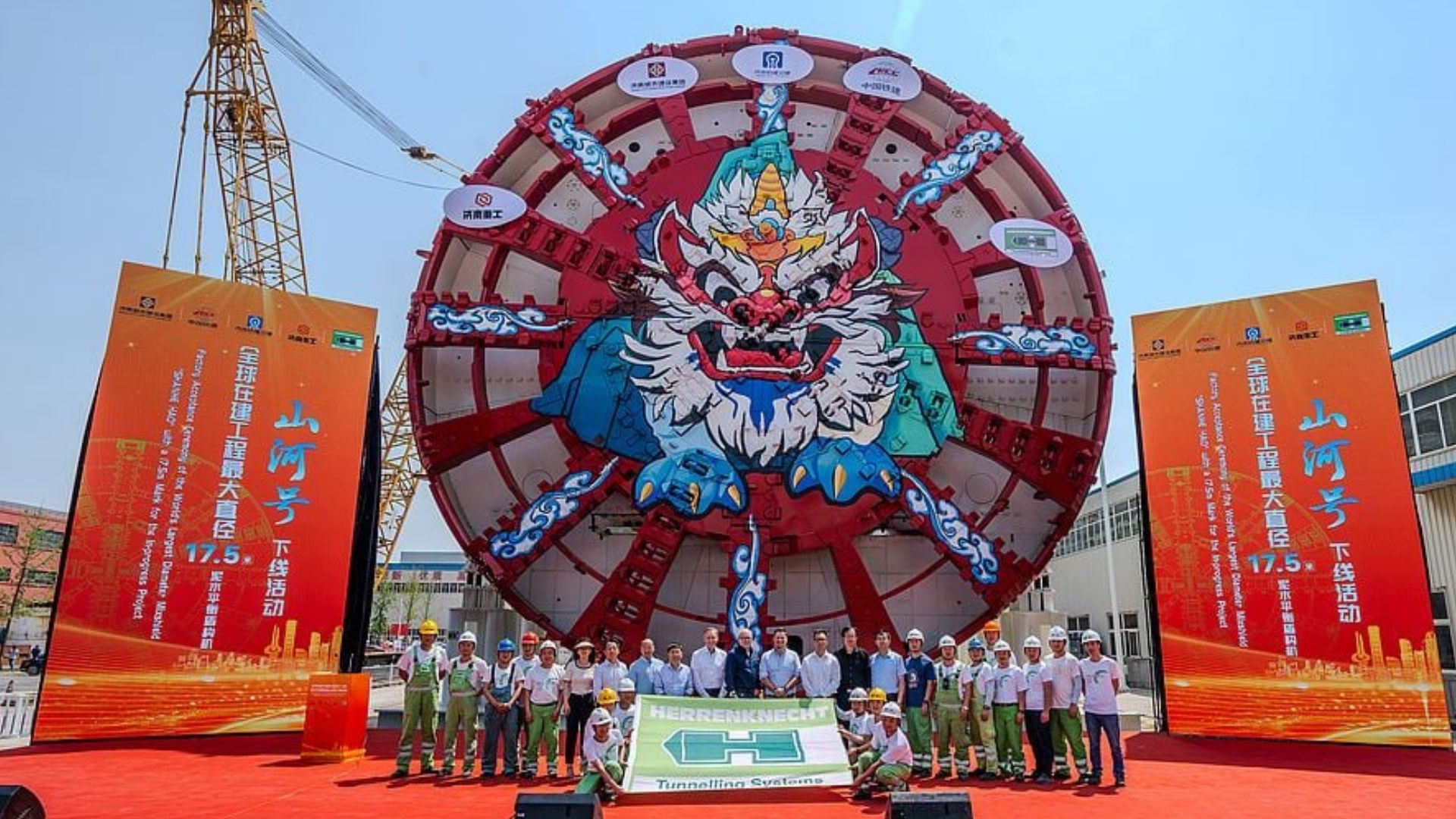


Herrenknecht Mixshield S-880 Qin Liangyu had a shield of 17.63 meters, 4,850 tons, and excavated under Hong Kong in extreme sea water pressure.
According to the Guinness World Records, the Herrenknecht Mixshield S-880 “Qin Liangyu” holds the world record for the largest tunnel boring machine by shield diameter, with 17.63 meters, equivalent to the height of a six-story building. Manufactured in Germany by Herrenknecht, the machine was 120 meters in total length and weighed 4,850 tons. The tunnel boring machine was operated by the Dragages Hong Kong consortium, a subsidiary of the French Bouygues Construction, in the construction of the Tuen Mun–Chek Lap Kok Link, a connection that links the northwest of Hong Kong’s New Territories to the International Airport and the Hong Kong-Zhuhai-Macau Bridge.
The total project is 9 km long, cost HK$ 18.2 billion, about US$ 2.3 billion, and includes a 5 km double underwater tunnel. The project became the deepest, longest, and widest underwater road tunnel in Hong Kong.
Herrenknecht Mixshield S-880 Qin Liangyu was the largest tunnel boring machine in the world by shield diameter
The Qin Liangyu was named after the Chinese general Qin Liangyu, from the Ming Dynasty, born in 1574 and known for courage and loyalty. The tribute follows the underground engineering tradition of giving female names to large tunnel boring machines.
-
In Cape Verde, Ekonatura Recycles 100 kg of Glass and Plastic per Hour into School Bags

-
Experts Reveal Which Water Bottle Material—Metal, Plastic, or Glass—Harbors the Most Bacteria and When Each is Best to Use
-
77-Year-Old Woman Earns Top Marks for Embroidered Children’s Book Thesis with Her 98-Year-Old Mother, Moves Audience After Returning to University Entrance Exams 30 Years Later with a Score of 980
-
Domestic Workers in Switzerland Earn Around $220 per Day, Compared to $24-$60 in Brazil


The machine is no longer necessarily the largest in all technical parameters, as new Chinese and international tunnel boring machines have emerged in recent years. Even so, the Qin Liangyu still holds the Guinness record for the shield diameter of 17.63 meters.

Its case remains extraordinary because it involved a very rare operation: the tunnel boring machine changed size within the tunnel it was excavating, without surfacing, while working under sea water pressure.
Tuen Mun–Chek Lap Kok Link required a giant tunnel boring machine due to Hong Kong’s geology
The underwater tunnel of TM-CLKL did not require the world’s largest tunnel boring machine due to excessive technical ambition. The choice came from the specific geological conditions of the seabed between Tuen Mun and Chek Lap Kok.
The area presents marine deposits and alluvial clays over 30 meters thick, extremely soft and water-saturated. In some points, the bedrock is about 90 meters below sea level.
Excavating this type of material with conventional methods would be unstable, dangerous, and slow. The solution was to use a Mixshield tunnel boring machine, capable of balancing pressure, bentonite slurry, and mechanical advancement in saturated soil.
TBM Mixshield uses bentonite slurry to contain water and soft soil during excavation
The Mixshield technology works with a pressurized excavation chamber, filled with bentonite slurry and supported by a compressed air cushion. This system controls the pressure at the machine’s front and prevents uncontrolled entry of water and soil.


As the cutting wheel advances, the excavated material mixes with the slurry and is pumped to the surface through pipelines. On the surface, a plant separates the soil from the bentonite, allowing the clean slurry to return to the system.
This cycle transforms the tunnel boring machine into a moving underground industrial plant. Each meter excavated requires simultaneous control of pressure, pumping, hydraulic advancement, concrete lining, and ground stability.
Internal diameter of 15.6 meters required an external shield of 17.6 meters
To accommodate the dual highway planned in the project, the tunnel needed a useful internal diameter of 15.6 meters. This space was necessary to accommodate traffic lanes, safety systems, ventilation, maintenance, and internal infrastructure.
As the prefabricated concrete walls were installed by the tunnel boring machine itself during advancement, the external diameter needed to be larger. Therefore, the machine’s shield reached 17.63 meters.
The Qin Liangyu was sized precisely for this demand. The colossal size of the machine resulted from the combination of road traffic, structural lining, and unstable underwater soil.
Working at 5 bar pressure made the project one of the most extreme in civil engineering
The operation of the Qin Liangyu occurred under hydrostatic pressure of up to 5 bar, equivalent to five times the atmospheric pressure at sea level. This condition is similar to that faced by divers at approximately 50 meters deep.

To maintain the pressurized excavation front and, at the same time, preserve workers in normal pressure areas, the machine used airlock chambers. These chambers allowed controlled access to the pressurized zone during maintenance operations.
When it was necessary to inspect, clean, or change cutting tools, specialized workers needed to enter the pressurized chamber. The service required hyperbaric medicine protocols, limited exposure time, and controlled decompression.
Cross passages under pressure required a mini-slurry TBM in an unprecedented solution
In the cross passages between the two tunnel tubes, the pressure reached up to 5.8 bar. Above 3.6 bar, Herrenknecht standards indicate that work in pressurized chambers should preferably be done by professional divers.

The TM-CLKL project needed to create an unprecedented solution for the 57 cross passages. Instead of using soil freezing, a conventional technique in some underwater tunnels, the team employed a 3.6-meter mini-slurry TBM.
This was a global innovation for constructing cross passages under pressure. The solution reduced risks in an environment where soft soil, seawater, and extreme pressure made traditional methods much more complex.
Qin Liangyu changed from 17.6 meters to 14 meters within the tunnel itself
The most impressive aspect of the operation was the diameter conversion done inside the tunnel. The machine that started the excavation was not exactly the same one that completed the underwater section.
The first 650 meters required a diameter of 17.6 meters because they included the transition to the northern approach structure. After this section, the rest of the route needed only a 14-meter diameter.
Instead of using a second tunnel boring machine for the smaller section, the engineers converted Qin Liangyu itself inside the tunnel. External components of the shield were removed, internal systems were reconfigured, and a new 14-meter shield was installed.
Advance of 30 meters per day required continuous logistics of concrete, slurry, and pressure
Qin Liangyu recorded a maximum daily advance of 30 meters and a weekly record of 167.2 meters. These numbers are impressive because each meter excavated involved a complex sequence of industrial operations.
The cutting wheel advanced against the soil, the material was mixed with bentonite slurry, pumped to the surface, and separated at a plant. At the same time, the clean slurry returned to the system to keep the excavation under control.
Meanwhile, concrete segments were transported by the machine’s rear and installed by a robotic erector. Each advance depended on an uninterrupted supply of rings, pressure stability, and constant monitoring of the soil above the tunnel.
Hong Kong’s underwater tunnel received international award for technical innovations
The TM-CLKL tunnel received the ITA Tunnelling Award in 2019, the main award from the International Tunnelling and Underground Space Association. The recognition came for the technical solutions developed during the construction.

The shield conversion inside the tunnel was documented as an advancement applicable to future projects with different diameters in the same excavation. The mini-slurry TBM technique for cross passages also became a reference in underwater tunnels.
Another innovation was the caterpillar cofferdam system in the northern approach structures. This solution functioned as an alternative to the conventional diaphragm wall in very soft soils, expanding the technical repertoire of underground engineering.
Largest Guinness tunneling machine became a symbol of a new era in underground engineering
The Herrenknecht Mixshield S-880 Qin Liangyu represents more than a diameter record. It epitomizes a phase of engineering where dense cities, airports, bridges, and highways began to rely on mega-machines capable of working under the sea.
Its legacy combines scale, extreme pressure, unprecedented shield conversion, use of mini-slurry TBM, and excavation control in saturated soft soil. Few projects have brought together so many technical challenges in a single operation.
The German machine that excavated under Hong Kong was, at the same time, the pinnacle of a European generation of tunneling machines and an inspiration for the Chinese industry that is now advancing in the sector. The Qin Liangyu paved the way for a new global race for larger, deeper tunnels built by increasingly colossal machines.


