






 Portuguese
  Spanish


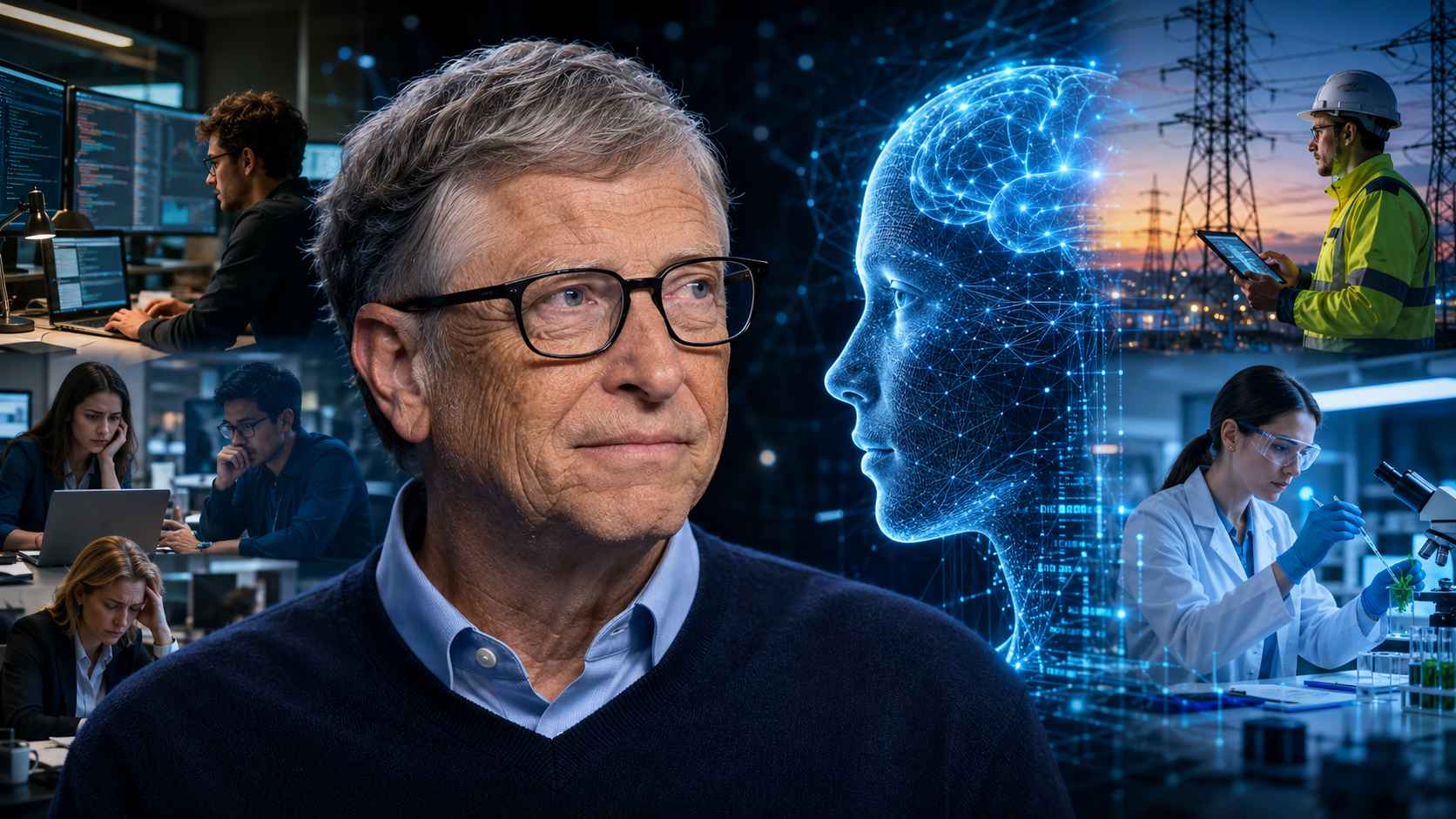


Bill Gates reignited the debate by predicting that artificial intelligence could reduce the need for humans in many jobs, while ChatGPT assessed that the greatest risk is in repetitive, standardized, and easy-to-automate tasks
Bill Gates returned to the center of the debate on artificial intelligence by predicting that the technology could reduce the need for humans in many jobs, while ChatGPT assessed that the impact is likely to affect more tasks than entire professions. The Microsoft founder pointed to coders, energy specialists, and biologists as more protected areas, but the AI itself presented a less absolute view of the future of work.
The prediction gained traction after Gates warned that many positions will no longer require real people as artificial intelligence advances in workplaces.
Microsoft also listed 40 jobs considered more exposed, including interpreters, translators, mathematicians, and journalists, reinforcing the concern about roles based on standardized activities.
-
Former Yale Hospital Cleaner Returns as Resident Doctor After a Decade; Shay Taylor-Allen Transitions from Janitorial Duties to Medical Practice

-
Microsoft Submerges 855 Computers in Nitrogen-Filled Capsule 35 Meters Under the Scottish Sea, Records Eight Times Fewer Failures Than on Land After Two Years

-
Animal Once Thought Extinct in the 2000s Reborn in Lab, Survives Minutes, Becomes Rare Biological Case

-
Brazilian School Receives Israeli Biodigester That Converts Food Waste into Cooking Gas Equivalent to Nearly Three 13-Kilogram Cylinders Monthly


Bill Gates points to three more resilient areas
In the assessment attributed to Bill Gates, three professions would have a greater chance of resisting the takeover by AI in the professional environment. Coders, energy specialists, and biologists appeared as the safest groups within this scenario, although the topic itself was treated as a prediction, not as a certainty about the future.
ChatGPT’s reaction was more cautious. The tool stated that Gates is “directionally correct,” but assessed that the real division does not depend solely on the chosen profession. The central point would be in repetitive, predictable, and easy-to-standardize tasks within each occupation.
The AI admitted that it already replaces or reduces parts of jobs, but also creates new activities and increases productivity. This reading indicates that technological advancement can change routines, demands, and team structures, without necessarily eliminating all affected roles.
ChatGPT sees repetitive tasks as the greatest risk
When asked about the safest jobs, ChatGPT cited skilled professions, such as plumbers and electricians, as well as healthcare areas, including nurses and therapists. The justification involves practical tasks, human contact, and decisions that still depend on professional judgment.
In healthcare, AI can assist in diagnosis, but the tool stated that patients still want humans making final decisions and providing care. This point keeps doctors, nurses, therapists, and other professionals in a relevant position, even with more technological tools present.
ChatGPT also agreed that scientists remain less vulnerable. Although artificial intelligence is powerful for analysis, scientific advances still require intuition, hypothesis formulation, and human interpretation, elements that do not appear as simple automated tasks.
Leaders, executives, and entrepreneurs were also cited as the most difficult roles to replace. The tool related this protection to the degree of uncertainty and responsibility, stating that the greater these factors, the more complex it becomes to completely replace them with automated systems.
Fewer positions and more qualification requirements
When discussing the risks, ChatGPT avoided pointing to a specific profession as doomed. The tool stated that no area is permanently safe because the capability of AI advances too quickly for absolute predictions about which fields will be preserved.
The comparison used was that calculators did not eliminate accountants, and the internet did not eliminate journalists, but both drastically changed these jobs. For AI, the main question is not whether a field will be affected, but which human skills will remain scarce.
The most vulnerable, in this view, are workers who perform repetitive computer-based tasks, professionals who avoid using AI tools, and roles that are easy to measure and standardize. The risk does not always mean immediate unemployment, but it can involve lower salaries, fewer positions, and more intense competition.
ChatGPT also predicts smaller teams and fewer entry-level opportunities. A lawyer using AI, for example, could perform the work of three junior associates. In the final analysis, the message is straightforward: AI changes jobs more than it destroys them on a large scale.


