






 Portuguese
  Spanish


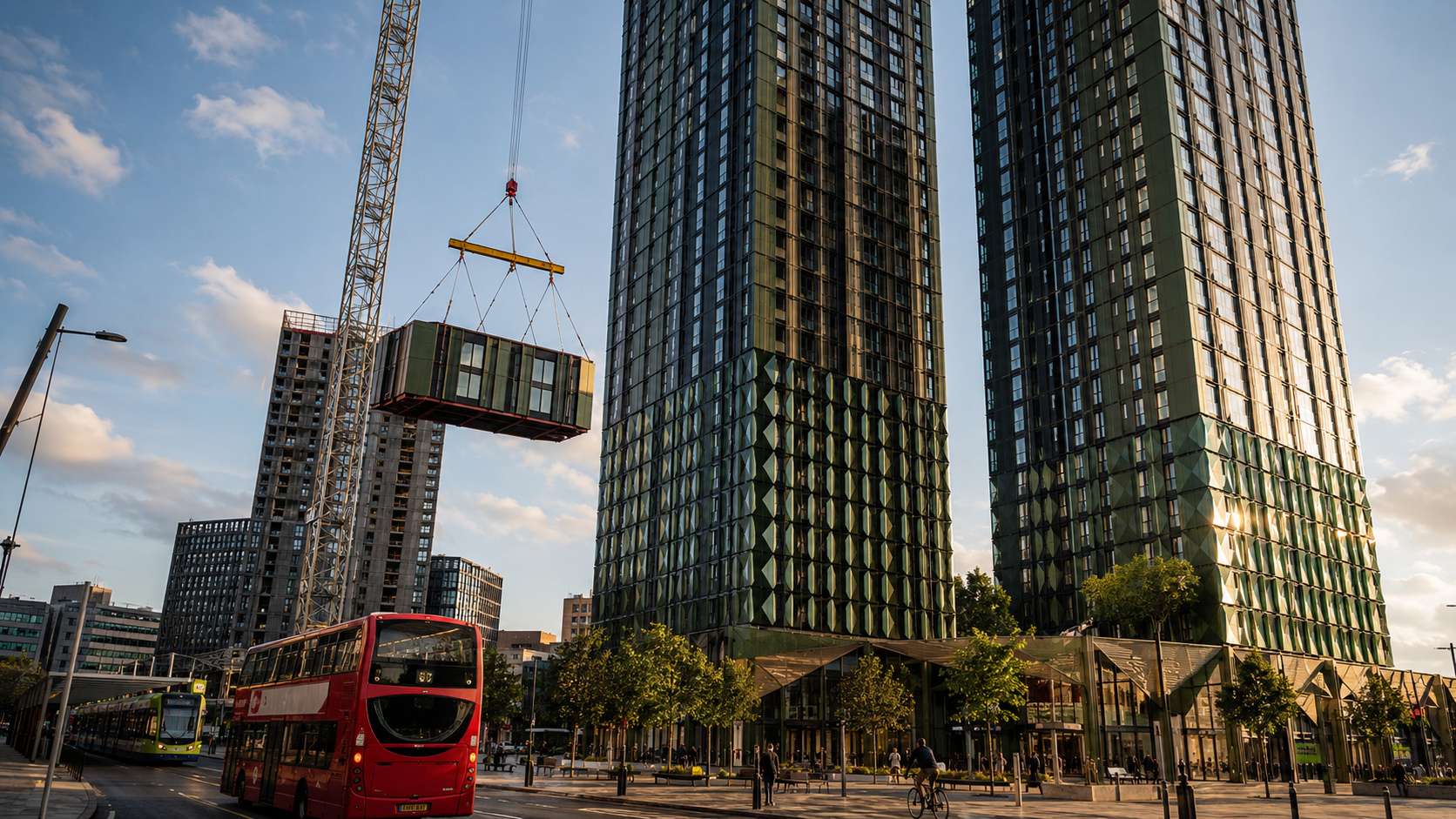

The Ten Degrees complex in Croydon shows how modular construction can move from small houses to tall buildings. With 546 apartments, factory-ready modules, and crane assembly, the project became a strong case for speed, urban housing, and construction in dense areas.
Modular construction gained a significant example in London. In the Ten Degrees complex in Croydon, two residential towers of 44 and 38 floors were erected with over 1,500 ready modules.
The information was released by Vision Volumetric, a volumetric construction company, which presented the central data of the project. The development is also known as 101 George Street and comprises 546 apartments.
The strongest impact is on the timeline. From excavation to completion, the construction took 26 months and had a 42% reduction compared to traditional construction. For crowded cities with little space, this type of construction changes the conversation about how to build faster.
-
Man Converts Water Tank into $20,000 Luxury Boat, DIY Video Reaches 571,000 Views on World Tech Channel

-
Inventor Builds Amphibious Vehicle with Kayak and Electric Motors, Gains 223,000 Views on Quiet Nerd Channel
-
Former Yale Hospital Cleaner Returns as Resident Doctor After a Decade; Shay Taylor-Allen Transitions from Janitorial Duties to Medical Practice

-
Microsoft Submerges 855 Computers in Nitrogen-Filled Capsule 35 Meters Under the Scottish Sea, Records Eight Times Fewer Failures Than on Land After Two Years





More than 1,500 ready modules transformed Ten Degrees into a landmark of modular construction in London
Ten Degrees was developed by Tide Construction and manufactured by Vision Modular Systems. The project is located in Croydon, a region of London, and combines residential scale with industrialized construction.


The central idea is simple to understand. Instead of doing almost everything on-site, many parts of the building were produced beforehand and arrived at the site as volumetric units. These units are complete blocks that form parts of the building.
In the case of Ten Degrees, more than 1,500 volumetric units were delivered to the site. Then, these modules were positioned in the towers to form the two residential buildings of 44 and 38 floors.
This number draws attention because it shows that modular construction was not limited to small projects. It was used in a tall complex, with hundreds of homes and a strong urban presence.
How factory-made modules managed to become two residential towers of more than 40 floors
The modules arrived at the site already equipped. This means that an important part of the construction was done before arriving at the site, in an industrial environment, with repeated and more organized stages.
After manufacturing, the units were taken to the site and installed with cranes. These cranes were positioned over the concrete cores of the buildings.
The concrete core is the central and firm part of the tower. It helps provide support and houses important circulation areas. With this base ready, the modules could be hoisted and fitted in sequence.
This method shows a different logic from traditional construction. First, a large part of the structure is manufactured, then transported, then assembled on site. The result was a complex with 546 apartments and two tall towers.
A 26-month deadline and 42% reduction show why the case caught the sector’s attention
The construction time is one of Ten Degrees’ strongest points. The period between excavation and completion was 26 months, with a program saving of 42% compared to the traditional model.
Vision Volumetric, a volumetric construction company, detailed that more than 1,500 volumetric units were delivered to the site already equipped. The assembly used cranes placed over the concrete cores.
In practice, this type of reduction can make a difference in urban areas. A shorter construction tends to occupy the land for less time and can reduce impacts on the surrounding routine.
The case also helps explain why modular construction has started to interest large-scale projects. When manufacturing and assembly follow a clear sequence, the timeline no longer depends solely on the traditional pace of the site.
Modular construction in tall buildings changes the idea that ready modules are only for small projects
Many people still associate modular construction with single-story houses or low-rise buildings. Ten Degrees shows another path, with ready modules forming towers of 44 and 38 floors.
This point is important because large cities need more housing in already occupied areas. Building upwards is a way to better utilize the land, especially in regions with high demand for apartments.
The project also enters the debate on residential rental and urban regeneration. It shows that modular construction can participate in housing developments in dense areas.
With 546 apartments, Ten Degrees is not just a technical showcase. It demonstrates a real application of volumetric construction on an urban scale, with height, number of units, and reduced timeline.
Cranes over the concrete cores were decisive for assembling the towers with ready modules
The assembly of the towers required planned logistics. The cranes were installed on the concrete cores, which allowed lifting and positioning the volumetric units along the floors.
This detail is one of the most curious points of the project. It was not enough to produce the modules in the factory. It was necessary to create an efficient way to bring each unit to the right point of the tower.

In tall buildings, the assembly sequence needs to be careful. Each module depends on the correct position so that the set advances without compromising the organization of the construction.
For this reason, Ten Degrees became a standout case. It shows that modular construction at height requires factory, transportation, cranes, and construction site working as parts of the same mechanism.
What Ten Degrees reveals about the future of construction in large cities
Ten Degrees shows that modular construction can enter the center of the discussion about urban housing. The project combined tall buildings, ready modules, and significant reduction in time.
The construction also shows that the site may cease to be the only place where the building is born. An important part of the building can be prepared beforehand, arrive ready, and be assembled more quickly.
This model does not eliminate the complexity of a residential tower. However, it changes the way of organizing the construction and shows that factory modules can reach vertical scale.
In a large city, this type of solution attracts attention because it combines density, speed, and planned use of space. The case of Croydon proves that modular construction can be a topic for tall buildings, not just small projects.
In the end, Ten Degrees stands out for bringing together numbers that are hard to ignore: 44 and 38 floors, more than 1,500 ready modules, 546 apartments, 26 months of construction, and 42% reduction in time.
The question that remains is simple: if ready modules have already managed to form towers of this size in London, what still prevents this solution from advancing in large Brazilian cities? Share your opinion in the comments.


