





Country in the Horn of Africa maintains unusual rules for visitors, low digital connectivity, and strong state control, in a reality that contrasts with banking services, internet, and mobility common in other parts of the world.
Eritrea, a country in the Horn of Africa located on the shores of the Red Sea, has a routine marked by strong state control, low digital connectivity, and limited circulation for foreigners.
According to official travel advisories from the governments of Australia and Canada, visitors do not find widely functioning ATMs, rely almost entirely on cash, and need authorization to travel to areas outside Asmara, the capital, and the province of Zoba Maekel.
These restrictions help explain the international interest in the country.
-
Lenovo Unveils Legion Y700 Tablet with RGB Backlighting, 5G, and SIM Card Support
-
Lenovo Unveils Legion Y700 Tablet with RGB Backlighting, 5G, and SIM Card Support
-
Northern Brazilian City Prepares Task Force to Mitigate El Niño Impacts with Stockpiled Fish, Drone Monitoring, Firefighting, and Water Supply Reinforcement in Remote Areas

-
Brazil to Issue “Panda Bonds” in China, Aiming to Raise Up to 5 Billion Yuan at Lower Interest Rates Than Dollar Debt

While digital banking services, transportation apps, and social networks are part of everyday life in many regions, Eritrea maintains a model where in-person payments, printed documents, and formal authorizations remain central for residents and tourists.
The scenario also reflects the country’s political organization, governed since formal independence in 1993 by President Isaias Afwerki.
Why Eritrea is called the North Korea of Africa
The comparison with North Korea appears in international reports and analyses due to political closure, control over information, and limitation of civil liberties.
Eritrea became formally independent in 1993, after decades of conflict with Ethiopia, and came to be led by Isaias Afwerki.
The People’s Front for Democracy and Justice, a party linked to the government, concentrates political power in the country.
Reports from international organizations describe an environment of strong repression.
Human Rights Watch states that the Eritrean government restricts freedom of expression, opinion, and religion, as well as limits the work of independent observers.
Reporters Without Borders, in turn, reports that independent press has been banned since 2001 and that existing media operate under the control of the Ministry of Information.
Mandatory national service also appears among the main points of criticism of the government.
According to Amnesty International, the policy of military conscription and compulsory labor for an indefinite period continued in force in 2025.
The organization reports violations associated with the program, which reinforces Eritrea’s presence in international surveys on human rights, press freedom, and forced migration.
Tourists need authorization to leave Asmara
For tourists, control does not end upon entering the country.
The Australian government states, in official travel guidance, that foreigners need to obtain permission to travel more than 25 kilometers from Asmara and the Zoba Maekel region.
The same guidance warns that the use of public transportation by visitors may be unfeasible outside the capital, increasing the reliance on rental cars or private taxis.
This rule makes Asmara the main point of stay for many travelers.
The capital houses international hotels, authorized exchange points, and some locations with internet access.
Traveling to other regions depends on planning, specific documentation, and compliance with the rules established by local authorities.
The requirement changes the travel experience compared to destinations where tourists can move around without internal authorizations.
In Eritrea, visiting cities outside the capital does not depend solely on itinerary, transportation, or budget.
Movement is part of the State’s administrative control structure and must follow the conditions imposed by the government.
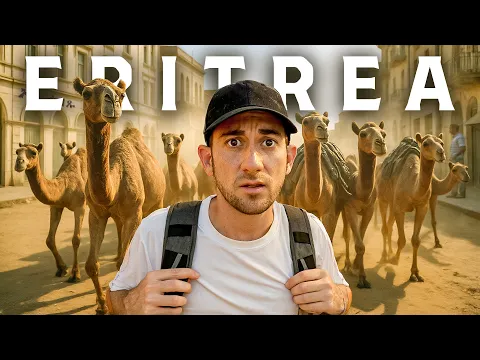

Eritrea operates almost without ATMs
The absence of ATMs available to the public is one of the most cited aspects in international guidance on Eritrea.
The Australian government states that the local economy operates essentially in cash and that there is no ATM or credit card infrastructure for general use.
The Canadian government also advises travelers to consider that cards are not accepted in day-to-day transactions.
In practice, visitors need to enter the country with cash and exchange currency only at authorized locations, such as official exchange houses or recognized hotels.
The use of foreign currency in common commerce is restricted, reducing alternatives for those accustomed to making payments by card, mobile, or banking apps.
Digital mobility services are also not part of the local routine.
The Australian guidance informs that international transportation apps do not operate in the country.
As a result, travel, shopping, and services depend on in-person solutions, direct negotiation, and traditional means of payment.
Limited internet and social networks under restriction
Internet access in Eritrea is limited and concentrated in a few spaces.
The World Bank gathers data on internet users in the country based on information from the International Telecommunication Union, but the consulted series only records data up to 2020.
The Australian guidance for travelers states that connection can be found in some international hotels and cyber cafes in Asmara, although it describes phone and internet services as unreliable.
There are also documented records of social network blockages.
The Internet Society identified a blockage of Facebook and other platforms between June 15 and 25, 2019.
Organizations like Reporters Without Borders and the Committee to Protect Journalists associate Eritrea with strong information control and restrictions on online access.
Even so, there is no secure confirmation of a permanent blockage of all social networks in 2026.
Therefore, the most accurate formulation is to treat the topic as an environment of restricted access, with records of blockages and strong state control over information, rather than stating that all platforms are unavailable all the time for the entire population.
In this context, sociability remains more linked to physical spaces.
Cafes, streets, markets, and family gatherings play a significant role in urban routine, especially in Asmara.
The limitation of connection and the low presence of digital services reduce the mediation by online platforms in activities that, in other countries, have come to depend on apps.
Asmara preserves Italian heritage recognized by UNESCO
The Eritrean capital also stands out for its architecture.
UNESCO recognizes Asmara as “a modernist African city” and states that its urban development was marked by the Italian colonial presence.
The city began to consolidate as a military post in the 1890s and, after 1935, received a construction program associated with Italian rationalism.
Government buildings, residential buildings, cinemas, hotels, churches, and mosques are part of this urban ensemble.
The preservation of this heritage led Asmara to the UNESCO World Heritage list, highlighting the combination of modernist urban planning and adaptation to the African context.
The Italian influence also appears in the daily life of the capital, especially in cafes and old establishments.
Traveler accounts mention traditional cafes and preserved spaces, but these details vary according to each visitor’s experience and should not be treated as a general rule for the country.
The most verifiable information is the formal recognition of the city by UNESCO and the documented presence of Italian architectural heritage.
The interior of Eritrea that few tourists can visit
Outside Asmara, access tends to be more restricted for foreigners.
Keren, pointed out as one of the main cities in Eritrea, appears in travel accounts as a destination associated with rural markets and traditional trade routes.
However, as travel outside the capital requires authorization, not every tourist can visit these areas independently.
The original text mentions villages on the way to Keren, communities without running water, use of solar energy, and the case of a boy named Abdul Majid who reportedly learned languages with offline apps.
As no independent confirmation was found in official or reliable journalistic sources, these details were not maintained as facts in the body of the article.
The absence of confirmation does not eliminate the relevance of the central theme.
Eritrea gathers verifiable elements that already explain its place in the international debate: single-party government, press without independence, indefinite national service, low connectivity, cash economy, and requirement of authorization for internal travel of visitors.
These characteristics help to understand why the country is cited in reports on political isolation and restriction of freedoms.
At the same time, accounts from travelers and international organizations show that daily life cannot be summed up only by the absence of technology.
The local routine also involves markets, cafes, face-to-face relationships, and community practices that remain important in an environment of lower digitalization.
Eritrea combines political isolation and face-to-face life
Eritrea occupies a particular position in the debate on closed countries.
The territory has a strategic location on the Red Sea, borders Sudan, Ethiopia, and Djibouti, and maintains a political trajectory marked by recent independence, power centralization, and regional conflicts.
These factors help to contextualize the internal restrictions and the perspective of international organizations on the country.
For the foreign visitor, the limitations appear in concrete situations: withdrawing money is not a common option, paying with a card may not work, accessing the internet depends on specific locations, and traveling outside the capital requires permission.
The experience of circulation, therefore, is defined less by tourist spontaneity and more by the government’s administrative rules.
Reading this scenario requires care not to turn isolated reports into generalizations.
Eritrea should not be described solely by travelers’ impressions, but by verifiable information from official bodies, international entities, and monitoring organizations.
It is this set of sources that supports the description of a country with strong state control, low digital integration, and limited internal circulation.
In a world where an increasing part of everyday life has come to depend on screens, digital payments, and app-based travel, Eritrea shows how societies still exist organized on very different bases.






