Portuguese
  Spanish


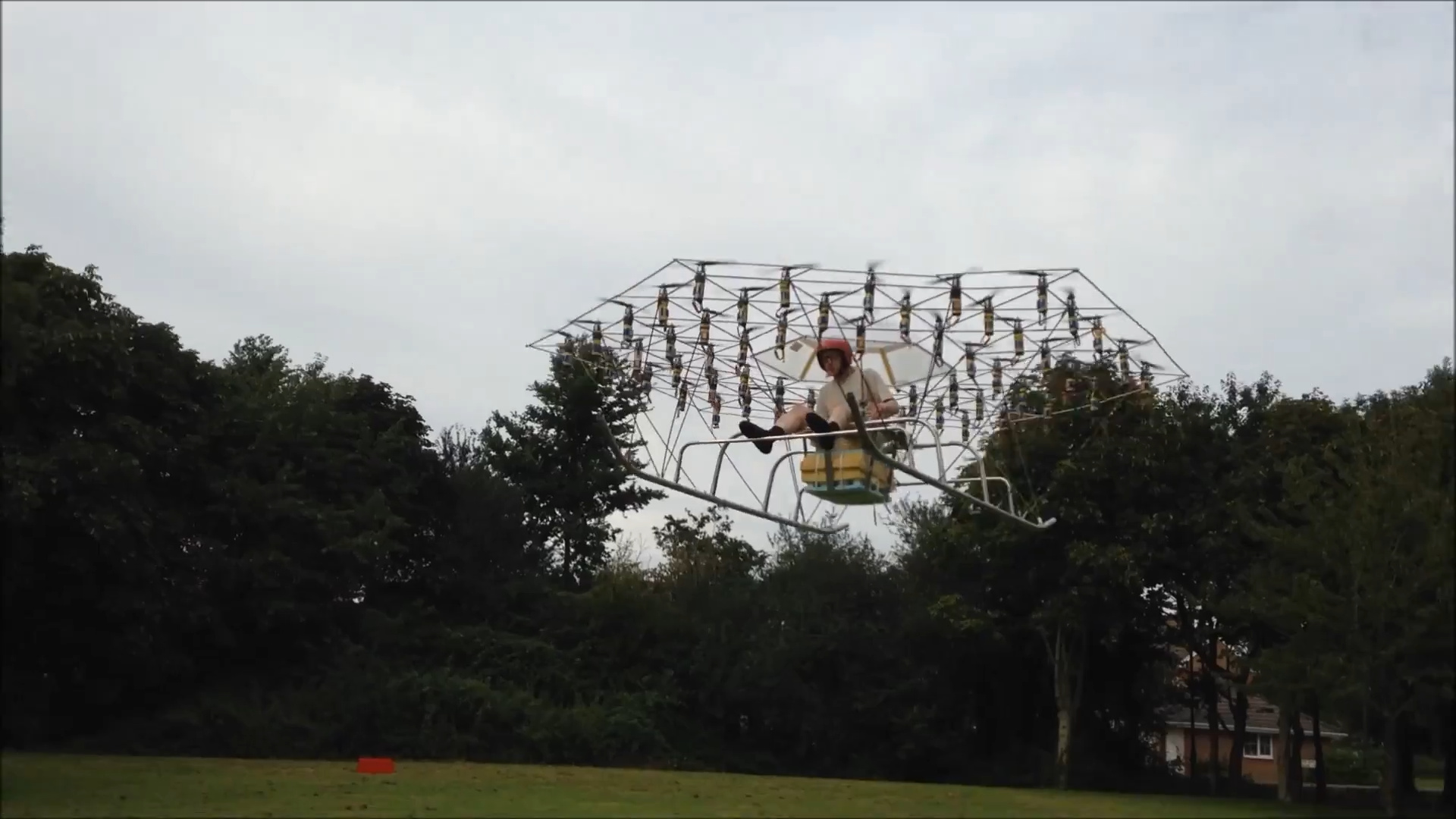


YouTuber creates experimental aircraft with 54 drone propellers, lifts 148 kg structure off the ground and goes viral with extreme home aviation project.
In September 2015, a machine that looked like it came out of a science fiction laboratory drew attention by managing to leave the ground using dozens of drone propellers working simultaneously. The experiment was conducted by content creator gasturbine101, who built a manned aircraft equipped with 54 independent electric rotors, named Swarm. In a report published by Wired on September 4, 2015, the project was described as the first “pentacontakaitetracopter,” transforming common model aircraft parts into a structure capable of lifting a person off the ground.
The experimental aircraft weighed about 148 kg and managed to hover at almost 0.9 meters high during initial tests. The experiment went viral because the vehicle did not resemble a conventional helicopter: instead of a main rotor, the Swarm used 54 18-inch propellers spinning at about 5,000 rpm, creating the image of a true “swarm” supporting the structure in the air.
The visual result looked like a mix between an industrial drone, a flying platform, and an improvised experimental garage machine, exactly the kind of invention that challenges the boundaries between hobby, engineering, and science fiction.
-
Wyoming Couple Grows Tropical Fruits Year-Round in -40°C Using Geothermal Greenhouse, Demonstrating Earth’s Heat Can Produce Oranges and Lemons in Snow Without Traditional Heating

-
Ship Returns from Brazilian Coast with Thirty Newly Discovered Life Forms
-
Nigerian Professor Invents Electricity-Free Refrigerator Using Clay Pots and Wet Sand, Extending Shelf Life of Vegetables to 27 Days; 7,000 Units Distributed in Energy-Deprived Villages

-
Flower Farms Supplying London and Amsterdam Face Backlash for Environmental Impact on African Lake, Threatening Jobs for 50,000 Workers




YouTuber transformed dozens of drone motors into a manned aircraft
The project was created by Peter Sripol, known online as gasturbine101, an American YouTuber specializing in experimental engineering, homemade jet turbines, and improvised flying vehicles.
The goal of the Swarm was simple yet absurd in scale: to find out if dozens of small drone motors could replace a traditional helicopter system.
Instead of using a large-diameter main rotor, as is common in conventional helicopters, Sripol decided to distribute the lift among dozens of smaller rotors positioned side-by-side on a circular metal structure. Each motor operated synchronously to produce collective lift sufficient to raise the pilot and the entire vehicle structure.
The idea transformed the project into something visually very different from any traditional aircraft, because the Swarm literally looked like a “flying swarm” composed of dozens of drones fused into a single manned platform.
Swarm used 54 propellers working simultaneously
The best-known version of the Swarm used 54 independent electric rotors distributed in a circular structure. Each rotor functioned as a small individual propulsion system similar to those used in large commercial drones.


The central principle was to divide the lift effort among many small motors instead of relying on a few giant propellers. This reduced the need for complex mechanical components such as gearboxes, central shafts, and traditional helicopter tail rotors.
According to the creator himself, the electronic control of the motors was one of the biggest challenges of the project. Any significant synchronization failure between dozens of propellers could lead to immediate loss of stability during flight.
148 kg machine managed to get off the ground during tests
The moment that went viral occurred when the Swarm finally managed to take flight during open-field tests. According to Wired, the experimental aircraft weighed about 148 kg and managed to hover approximately three feet above the ground, equivalent to almost 1 meter in height.
Although the flight was short and extremely controlled, it was enough to demonstrate that the concept actually worked.

The machine managed to generate stable enough lift to raise both pilot and structure at the same time, something many users initially believed to be impossible using only commercial drone motors.
The test also showed the enormous energy consumption involved in projects of this type. The dozens of electric motors required a large number of batteries to keep the platform in the air even for a few minutes.
Project looked like a mix of giant drone and experimental helicopter
Visually, the Swarm differed completely from conventional aircraft. Instead of wings, an enclosed cabin, or a traditional fuselage, the vehicle basically consisted of a circular metallic platform surrounded by dozens of electric rotors.
The pilot remained seated in the center of the structure while the motors worked simultaneously to maintain balance and lift. The improvised appearance ended up contributing to the experiment’s virality, as the machine seemed to be built directly in a home workshop using accessible model aircraft parts.
Even with its handcrafted appearance, the project required an enormous amount of calculations involving weight distribution, thrust, stability, and electronic control. The Swarm showed how technologies originally created for drones began to open up space for completely new forms of experimental aviation.
Electronic control replaced part of traditional helicopter mechanics
Conventional helicopters rely on extremely complex mechanical systems to control stability and direction. The Swarm attempted to simplify part of this process by using individual electronic control for each rotor.

Instead of altering the pitch of the main blades, the system adjusted the power of the motors separately to maintain the platform’s balance. This logic is much closer to modern drones than to the classic helicopters used in traditional aviation.
The advancement of electronic flight controllers was precisely what made projects like this technically possible. Without the modern digital stabilization systems used in drones, manually controlling 54 rotors at the same time would be practically unfeasible.
Project reinforced the growth of experimental garage aviation
The Swarm case drew attention because it did not originate within a billionaire manufacturer or aerospace laboratory. The project was developed by an independent creator using relatively accessible components found in the drone and model aircraft market.
In recent years, the advancement of electric batteries, brushless motors, and digital controllers has allowed small inventors to start building experimental aircraft previously restricted to large companies and universities.

This boosted the growth of what is called “garage aviation,” where independent engineers and YouTubers began testing extremely improbable concepts.
The Swarm became a symbol of this new era of experimental engineering, where relatively common commercial parts began to enable the creation of increasingly daring flying machines outside the traditional aerospace industry.
Experiment showed limits and challenges of manned drones
Despite the positive reception, the Swarm also revealed important limitations of this type of concept. The main problem continues to be flight autonomy. As dozens of electric motors operate simultaneously, energy consumption is gigantic even on extremely short flights.
Safety-related issues also remain critical. Battery failures, overheating, or loss of synchronization between motors could quickly compromise the aircraft’s stability. Furthermore, experimental vehicles of this type typically operate outside the conventional rules of commercial aviation.
Even so, the project served as a powerful visual demonstration of the possibilities opened up by multi-rotor electric systems. The experiment showed that drone logic has already begun to transcend the hobby universe and enter the territory of experimental manned aviation.
Rotor swarms could influence future urban aircraft
Although the Swarm is an extreme DIY project, some of the logic used in it also appears in billion-dollar urban air mobility companies. Various modern eVTOL projects use multiple electric rotors distributed throughout the aircraft to increase stability and redundancy.

Companies from China, the United States, Germany, and Brazil are developing electric vertical takeoff and landing vehicles based precisely on electronically controlled multiple propeller systems. The gasturbine101 experiment ended up functioning as a radical and improvised version of this same technological trend.
The Swarm showed that dozens of small propellers working together can already produce enough lift to raise a person off the ground, reinforcing how the drone revolution has begun to alter even the most traditional concepts of aviation.