Portuguese
  Spanish


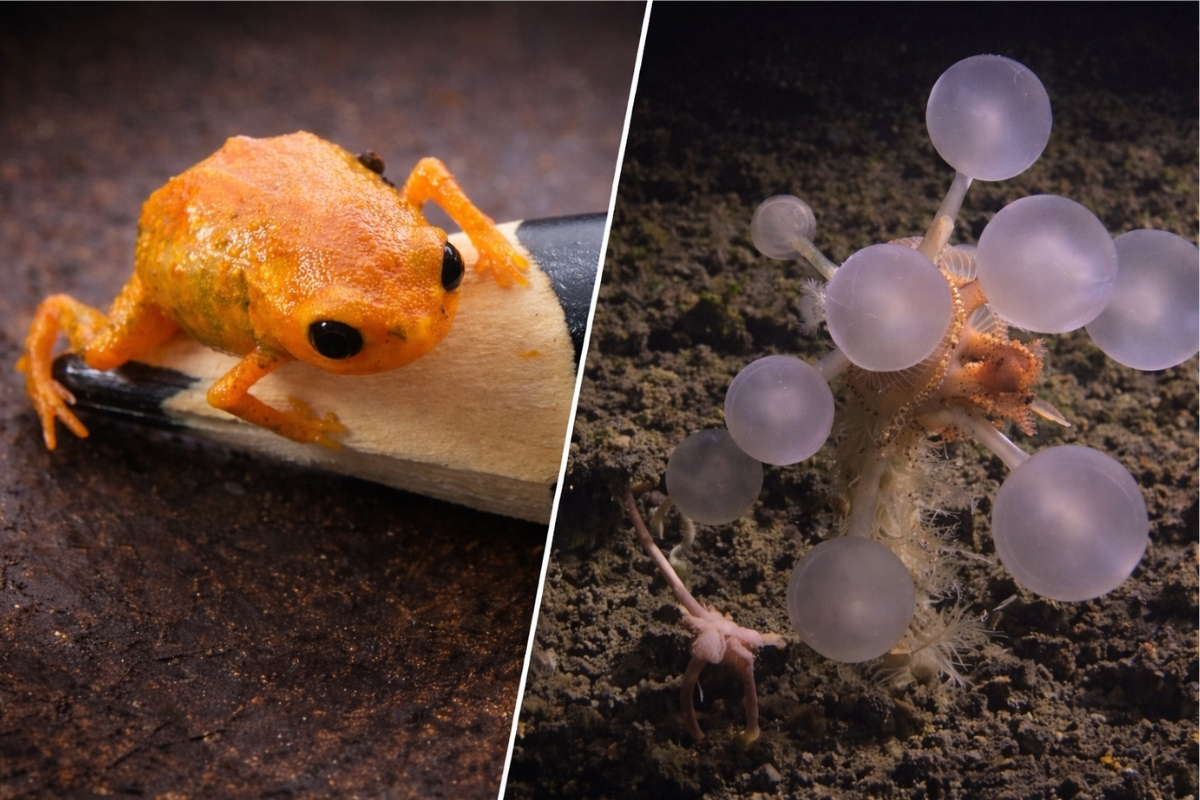


The List Brings Together Discoveries from the Deep Sea to Mountains, Highlighting How New Species Continue to Emerge Even After Centuries of Exploration
Even after centuries of scientific exploration, Earth continues to surprise. Millions of species have been described, but thousands still emerge every year, driven by tools like DNA sequencing that reveal previously invisible differences.
Each discovery adds another piece to the puzzle of how ecosystems function. Conservation also depends on this, understanding what really exists in each environment.
In 2025, new findings spanned the globe, from the deep sea to misty forests and mountain ranges.
-
3,000-Ton, 81-Meter Attack Submarine Begins Sea Trials, Equipped with Heavy Torpedoes and Anti-Ship Missiles

-
Boat Made from 10 Tons of Plastic and 30,000 Discarded Flip-Flops Sails Along African Coast, Serving as a Floating Classroom on Ocean Pollution
-
Welder Discovers 16th-Century Diamond Ring in England After 7 Hours with Metal Detector; Gold Jewel Linked to Edward I Pattern Auctioned for £17,000
-
Former Merchant Marine Captain Invents Fuel-Free Barrier, Removes 20,000 Tons of Trash from Chennai Rivers




What Happened and Why It Caught Attention
The year brought 14 new and unusual species presented by science. The collection stands out for its diversity in locations and survival strategies.
Some appear in extreme environments, such as great depths in the ocean. Others emerge in mountainous regions and high forests, where access is difficult and life goes unnoticed.
This contrast reinforces a central point: there is still much to map, even in areas that seem well-known.
From the Deep Sea to Beaches, Creatures That Change the Map of Oceans

In Japan, an undergraduate student found a jellyfish-like organism on a beach in the Tohoku region. The specimen turned out to be a new jellyfish, Physalia mikazuki, a venomous animal that looks like a jellyfish but is a colony of polyps.
The species was named to honor a local samurai warrior. Its presence in an area where it had not been seen before also draws attention to changes in marine ecosystems, with species arriving and local populations declining.
Due to its stinging tentacles, monitoring becomes practically important for beachgoers.
The Death Ball Sponge That Doesn’t Filter, It Captures Prey

The carnivorous sponge known as death ball breaks the notion that sponges are merely passive filter feeders. It exchanges plankton for small animals and uses tiny hooks on its body to capture prey.
The discovery occurred in 2025 during an expedition by the Schmidt Ocean Institute with the RV Falkor Too. The sponge was among 30 deep-sea species found after a massive iceberg broke off from a floating glacier in Antarctica.
The rapidity of environmental changes raises concerns but also uncovers unknown life and reinforces the importance of protecting the planet.
Venom on the Ocean Floor and Predators with Unexpected Shapes

A deep-sea snail, Turridrupa magnifica, was found in the South Pacific near New Caledonia and Vanuatu. It lives between 650 and 1,600 feet deep and hunts using harpoon-shaped teeth charged with venom.
This type of venom raises interest because relatives of this group have already shown medical potential, with applications related to pain control and even studies targeting cancer cells.
In the same deep-sea setting, a new guitar shark from the guitarfish family, Rhinobatos sp., was also found in the Indian Ocean near Mozambique and Tanzania. This is a critically endangered group, important for the balance of the ecosystem.
Self-Light, Living Jewel, and Abyss Fish, the Ocean Still Hides Records

In the twilight zone off the coast of Western Australia, a new lantern shark, Etmopterus westraliensis, was found at about 2,000 feet deep. It measures 16 inches and has large eyes for low light, as well as bioluminescent glow on its underside.
Off the coast of Ningaloo, also in Western Australia, a porcelain crab, Porcellanella brevidentata, measuring 15 millimeters wide, emerged. It lives in association with a sea feather, a type of soft coral, and feeds by filtering plankton.
On the California coast, in the outer canyon of Monterey, a new snailfish, Careproctus colliculi, was recorded at 10,722 feet deep. An adult female was about 3.6 inches long and caught attention for its large eyes, distinctive head, and textured skin.
Mountains, Misty Forests, and Tiny Species with a Big Impact

In the western Himalayas, in Jammu and Kashmir and Himachal Pradesh, two new species of bent-toed geckos were described, Cyrtodactylus himachalensis and Cyrtodactylus shivalikensis. These animals help control insects and also serve as food for snakes, larger lizards, and birds.
In southern Brazil, in the humid, high-altitude forests of the Serra do Quiriri, the pumpkin toadlet, Brachycephalus lulai, appeared. It is small enough to sit on the tip of a pencil and measures less than 14 mm in length.
The strong orange coloring contrasts with the idea of camouflage, but it is hard to spot. The location was made possible by sound, as males make characteristic calls to attract partners.
Rare Spiders, A High-Altitude Marsupial, and the Milestone of the 1,500th Bat
In Thailand, a new tropical spider, Damarchus inazuma, was recorded with a rare phenomenon called gynandromorphism. Part of its body exhibits female characteristics while the other part shows male traits, creating a striking visual pattern.
In Peru, in the eastern Andes, a small marsupial was found at nearly 9,000 feet of altitude, the Marmosa chachapoya. It has a body of only 4 inches and stands out for its thin, elongated snout and facial markings.
On Bioko Island in Equatorial Guinea, a new bat, Pipistrellus etula, was described, marking the 1,500th bat known to science. The species inhabits cool high-altitude forests above 2,000 meters, a type of habitat that was not occupied by similar bats.
In the mountains of northern Ethiopia, a new shrew, Crocidura stanleyi, was also found, described as a tiny mammal weighing 3 grams.
The list of 14 new species described in 2025 reinforces a simple reality: there is still much unknown life in deep oceans, misty forests, and hard-to-reach mountains.
These discoveries are not just curiosities; they help us understand ecosystems and show why knowing what exists is an essential part of any nature conservation effort.