






 Portuguese
  Spanish


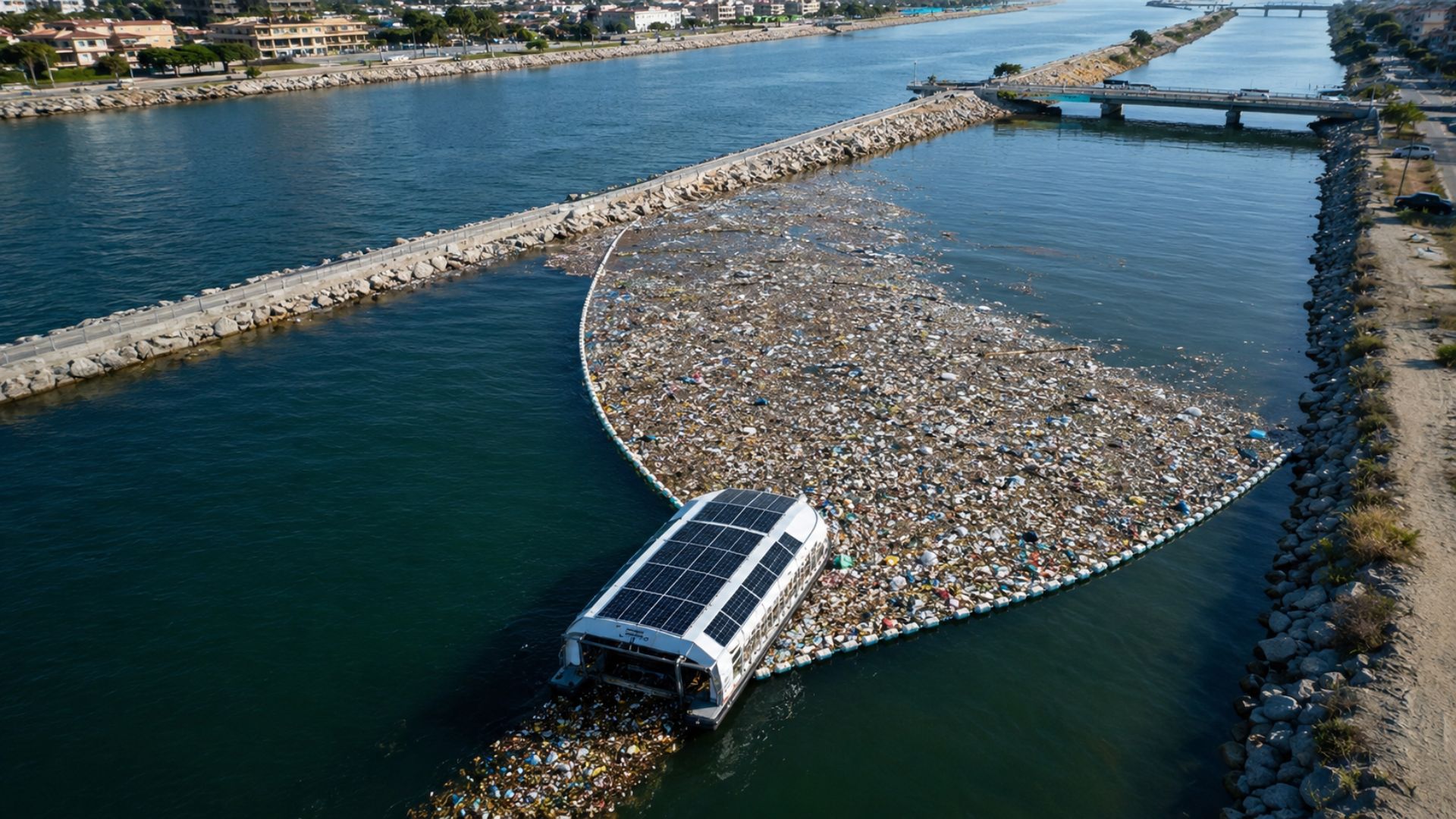


A silent boat powered by solar energy operates almost autonomously in the world’s most polluted rivers, capturing up to 50 tons of trash per day during the rainy seasons. Floating barriers positioned at an angle along the river redirect tons of trash to a single point, where a conveyor belt continuously removes the waste from the water. The Interceptor boat system, from the NGO The Ocean Cleanup, requires no fuel, no permanent crew, and operates 24 hours a day, preventing plastics, bottles, and fragments from reaching the ocean where recovering them would be practically impossible.
A boat that does not sail, does not chase anything, and does not use fuel is removing tons of trash from rivers before they reach the ocean. The vessel, powered exclusively by solar energy, is positioned at a strategic point in the river where floating barriers concentrate all the trash that the current drags. An internal conveyor belt operates nonstop, removing bottles, plastics, and waste of all kinds directly from the water’s surface and depositing them in integrated containers within the boat, like a floating industrial line that works day and night.
Under normal conditions, the system removes several tons of trash per day. But during the rainy seasons, when rivers drag everything that has accumulated over weeks or months, the scale changes completely. The Interceptor boat can capture more than 50 tons of trash in a single day, a volume that represents thousands of bottles, bags, and plastic fragments that, without interception, would fragment into microplastics in the ocean and contaminate marine ecosystems for decades.
How the boat captures tons of trash without moving

The system starts before the boat. Along the river, floating barriers are positioned at an angle, taking advantage of the natural water current. The barriers do not block the river or interrupt the flow; they simply redirect the tons of trash towards a single capture zone where the boat awaits with its conveyor belt in continuous operation.
-
EcoFlow’s Portable Fridge Offers 43 Hours Off-Grid, Reaches -25°C, App-Controlled, Solar-Powered for Camping and RV Adventures

-
Vietnamese Inventor Overcomes Debt and Develops Agricultural Robot Sold in 15 Countries
-
3,000 Sheep Maintain 900 MW Solar Farm Transforming Texas Fields into Energy for Data Centers

-
Distant Galaxy Shaped Like a Giant Jellyfish Sheds Gas, Forming New Stars as It Moves Through Hot Cosmic Gas




When the waste reaches the capture zone, the conveyor lifts it from the water surface into the boat. Internal sensors constantly monitor the load level in the containers, and when they are full, the system sends a signal for them to be quickly replaced without interrupting the entire operation. It’s a continuous cycle: capture, store, empty, repeat. The tons of processed trash accumulate day after day, week after week, in a cumulative effect that begins to transform the environment in a matter of months.

Photo: Ocean Cleanup / Publicity
Visible results in a few weeks
In areas where the system has been implemented, the amount of tons of trash reaching the sea has significantly decreased in a matter of months. Beaches became cleaner, the amount of floating debris decreased, and the environmental impact became visible even before any formal measurement, because the difference is noticeable to the naked eye.
What makes the result lasting is that the system does not rely on occasional campaigns. It operates every day, without stopping, which means the effect is not momentary but cumulative. Each day of operation means more tons of trash that will never become microplastics, never contaminate fish, and never wash up on remote beaches. It is industrial-scale prevention applied at the exact point where the problem can be solved most efficiently: before the trash reaches the ocean.
Solar energy that dispenses with fuel
The boat operates entirely with solar panels, which eliminates the need for fossil fuel and allows for long periods of operation without refueling. Energy autonomy is crucial because the system needs to operate continuously, and any fuel dependency would limit the ability to capture tons of trash during rainy seasons, when the volume is higher and the operation cannot stop.
Solar power also means that the boat does not generate emissions while cleaning the river, avoiding the paradox of polluting the air to clean the water. The system requires minimal maintenance and sporadic supervision, which reduces operational costs and allows the same team to monitor multiple vessels in different rivers.
What happens when tons of trash have already reached the ocean


The boat solves the problem in rivers, but tons of trash already accumulated in the ocean require different solutions. In the open sea, huge floating barriers move slowly forming giant funnels that use ocean currents to concentrate dispersed plastic at a central point, where it can be collected without engines or brute force.
There are also ships designed not only to collect but to process the waste onboard, separating what can be recycled and transforming the rest into energy to power the ship itself. Each technology tackles a specific part of the problem: solar boats intercept in rivers, barriers concentrate in the ocean, and processing ships eliminate what is already dispersed. Together, these solutions form a complete system against plastic that, for the first time, operates on the same scale as the problem.
Did you know that a solar boat can capture 50 tons of trash per day in a river before it reaches the ocean? Do you think this technology should be installed in all polluted rivers around the world? Tell us in the comments.




Every country should have at least one