






 Portuguese
  Spanish


NASA declared the MAVEN probe, which had been orbiting Mars for more than 11 years and studying the Martian atmosphere, irrecoverable. The spacecraft, which also relayed data from rovers like Perseverance, disappeared in December when it passed behind the planet, spun abnormally, and drained its batteries.
The NASA officially ended one of its most important missions on Mars. The American space agency declared on Wednesday (3) that the MAVEN probe, which was studying the Martian atmosphere, is irrecoverable, months after losing contact with the spacecraft in December.
According to NASA, MAVEN spent more than 11 years orbiting the planet and operated for almost a decade beyond its expected mission duration. Besides investigating the Martian atmosphere, it helped relay data from rovers like Perseverance back to Earth, a role that will now be taken over by other spacecraft.
What happened to the MAVEN probe
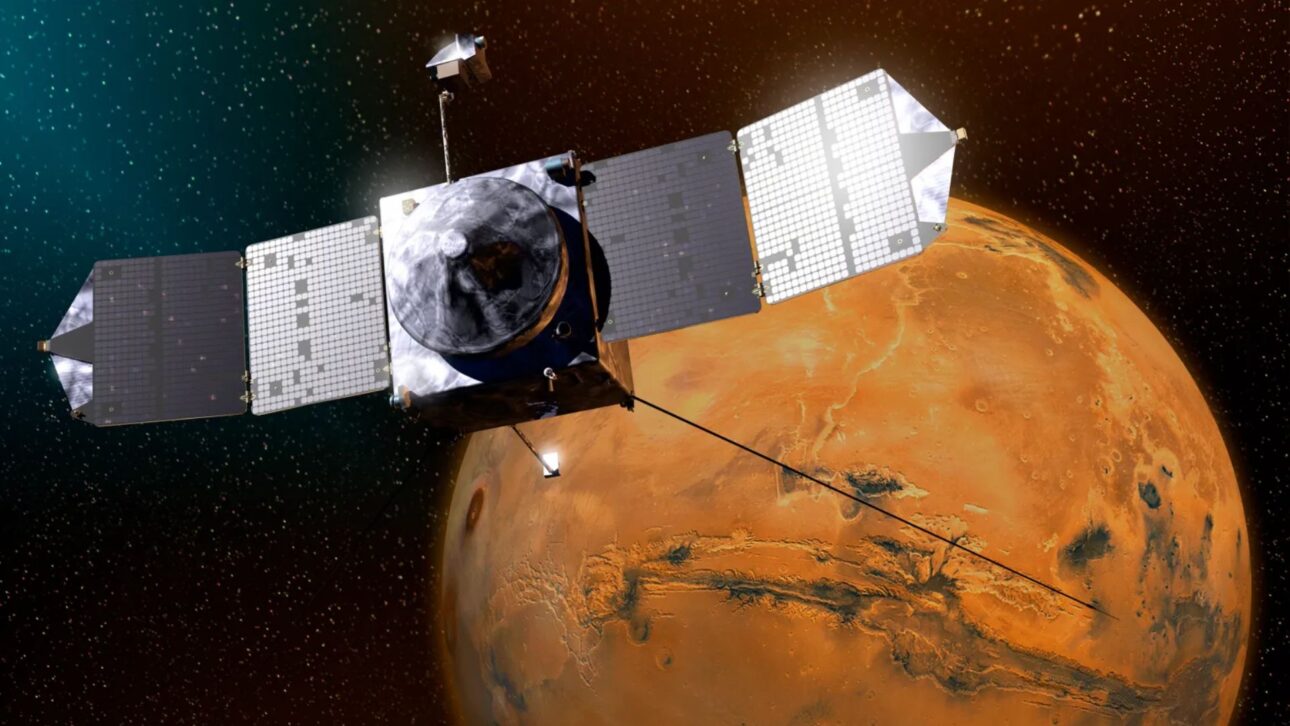
Credit: NASA/Goddard/University of Colorado/Laboratory for Atmospheric and Space Physics
The last signal arrived on December 6, shortly after the spacecraft passed behind Mars. Up to that point, telemetry showed all systems functioning normally.
-
Meta to Launch Arena, a New Prediction App Targeting 3.56 Billion Users, Competing with Polymarket and Kalshi

-
Scientist Challenges Famous Human Evolution Theory, Argues Homo Sapiens Evolved Gradually Over Thousands of Years
-
15-Year-Old American Builds Ocean Generator with PVC Pipe and 3D-Printed Propeller for $12, Wins National Prize, Presents at White House, and Makes Forbes 30 Under 30 List

-
$12 Billion Invested in AI Data Centers in Semi-Desert Mexican State, But 17 of 18 Municipalities Now Face Water Shortages, Residents Receive Water Only 3 Days a Week




The problem is that when MAVEN was supposed to reappear on the other side of the planet, NASA‘s Deep Space Network did not pick up any signal back.
Upon analyzing the recorded radio data, engineers found clues to the disaster. The probe had entered safe mode and was spinning at an abnormally high speed, which disturbed its orbit and drained the batteries. Without power, the communication system simply shut down.
A review committee, formed in February, concluded that the spacecraft could no longer recover, although the main cause of the anomaly is still under investigation, with a final report expected this year.
A decade studying the Martian atmosphere
Launched in November 2013 and in orbit since September 2014, MAVEN was the first mission dedicated exclusively to understanding the Martian atmosphere and how it evolved.
Scientists used the probe to investigate how solar activity stripped particles from the Martian atmosphere over billions of years, helping to explain one of the biggest questions about the Red Planet.
The results were valuable. The mission helped understand how Mars transitioned from a wetter and potentially habitable world to the cold and dry planet it is today, as well as revealing details about the climate history and the fate of the water that once existed there.
During the extended phase, MAVEN even observed a rare interstellar comet, showing versatility far beyond the original plan of just one year of operation.
The relay role for Curiosity and Perseverance
MAVEN did not work alone. Besides the science, it functioned as a communication bridge, relaying to Earth the data collected on the surface by the rovers Perseverance and Curiosity.
This support allowed scientists to receive a larger volume of information and strengthened the links between the various NASA missions on Mars.
The probe was one of five spacecraft used as relays on the planet. The other four, still active, continue to ensure this function, preventing the loss of MAVEN from leaving the rovers isolated.
In practice, the work of Perseverance and Curiosity continues, now supported by orbiters like Odyssey and MRO, from NASA itself, and by European probes.
The legacy of NASA with MAVEN and what’s next
Even after being concluded, the mission is expected to yield results for a long time. Louise Prockter, director of the Planetary Science Division at NASA, stated that data from MAVEN will continue to provide important information about Mars for decades, including understanding the radiation conditions that astronauts may face on future manned trips to the Red Planet.
The principal investigator of the mission, Shannon Curry, highlighted the lasting scientific impact and the significant improvement in knowledge about the Martian atmosphere and the evolution of planets. NASA still intends to archive the entire data set from the probe so that researchers can continue using the material in new studies.
The bittersweet lesson remains: MAVEN was lost, but it lived far beyond expectations and left a legacy hard to erase.
The end of MAVEN shows how even the most successful missions have an endpoint, but also how much a probe can teach about Mars.
Tell us in the comments if you think NASA should prioritize new missions to study the Martian atmosphere or quickly accelerate the arrival of astronauts to the Red Planet.





