






 Portuguese
  Spanish


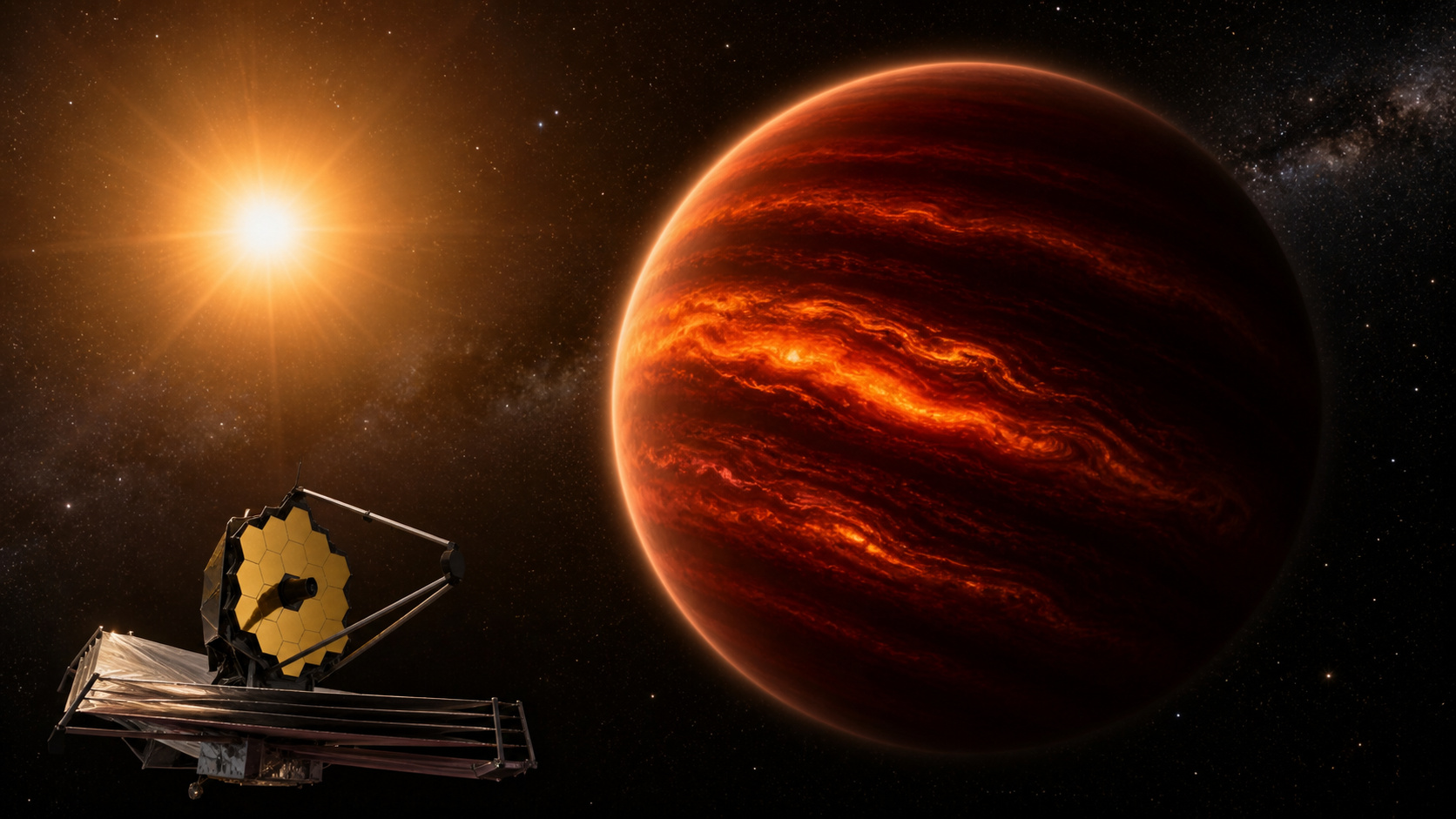


James Webb observes 29 Cygni b, a giant planet with 15 Jupiter masses that challenges the boundary between planets and stars.
In April 2026, NASA announced a discovery that challenges one of the most difficult boundaries in modern astronomy: where a giant planet ends and a failed star begins. The target is 29 Cygni b, an object about 15 times the mass of Jupiter, directly observed by the James Webb Space Telescope.
The case drew attention because 29 Cygni b is precisely in the zone of doubt between two scientific worlds. It is too massive to appear like a common planet, but chemical and orbital evidence indicates that it was born as a planet, by accretion in a protoplanetary disk, and not as a star by gravitational collapse.
Next, understand why this giant, about 133 light-years from Earth away, could help redefine the line separating extreme planets, brown dwarfs, and objects that seemed to belong to different categories of the Universe.
-
World’s Largest Camera, with 3,200 Megapixels, Begins Operation, Capturing Sky Images Every 30 Seconds for the Next Decade

-
Canary Island with 11,000 Residents and Over 500 Volcanoes Uses Wind and Water as a Giant Battery to Demonstrate Remote Areas Can Survive Without Fossil Fuels

-
Brazilian Craftsman Builds Small Hydropower Plants Generating Over 1,000 kWh Monthly, Paying for Themselves in Just Over a Year

-
Unknown Molecule Possibly Detected on Pluto and Titan by James Webb Telescope



James Webb directly observed 29 Cygni b, a giant planet with 15 times the mass of Jupiter
29 Cygni b was not detected only by brightness variations or indirect gravitational effects. It was directly imaged by James Webb using the NIRCam camera in coronagraphic mode, a technique that blocks the intense light from the star to reveal very faint objects near it.
This detail is important because direct observation allows for studying characteristics of the planet itself, including chemical signatures in its atmosphere. In the case of 29 Cygni b, Webb was able to search for signatures associated with compounds such as carbon dioxide and carbon monoxide.


The estimated mass, about 15 times that of Jupiter, places the object in a critical region. It is close to the traditionally used boundary separating giant planets from brown dwarfs, often popularly called “failed stars”.
The discovery challenges the boundary between giant planet and failed star
The scientific doubt exists because stars and planets do not form in the same way. Planets grow from the bottom up, when small grains of dust, rock, and ice come together in disks around young stars to form larger worlds.
Stars, on the other hand, are born when large clouds of gas fragment and collapse under their own gravity. This process could also form massive objects in protoplanetary disks, creating bodies that look like planets but were born in a way more similar to stars.
29 Cygni b lies at the boundary between these explanations. According to ESA, it weighs about 15 Jupiter masses and orbits its star at an average distance of 2.4 billion kilometers, similar to Uranus’s distance in the Solar System.
Heavy elements like carbon and oxygen indicate the giant was born as a planet
The strongest data from the research came from its chemical composition. NASA reported that James Webb found evidence of heavy elements, such as carbon and oxygen, which suggests that 29 Cygni b accumulated enriched material within a protoplanetary disk.
In astronomy, elements heavier than helium are often called “metals”. In the case of this giant planet, the amount of these elements is high relative to the host star, which has a composition similar to that of the Sun.
NASA states that, considering the planet’s mass, the amount of heavy elements is equivalent to about 150 Earths. This number reinforces the hypothesis that it swallowed large volumes of metal-rich solids during its formation.
The giant planet may have grown from the bottom up, like smaller worlds
Formation by accretion is the classic process of planet birth. Small grains come together, form pebbles, then larger bodies, until protoplanets capable of accumulating gas and transforming into giants emerge.
The problem is that the larger the planet, the harder it is to explain its growth this way. Gas and dust disks do not last forever, and gas giants need to form before the available material around the star disappears.

Therefore, a planet with 15 Jupiter masses was an extreme test. If 29 Cygni b was indeed born by accretion, it means that nature can build much more massive planets by this process than simpler models suggested.
The orbit aligned with the star reinforces the disk formation hypothesis
Besides the chemistry, astronomers analyzed the planet’s orbit. The team used the ground-based telescope array CHARA to verify if the orbit of 29 Cygni b was aligned with the rotation of the host star.
According to NASA, this alignment was confirmed. This data matches the idea that the object formed within a protoplanetary disk, the same environment where planets grow around young stars.
When chemical composition and orbital dynamics point in the same direction, the case becomes stronger. Therefore, lead author William Balmer stated that the evidence suggests formation by rapid accretion of metal-rich material, rather than by gas fragmentation.
Why 29 Cygni b shakes up the classification of extreme exoplanets
For decades, many astronomers used mass as a practical criterion to separate giant planets from brown dwarfs. Objects above a certain limit were viewed with suspicion because they might have been born more like stars than planets.
The case of 29 Cygni b shows that this boundary may be more complicated. It is heavy enough to appear close to a brown dwarf, but the evidence indicates a planetary origin.
This changes the central question. Instead of just asking “what is the mass of the object?”, scientists begin to ask “how was this object born?”. The origin can be as important as the size.
A young, hot world far from the star helps test planetary formation models
The team chose young and still hot targets to facilitate atmospheric study. According to NASA, the planets in the program had temperatures between about 530 °C and 1,000 °C, still preserving heat from their formation.
These temperatures make it clear that 29 Cygni b does not enter the habitability debate. The scientific interest is not in searching for life, but in understanding how giant planetary objects can exist.
The orbital distance also draws attention. The planet orbits about 2.4 billion kilometers from its star, a region comparable to Uranus’s orbit in the Solar System, where accretion formation becomes more difficult to explain in very massive objects.
James Webb opens a new phase in the investigation of supergiant planets
29 Cygni b was the first of four objects observed in a program led by William Balmer. According to NASA, all known targets of the program have masses between 1 and 15 times that of Jupiter and orbit within about 15 billion kilometers of their stars.
This means that the discovery is not an isolated point. It is part of a larger attempt to understand if very massive planets can frequently form by accretion or if 29 Cygni b is a rare case.
If other similar objects show similar chemical and orbital signs, astronomy may revise how it classifies the largest planets in the galaxy. Webb becomes a decisive tool in this separation between appearance and origin.
The planet 133 light-years away shows that the Universe can hide giant worlds in boundary zones
The location of 29 Cygni b, about 133 light-years from Earth, places the object relatively close on an astronomical scale. Even so, it reveals processes that help understand planetary systems far beyond our own.
The Solar System has giants like Jupiter and Saturn, but does not have a planet with 15 Jupiter masses. Therefore, objects like 29 Cygni b function as natural laboratories to test the limits of planetary formation.

The discovery reinforces an increasingly evident idea in modern astronomy: the planets of the Milky Way are much more varied than models based solely on the Solar System suggested. Some worlds may be born in regions, masses, and conditions that seemed unlikely a few decades ago.


