Portuguese
  Spanish


Prosthesis created during the pandemic went from a homemade 3D printed prototype to a scientific study on brain signal control, artificial intelligence, and assistive technology.
A robotic prosthesis controlled by brain signals, initially made in a basement with a $75 3D printer, reached scientific literature in 2025.
The work of Benjamin Choi, a Virginia student who began developing the arm during the pandemic, was published in the Journal of Neural Engineering in an article co-authored with Ji Liu from Stony Brook University.
The update provides new context to a story that gained attention in 2022 when Choi was selected among the 40 finalists of the Regeneron Science Talent Search, a U.S. science competition aimed at high school students.
-
Scientists Discover Super-Earth Just 25 Light-Years Away That Could Support Life Beyond Our Solar System: Meet GJ 3378b

-
Brazil’s Most Famous Virtual Sales Assistant Drives $100 Million in Sales in 8 Months: Magazine Luiza’s AI-Powered WhatsApp Engages 7.7 Million Users and Triples Conversion Rates Compared to Other Digital Channels

-
Mozambican Teen Develops Drone Using Market Kits to Deliver Food and Medicine to Remote Areas

-
Experiment Shows Sea Water-Treated Ice Resists Melting Better from May to September



At the time, the project drew attention for proposing an accessible prosthesis, controlled without invasive brain surgery, with an estimated manufacturing cost of less than $300.
The project brings together areas that have advanced in assistive technology, such as artificial intelligence, 3D printing, electroencephalography, and brain-computer interfaces.
Choi’s proposal was not presented as a market-available medical product but as a low-cost prototype to test ways of controlling artificial limbs.
The 2025 scientific publication describes the device as a non-invasive transhumeral prosthesis, operated by a combination of electroencephalography signals, known as EEG, and head gestures.
In simple terms, the system attempts to interpret electrical patterns captured on the user’s head and combine them with auxiliary commands to move the robotic arm.
Prosthesis controlled by brain signals began during the pandemic
The development began in 2020, when Choi was still in the 10th grade, equivalent to the start of high school in the United States.
He planned to spend the summer in a lab researching aluminum fuels, but the closure of in-person activities during the pandemic interrupted these plans.
With unexpected free time, the student revisited an old memory.
As a child, he had watched a report on the “60 Minutes” program about neural interfaces used to control robotic prostheses.
In the case shown, researchers had implanted sensors in a patient’s motor cortex, which allowed moving a mechanical arm through brain activity.
The technology piqued Choi’s interest, but it also led the student to question the cost and necessity of brain surgery.
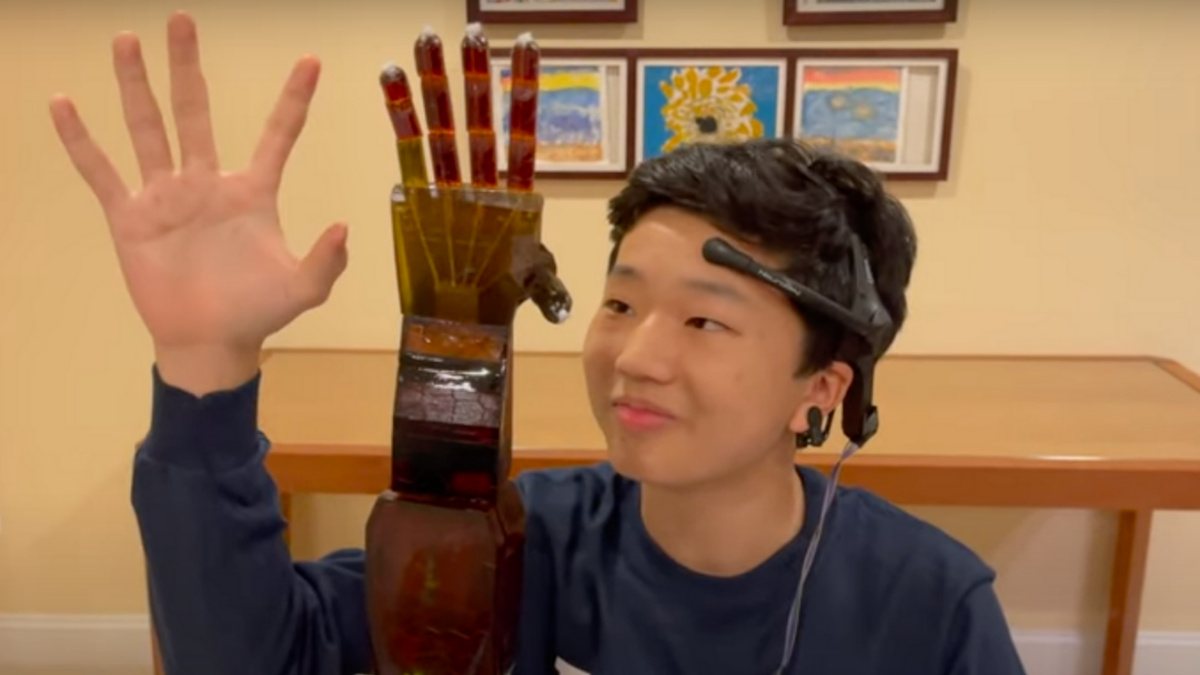
In an interview with Smithsonian Magazine, he stated: “At the time, I was very impressed because this technology was very advanced.”
In the same statement, Choi said he was alarmed because the method required open brain surgery and cost hundreds of thousands of dollars.
From this comparison, the student decided to test another path.
Instead of brain implants, Choi sought an external solution, with sensors placed on the head and the use of algorithms to interpret the signals.
The stated goal was to reduce cost, complexity, and surgical risk.
The initial proposal, therefore, started from a practical question: how to create a robotic arm controlled by movement intention without opening the user’s skull?
Prototype was born with a home 3D printer
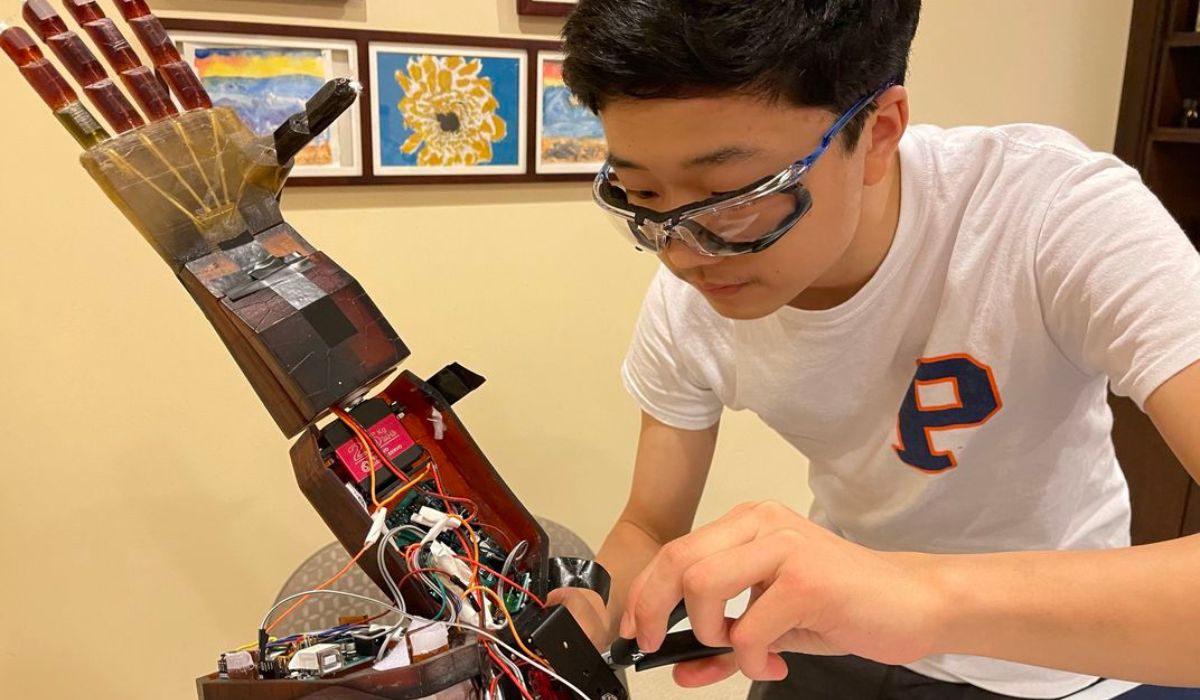
Without access to a professional structure during the pandemic, Choi set up a workspace in the basement of his house, on a ping-pong table.
The first prototype was produced with a $75 3D printer belonging to his sister, as well as parts printed in smaller sections, screws, rubber bands, and lines used as mechanical tendons.
The limitation of the printer influenced the initial design.
Since the equipment could not print large parts, the arm had to be divided into smaller sections and then assembled manually.
According to reports published about the project, the first version took about 30 hours to print.
The structure was still experimental, but it already allowed testing the combination of mechanics, electronics, and external commands.
Choi already had experience with programming and competitive robotics, including in high-level competitions.
This background helped in creating the electronic and mechanical system, although the project required steps beyond physical assembly.
The main challenge was to create a method capable of transforming externally captured signals into useful commands for the prosthesis.
For this, the initial version combined brainwave data and head movements.
As the work progressed, the student began developing an interpretation algorithm based on artificial intelligence.
The system was designed to recognize patterns in signals captured by EEG sensors and associate them with movements of the robotic arm.


Artificial intelligence interprets EEG signals
The EEG measures the brain’s electrical activity through sensors placed on the head.
Unlike neural implants, this type of capture does not require surgery but usually records weaker signals and is subject to interference.
Due to these limitations, the computational stage plays a central role in this type of project.
The algorithm needs to separate useful patterns from noise produced by muscle movements, blinks, individual variations, and environmental interference.
In the case of Choi’s prosthesis, the system was developed to try to distinguish patterns associated with the intention of movement.
The student explained, in an interview published by Smithsonian Magazine, that performance could improve with use: “The more you use it, the more the system specifically understands how you think and what your brainwave patterns are.”
This feature brings the project closer to a personalized approach, according to the description made by the inventor himself.
Instead of relying solely on generic commands, the system tries to adjust to each user’s patterns over time.
The proposal described in the work is to use machine learning to enhance control accuracy.
According to material released at the time of the award, the algorithm achieved an average accuracy of 95% in initial tests reported by Choi.
This number should be read within the context of research and prototype.
It does not equate to guaranteed performance in clinical, commercial, or everyday use, especially since medical devices need to undergo specific validations before reaching patients.
School project gained scientific recognition
The robotic arm received external support even in the early stages.
In October 2020, Choi obtained a manufacturing grant from the company polySpectra, which produces durable materials for 3D printing.
The support allowed advancement to versions made with engineering materials, more suitable for testing beyond the initial prototype.
This stage marked the transition from a domestic structure to more resistant models.
In 2021, the student also received support from the MIT THINK program, aimed at science and engineering projects developed by high school students.
The following year, it was included among the finalists of the Regeneron Science Talent Search 2022, according to the Society for Science.
The journey also went through the Davidson Fellows, a program that recognizes the work of young researchers.
On his profile page at the institute, Choi described the project as a low-cost, non-invasive transhumeral prosthesis, supported by a brainwave interpretation algorithm.
The most recent update found in the consulted sources appeared in 2025, when the work was published in the Journal of Neural Engineering.
The article, signed by Benjamin J. Choi and Ji Liu, describes a low-cost transhumeral prosthesis operated by a machine learning-assisted system, combining EEG and head gestures.
With this publication, the project began to have a technical description in a scientific journal.
This does not mean medical approval or market arrival, but indicates continuity of development after the initial impact in student competitions.
Non-invasive prostheses still face challenges
The case, which was initially publicized as an invention developed during the pandemic, began to be presented in a broader academic context, linked to brain-computer interfaces and assistive technologies.
In the academic summary of the study, the authors point out three recurring challenges in upper limb prostheses: ineffective control systems, high cost, and the requirement of invasive techniques in some brain-controlled solutions.
The proposed response was a non-invasive neuroprosthesis, supported by EEG, head gestures, and machine learning.
The research connects to an area that seeks to create communication channels between nervous system signals and external devices.