






 Portuguese
  Spanish
  5 min of reading
  0 comments


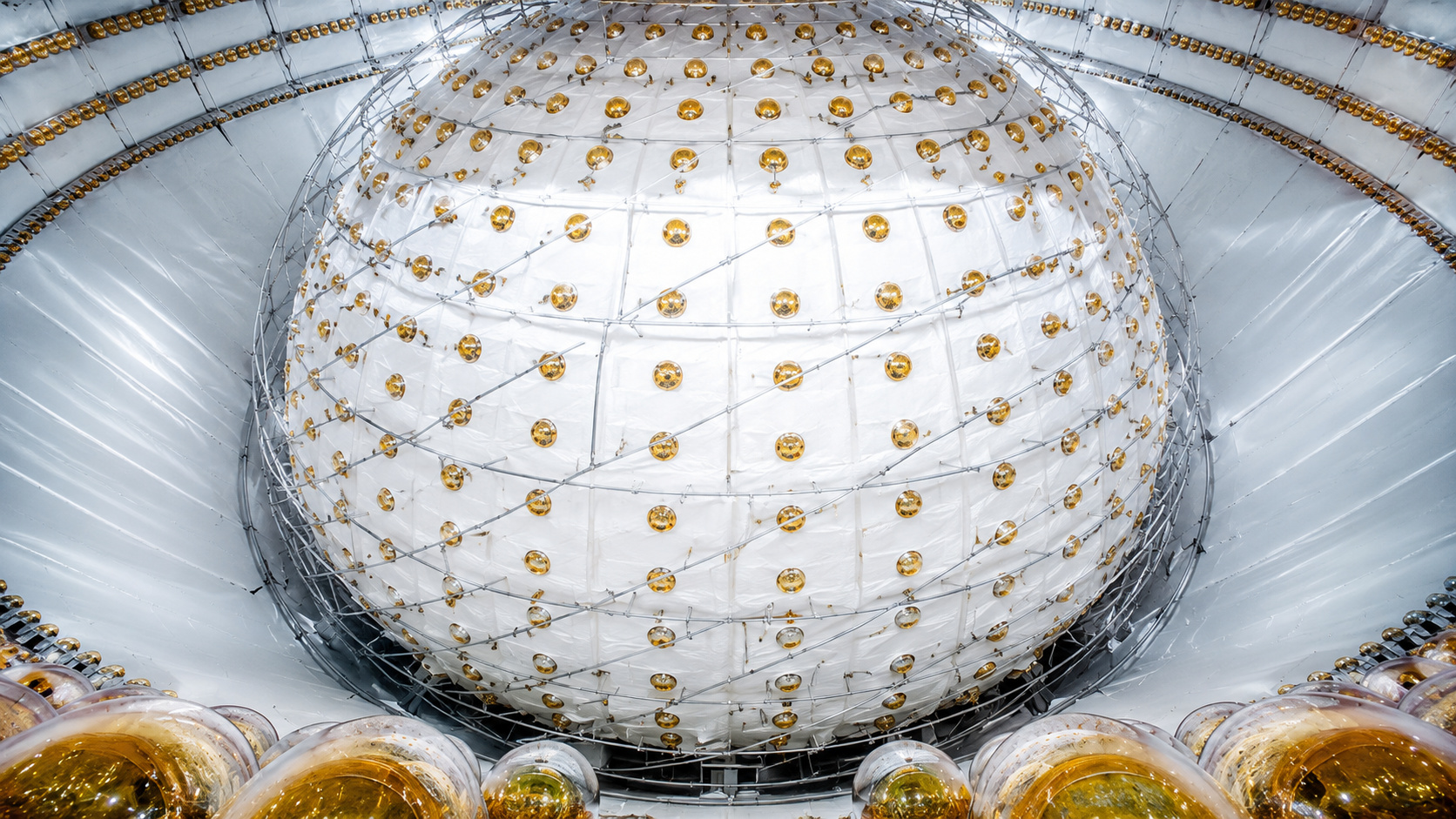
The gigantic underground detector JUNO was created to capture almost invisible neutrinos and help scientists unravel fundamental properties of these particles, considered essential for understanding the structure of the Universe and matter.
About 700 meters below the ground, in southern China, scientists have built one of the most impressive machines ever created to study almost invisible particles that traverse the entire Universe. The project is called JUNO and uses a colossal sphere filled with 20,000 tons of light-sensitive liquid to detect neutrinos coming from nuclear reactors.
The observatory was installed near the city of Jiangmen, in Guangdong province, and is part of the international race to understand some of the biggest questions in modern physics. The main goal is to solve the so-called neutrino mass hierarchy, a problem that has challenged scientists for decades. For this, JUNO had to combine extreme engineering, ultra-sensitive sensors, and a gigantic underground structure designed to operate almost isolated from the rest of the world.
JUNO Observatory was buried 700 meters below the ground to escape interferences
The location chosen for the observatory was not random. The detector was installed about 700 meters deep precisely to reduce interferences caused by cosmic rays and particles coming from the Earth’s atmosphere. Without this natural protection provided by the rock, it would be much more difficult to identify real neutrinos amidst the enormous volume of background noise.
-
Helicopter Drops 180 Tons of Sand and Gravel on Swedish River to Revive Ecosystem Damaged by Decades of Exploitation

-
Brazilian Company Launches Retro Smartphone with 48 MP Camera, T9 Keyboard, and Privacy Features for Social Media-Free Use

-
Self-Taught Chinese Farmer Builds 5-Ton Submarine from Scrap, Launches It in Anhui River
-
Invisible Induction Technology Enables Wireless Power for Blenders, Coffee Makers, and Air Fryers, Reducing Countertop Cables






The central element of JUNO is a gigantic spherical tank filled with approximately 20,000 tons of liquid scintillator. This material has a special characteristic: it emits small flashes of light when particles pass through the detector and interact with the atoms present in the liquid. Neutrinos almost never interact with matter, but when they do, the detector tries to record the event.
Gigantic sphere uses tens of thousands of sensors to capture tiny flashes
Around the tank, thousands of ultra-sensitive optical sensors called photomultipliers were installed. According to the project, the system uses tens of thousands of these sensors to capture extremely weak signals produced by neutrino interactions. The flashes last for minimal fractions of a second and need to be identified in an extremely controlled environment.
Neutrinos are among the most mysterious particles known to science. They have an extremely small mass and practically do not interact with matter. Trillions of them pass through the human body every second without causing any perceptible effect. This characteristic is precisely what makes their detection so difficult and fascinating.
Chinese nuclear reactors function as an artificial source of neutrinos
JUNO uses neutrinos produced by nuclear power plants near the observatory. Nuclear reactors release enormous quantities of these particles during atomic fission processes. By measuring how neutrinos change during their journey to the detector, scientists hope to solve one of the biggest questions in particle physics.

The main scientific objective of JUNO is to discover the so-called neutrino mass hierarchy. Scientists know that there are three main types of these particles, but they still cannot determine exactly how their masses are organized. This question is considered fundamental to understanding the structure of the Universe on a microscopic scale.
Mystery of neutrinos may help explain why the Universe exists
The importance of the research goes far beyond theoretical physics. Neutrinos may be linked to profound questions about the origin of matter and the very existence of the Universe. Some scientists believe that better understanding these particles may help explain why the cosmos is dominated by matter and was not destroyed by antimatter shortly after the Big Bang.
The size of JUNO has turned the project into a gigantic engineering challenge. The main acrylic sphere is about 35.4 meters in diameter and had to be assembled inside a large underground cavern built especially for the observatory. The entire environment was designed to minimize vibrations, contamination, and external interference.
Ultrapure water helps block radiation and protect the detector
In addition to the scintillator liquid, the system uses large volumes of ultrapure water around the main structure. This water acts as a shield against external radiation and unwanted particles. The purity control is extreme because any contamination can interfere with the measurements.


JUNO is part of an international race involving gigantic observatories dedicated to the study of neutrinos. Projects like IceCube, Hyper-Kamiokande, and DUNE also seek answers to fundamental mysteries of physics. The difference is that each project uses different methods and sources of neutrinos.
Modern detectors function like telescopes for invisible particles
Although they do not use conventional mirrors or lenses, observatories like JUNO function as true particle telescopes. They attempt to capture extremely rare signals to reconstruct events invisible to the human eye. In practice, they transform particles almost impossible to detect into valuable scientific data.
These particles can pass through stars, planets, and dense clouds of matter practically without being blocked. This means they carry unique information about extreme processes in the Universe. For this reason, neutrinos are considered one of the most important tools of modern astrophysics.
Artificial intelligence and supercomputers help interpret the detector’s signals
The volume of data produced by JUNO is gigantic. Scientists use advanced computing systems and artificial intelligence to filter real events amid noise and interference. Without this processing, it would be practically impossible to analyze the detected signals.
Current particle physics experiments require structures on impressive scales. In the case of JUNO, tunnels, underground caverns, ultrasensitive sensors, and thousands of tons of special materials were needed. All this to try to observe particles that normally pass through the entire Earth without leaving traces.
The success of the observatory can bring important advances to modern physics. Besides the neutrino mass hierarchy, the detector can also study supernovas, nuclear processes, and phenomena related to the evolution of the Universe. Each neutrino detected helps scientists piece together a puzzle that is still far from being fully understood.
The machine buried in China attempts to capture almost invisible particles that traverse the entire planet
The most impressive aspect of JUNO might be precisely the scale of the operation. Thousands of sensors, 20,000 tons of special liquid, and a colossal underground facility work together to detect particles that almost never collide with anything. It is an extreme attempt to see a side of the Universe that remains practically invisible to traditional instruments.
Did you imagine that scientists would need to bury a gigantic sphere with 20,000 tons of light-sensitive liquid to try to capture particles that traverse the entire Earth almost without leaving traces?





Be the first to react!