Portuguese
  Spanish


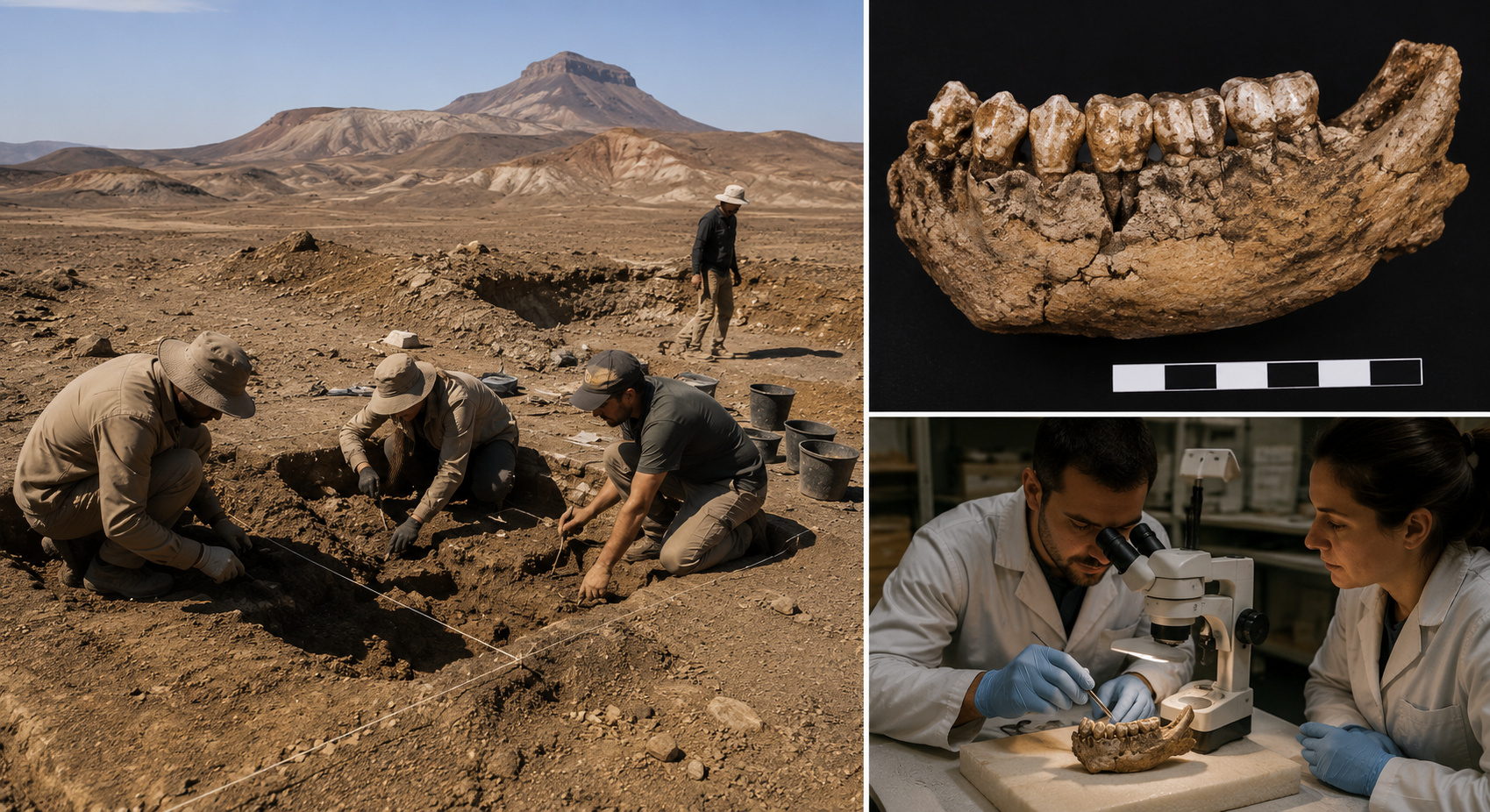

2.6-million-year-old jaw found in Afar, Ethiopia, reveals the first Paranthropus in the region and changes the map of human evolution.
According to the University of Chicago, a study led by paleoanthropologist Zeresenay Alemseged, professor of Organismal Biology and Anatomy at the institution, published in the journal Nature on January 21, 2026, describes the discovery of the first Paranthropus specimen ever found in the Afar region, northern Ethiopia. The fossil was identified more than 1,000 kilometers north of the previous northernmost occurrence of the genus.
The partial jaw, named MLP-3000, was dated to approximately 2.6 million years ago. This places it among the oldest Paranthropus specimens ever discovered anywhere in Africa, in a region famous for revealing key fossils of human evolution.
The discovery changes the understanding of the geographic distribution of Paranthropus and its environmental adaptability. The genus, previously seen as more restricted and specialized, now appears as a more versatile hominin, capable of occupying environments where scientists did not expect to find it.
-
Teen Inventors Win $50,000 for Pen-Sized Device Using Ultrasound to Remove 94% of Microplastics from Water

-
Ultra-Black Car Paint Absorbs 99.9% of Light, Making Vehicles Look Like “Black Holes” on Wheels

-
Ancient Maya City Discovered in Remote Mexican Area with 12-Meter Pyramid, Palaces, Canals, and 14 Preserved Monuments
-
Indigenous 8-Year-Old Girl Wins National Science Award for Solar-Powered Water Heater Invention Using Recycled Materials


Paranthropus in Afar changes the map of human evolution in Africa
The Afar region is one of the most important sites in world paleoanthropology. It was there that fossils like Lucy, of the genus Australopithecus, helped reconstruct essential chapters of human evolution.
Over decades, hundreds of fossils of Ardipithecus, Australopithecus, and Homo have been found in northern Ethiopia. The absence of Paranthropus, therefore, was considered intriguing by many researchers.

Jan 23, 2026
According to Zeresenay Alemseged, this absence led some paleoanthropologists to conclude that the genus might never have reached so far north. The MLP-3000 shows that this interpretation was wrong: Paranthropus was in Afar, but had not yet been found.
What was Paranthropus and why the nickname “nutcracker” marked the genus
The Paranthropus was a genus of extinct hominins that lived between approximately 2.7 million and 1.2 million years ago in Africa. It is not a direct ancestor of modern humans, but a collateral branch of the evolutionary tree.
Their physical characteristics were striking: robust jaws, large molars, thick dental enamel, wide face, and a sagittal crest on top of the skull, where powerful chewing muscles were attached. This anatomy earned the group the informal nickname “nutcracker.”
The name became especially associated with Paranthropus boisei, discovered by Mary Leakey in 1959 at Olduvai Gorge in Tanzania. For decades, this robust appearance was interpreted as a sign of a highly specialized diet.
2.6 Million-Year-Old Jaw Challenges the Idea of a Limited Diet
The dominant hypothesis stated that Paranthropus relied on hard and abrasive foods, such as seeds, roots, and tubers. According to this interpretation, their teeth and jaws would be adaptations for chewing items that required extreme force.
If the genus was so specialized, its geographical distribution should be limited to regions where these foods were available. This helped explain why it was known in southern and eastern Africa, but not in the Afar.
The MLP-3000 jaw challenges this interpretation. The fossil indicates that Paranthropus had greater ecological flexibility than previously thought, occupying environments that previously seemed beyond its reach.
Fossil MLP-3000 Was Found in the Mille-Logya Desert, Northern Ethiopia
The discovery began in January 2019, in the Mille-Logya desert, a remote research area in the Ethiopian Afar. The region has temperatures that frequently exceed 40°C and requires fieldwork under difficult conditions.
The first fragment was found by Ali Haider, a local Afar assistant working with Alemseged’s team. The piece was a partial jaw, corresponding to the left half of the lower maxilla, with a visible molar.


The fragments were carefully collected, reassembled, and cataloged as MLP-3000. After that, the material was taken for analysis at the National Museum of Ethiopia in Addis Ababa.
Publication in Nature Took Seven Years Due to Detailed Fossil Analysis
The interval between the discovery in 2019 and the publication in 2026 was not a simple delay. It was seven years of morphological analysis, anatomical comparison, dating, and scientific validation.
The team used high-resolution computed microtomography to examine the internal structure of the jaw. This technique allowed observation of dental roots, internal bone architecture, and details that do not appear just through external analysis.
These characteristics are important because they help distinguish Paranthropus from Australopithecus and Homo. The classification needed to be supported by strong data, as the genus had never been confirmed in that region.
The absence of Paranthropus in Afar was one of the most intriguing gaps in paleoanthropology
Afar has always been fertile in hominin fossils. The region preserved evidence of important species from the last millions of years of human evolution, making the absence of Paranthropus increasingly difficult to explain.

Two hypotheses were recurrent. The first stated that Paranthropus had too specialized a diet to survive in Afar. The second suggested that the genus could have been outcompeted by more versatile Homo species.
The discovery of MLP-3000 weakens both explanations. According to Alemseged, the previous absence was an artifact of the fossil record, not proof that Paranthropus never occupied northern Ethiopia.
Microtomography revealed robust teeth and clues about Paranthropus’s diet
The micro-CT analysis produced some of the most important data of the study. The teeth of MLP-3000 have thick enamel, roots compatible with Paranthropus, and an internal structure distinct from other known hominins in the region.
The patterns of dental wear also help discuss diet. Very worn teeth in a certain way suggest the consumption of abrasive foods, while other patterns may indicate a more varied diet.
Comparison with Paranthropus fossils from other areas showed enough variation to support a hypothesis of greater dietary versatility. The robust jaw allowed for chewing hard foods, but this does not mean the animal depended exclusively on them.
Paranthropus and Homo may have coexisted in Afar 2.6 million years ago
The estimated age of 2.6 million years places MLP-3000 in a critical period of human evolution. Eastern Africa was undergoing increasing aridification, with forests giving way to savannas and mosaics of open habitats.
This period coincides with the emergence of the first representatives of the genus Homo and with the oldest stone tools associated with the Oldowan industry. This makes the presence of Paranthropus in the Afar even more relevant.
The discovery raises a central question: Did Paranthropus and Homo coexist in the same environment in northern Ethiopia? If so, researchers will have to investigate whether they competed for resources or occupied different ecological niches.