






 Portuguese
  Spanish


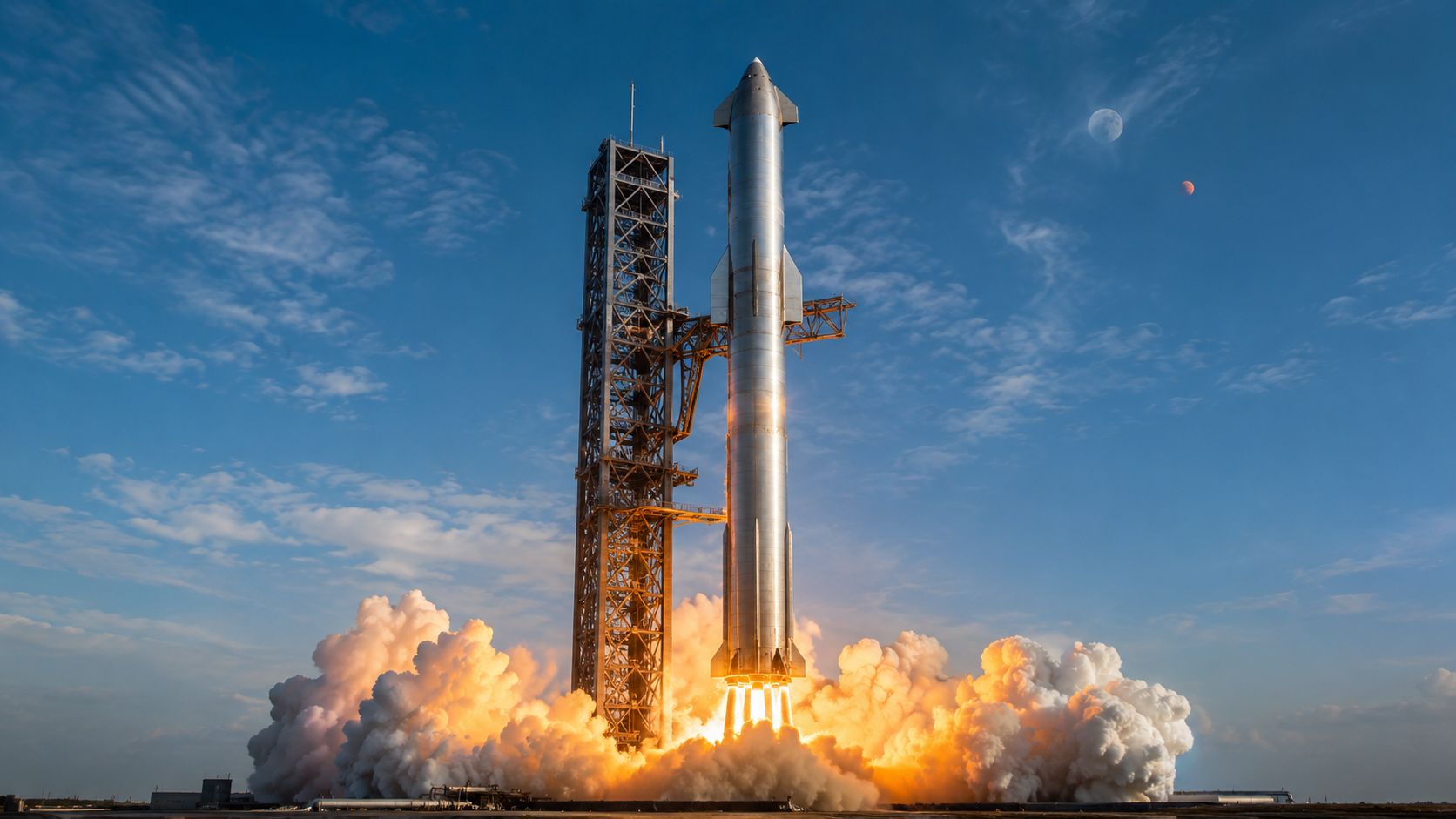


At 124 meters tall, 33 Raptor 3 engines, and a series of technical changes, the Starship V3 will conduct a new test in Texas after previous explosions and failures, in a mission linked to SpaceX and NASA’s plans to take astronauts to the Moon in 2028
The launch of the Starship V3, the next generation of the system formed by the Starship spacecraft and the Super Heavy booster, is scheduled for Tuesday, May 19, at Starbase, in southern Texas, in a decisive test for SpaceX.
The company intends to launch into space the tallest and most powerful rocket ever built, at 407 feet, or 124 meters, in its 12th test flight. The launch window will open at 6:30 PM, EDT, following the model of previous Starship tests.
The mission marks the debut of the new version of the spacecraft and comes after a series of flights that combined advances, damage, and explosions. SpaceX seeks to demonstrate greater control of the redesigned vehicle and advance in functions considered essential for its future plans.
-
China Develops Custom 140-Ton Electric Mining Truck with 770 kWh Swappable Battery, Deploys 290 Units in Xinjiang’s Largest Zinc Mine

-
Meta to Launch Arena, a New Prediction App Targeting 3.56 Billion Users, Competing with Polymarket and Kalshi

-
Scientist Challenges Famous Human Evolution Theory, Argues Homo Sapiens Evolved Gradually Over Thousands of Years
-
15-Year-Old American Builds Ocean Generator with PVC Pipe and 3D-Printed Propeller for $12, Wins National Prize, Presents at White House, and Makes Forbes 30 Under 30 List




The Starship V3 is presented as a centerpiece for the company’s ambition to take humans to the Moon with NASA in 2028. The flight will also be observed for the vehicle’s role in future operations involving Starlink satellites, propellant transfer in space, and missions to the Moon and Mars.
Starship V3 reaches the 12th test after failures and advances
The recent trajectory of the Starship had episodes considered remarkable. Last year, the seventh and eighth test flights caused a shower of burning debris. The ninth flight fell short of the company’s planned target.
Before the tenth test, a Starship spacecraft exploded on the platform during a routine check. Despite this history, the tenth flight, conducted in August 2025, was considered successful, although it suffered some damage during the mission.
The 11th flight, in October, occurred smoothly. Now, SpaceX enters a new stage with the V3, which brings together changes in the spacecraft, the Super Heavy booster, and also in the launch structure used at Starbase.
The countdown maintains the company’s characteristic tone. As in previous tests, the disclosed schedule does not simply end with the indication of Starship’s liftoff, but with the expression “excitement guaranteed,” associated with the risk and unpredictability of the trials.

How the test flight will be
If the plan is fulfilled, the mission will last just over an hour. The Starship should follow a suborbital trajectory, separate from the Super Heavy booster, and continue its course before returning for a controlled landing in the ocean.
After separation, the Super Heavy will perform a return maneuver to Earth and is expected to land in the water in the Gulf of Mexico. SpaceX is known for recovering rockets on land, but this attempt will not occur on this flight.
The decision is linked to the fact that this is the first test of a significantly redesigned vehicle. Therefore, the company will not attempt to capture the booster at a landing site, a step that would require greater operational precision.
After abandoning the Super Heavy, the Starship should release 22 Starlink satellite simulators. These fictitious objects will resemble the next generation of Starlink satellites and will serve as part of the mission’s evaluation.
Two of these simulators will also have the function of scanning the Starship’s heat shield. The protection was deliberately altered for the test, with the intentional removal of a heat shield tile.
The measure will allow observing differences in aerodynamic load on the neighboring tiles when one of them is absent. The information was described by SpaceX as part of the set of evaluations of the Starship’s atmospheric entry.
At the end of the mission, a successful test should still include the reignition of a Raptor engine in space. After that, the ship will make a controlled landing in the ocean, although the company has not specified the exact location.
Changes in the booster, the ship, and the platform
The third version of the Super Heavy received new features to improve performance during flight and stability on return. Among the changes are new grid fins positioned at the bottom of the booster.
The system also received a completely redesigned fuel transfer tube. The change aims to allow all 33 new Raptor engines to be ignited simultaneously during the rocket’s operation.
The Raptor 3 engines are expected to deliver more thrust than previous models. The Starship V3 also received a redesigned propulsion system, with a new engine start method, larger fuel tank volume, and improved reaction control.
The changes extend to the launch platform. The structure now has a greater propellant storage capacity and more pumps, so the rocket can be fueled more quickly before liftoff.
SpaceX stated that this set of changes aims to unlock core vehicle functions, including complete and rapid reuse, propellant transfer in space, Starlink satellite deployment, orbital data centers, and sending people and cargo to the Moon and Mars.
The weight of the test for NASA’s lunar plans
NASA relies on commercial partners to return humans to the Moon. Within this plan, the agency needs a commercial lunar module capable of transporting astronauts to the surface during the Artemis IV mission.
SpaceX is developing a lunar variant of the Starship for this task. The company, however, is competing with Blue Origin, which is also working on the project with the Blue Moon module.
The lunar plan involves sending astronauts in the Orion capsule and meeting a commercial lander in lunar orbit. This vehicle will take the crew to the surface and then return to the Orion.
The agency also intends to test the docking of Orion with one or both commercial options in low Earth orbit next year. The readiness of the lunar module will determine which supplier will take astronauts to the Moon in 2028.
The schedule also depends on NASA’s own preparation. The Artemis program faces delays, budget overruns, and is still awaiting suitable space suits for a lunar landing.
With information from LS.






