Portuguese
  Spanish


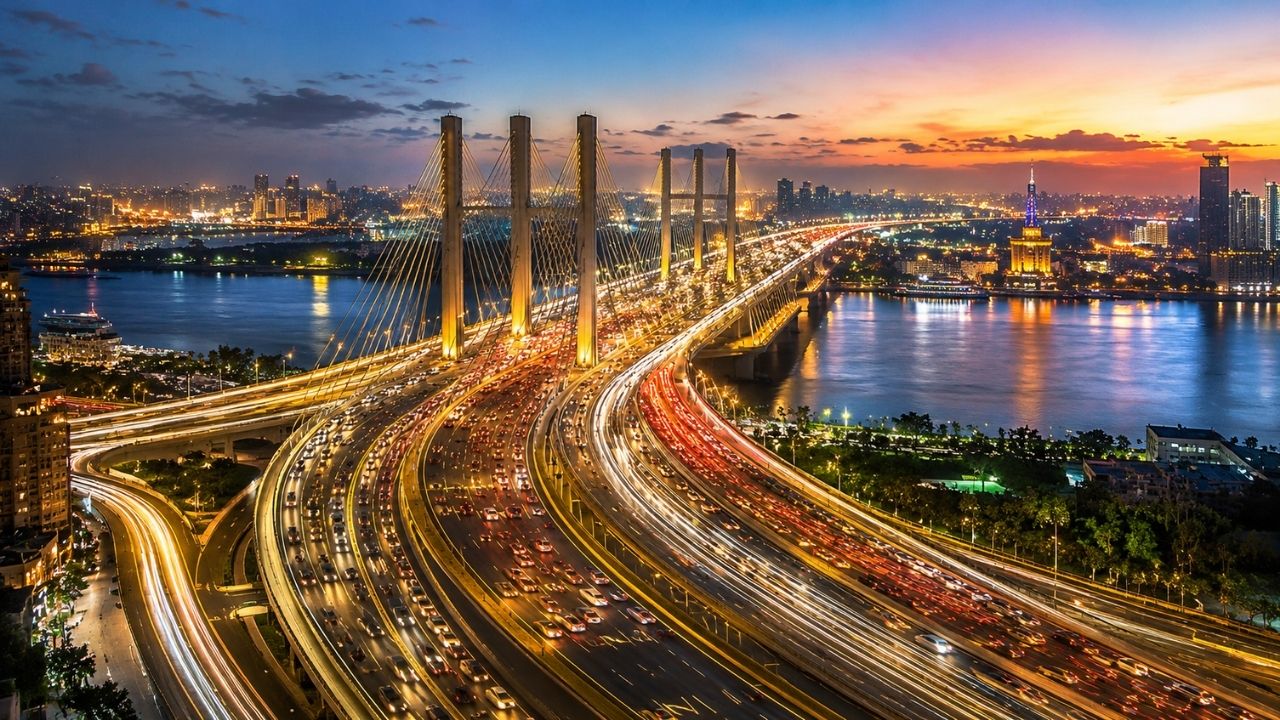

Tahia Misr Bridge, in Cairo, crosses the Nile with 540 meters in length, 67.3 meters in width, 12 lanes, and a central span of 300 meters, integrating the Rod Al-Farag axis to redistribute traffic, alleviate urban bottlenecks, and transform a crossing into a suspended avenue since 2019 in the Egyptian urban daily life.
The Tahia Misr Bridge, in Cairo, was inaugurated on May 15, 2019 and has become one of the most impressive roadworks in recent Egypt. Suspended over the Nile River, it draws attention not for its height, but for its width: 67.3 meters, with 12 traffic lanes.
According to the Construction Time channel on YouTube, integrated with the Rod Al-Farag axis, the structure was designed for much more than crossing the river. The proposal was to create a new logic of urban circulation, diverting flows before they reached the most congested areas of Cairo, one of the most pressured metropolises on the planet.
Bridge over the Nile functions as a suspended avenue
The Tahia Misr Bridge is 540 meters long with a central span of 300 meters, designed to maintain navigation on the Nile. The extreme width allows six lanes per direction, transforming the crossing into a kind of elevated avenue over the river.
-
Facing high rent, couple transforms parents’ garage into a fully functional apartment, creating a complete home at a fraction of the market cost.

-
MIT Scientists Develop Method to Transform CO₂ into a Construction Ally, Boosting Cement Strength by 13% in 24 Hours for More Sustainable Infrastructure

-
Canadian City Builds 8 Tiny Homes in 72 Hours for Homeless Youth, Plans 40 Affordable Houses for Female-Led Families Amid Housing Crisis

-
45-year-old Brazilian mother of 9 and grandmother of 12 receives 27 m² house made from recycled plastic, built in 15 hours with interlocking blocks and a recycled roof.


This configuration changes the traditional understanding of an urban bridge. Instead of just connecting one bank to the other, the work concentrates road capacity at a strategic point, functioning as part of a larger circulation corridor.
The Rod Al-Farag axis was created to allow vehicles to cross critical regions without passing directly through the urban center. This is essential in a city where old crossings over the Nile began to concentrate traffic instead of distributing it.
The bridge was not designed just to shorten commutes, but to reduce urban friction. In a congested metropolis, this means trying to decrease bottlenecks before they contaminate the entire road network.
Cairo needed more than just a new crossing

Cairo grew in layers, with urban expansion accumulated over time. The result was a road network that was not prepared for the current scale of the Egyptian capital.
The bridges over the Nile, which should function as connecting elements, have become bottlenecks. With the increase in population and the vehicle fleet, these crossings have reached their operational limit.
In this scenario, merely expanding existing structures would not solve the entire problem. The challenge was to create a path capable of redistributing traffic before entering the most saturated areas.
The Tahia Misr Bridge emerges precisely as part of this paradigm shift. The construction does not act alone but within a road axis designed to reorganize the circulation of the metropolis.
Extreme width required special structural solution
The great complexity of the bridge was not only in spanning the river but in supporting an unusual width. At 67.3 meters, the deck needed to maintain stability, transverse rigidity, and deformation control.
Therefore, the cable-stayed system was decisive. In this model, the cables transfer the deck loads to the towers, creating an efficient structural path to support a crossing with 12 simultaneous lanes.
The towers are approximately 92 meters high and function as the structural heart of the set. From them, about 160 cables are distributed in a semi-fan configuration, balancing the weight across the width.
The challenge was to prevent the bridge from behaving as a structure that was too heavy or too unstable. For this, the project adopted separate lanes, shared pillars, and a structural composition capable of distributing forces more evenly.
Construction required millimetric control and logistics on the river
The assembly of the bridge was executed with progressive advancement of the deck from the towers. This method allowed crossing the central span without installing intermediate supports in the river, reducing interference with Nile navigation.
During the construction, each segment needed to be aligned and tensioned precisely. Small deviations in level, position, or tensioning could generate cumulative effects on the final performance of the structure.
Logistics was also a critical stage. Operations with barges and floating cranes were used to transport and position large structural pieces.
Underground, the construction required deep foundations, with large diameter piles to transfer high loads to resistant layers below the Nile sediments. More than 4,000 professionals participated in the construction, reflecting the scale of the project.
Construction concentrated capacity at a critical point in Cairo

The estimated cost for the project was about 5 billion Egyptian pounds, a value associated with a large-scale road intervention. The investment reflects an attempt to tackle a concentrated problem: traffic bottlenecks at critical points in the capital.
Unlike bridges famous for spanning great distances, the Tahia Misr addresses another challenge: urban density. It stands out not only for its length but for its ability to gather an unusual road capacity over the Nile.
In practice, it’s like suspending a large avenue over the river. The expected effect is to reduce the overload of already saturated sections and provide more fluidity to the movements crossing the region.
The logic of the bridge is to concentrate capacity where the system most needed relief. Instead of spreading small interventions, the project created a robust structure in a strategically considered axis.
Rod Al-Farag Axis attempts to redistribute traffic
The integration with the Rod Al-Farag axis allows long-distance flows to be diverted before reaching downtown Cairo. This reduces pressure on critical areas and improves the efficiency of the road system as a whole.
This type of intervention does not eliminate traffic but changes its logic. By shifting part of the vehicles to structured corridors, the city gains more predictability and reduces congestion peaks in sensitive regions.
At the inauguration of the axis, estimates indicated savings of up to 300 million Egyptian pounds per year in fuel. It was also reported that the route between Shubra and the Cairo-Alexandria Desert Road began to be completed in approximately 20 minutes, cutting the time in half.
In a city like Cairo, travel time is not just comfort; it’s urban productivity. Fewer stationary vehicles mean less fuel waste, less wear and tear, and more efficiency for the local economy.
Bridge became a symbol of a large-scale urban response


The Tahia Misr Bridge does not solve all the mobility problems of Cairo. No isolated project would have that power in a metropolis marked by rapid growth, population density, and constant pressure on the roads.
Even so, the bridge established a new standard of response for large-scale urban bottlenecks. It shows that, in some cities, it’s not enough to create a crossing: it’s necessary to reorganize the flow before it collapses.
The project also benefits adjacent regions, enhancing connectivity and creating new possibilities for urban, commercial, and real estate development around the connected corridors.
In the end, the widest bridge in Cairo did not change the Nile River, but it changed the way part of the city crosses this historical obstacle.
Do you think a bridge of this size would make sense in any congested Brazilian metropolis, or would smaller, distributed solutions be more efficient? Share your opinion.