






 Portuguese
  Spanish


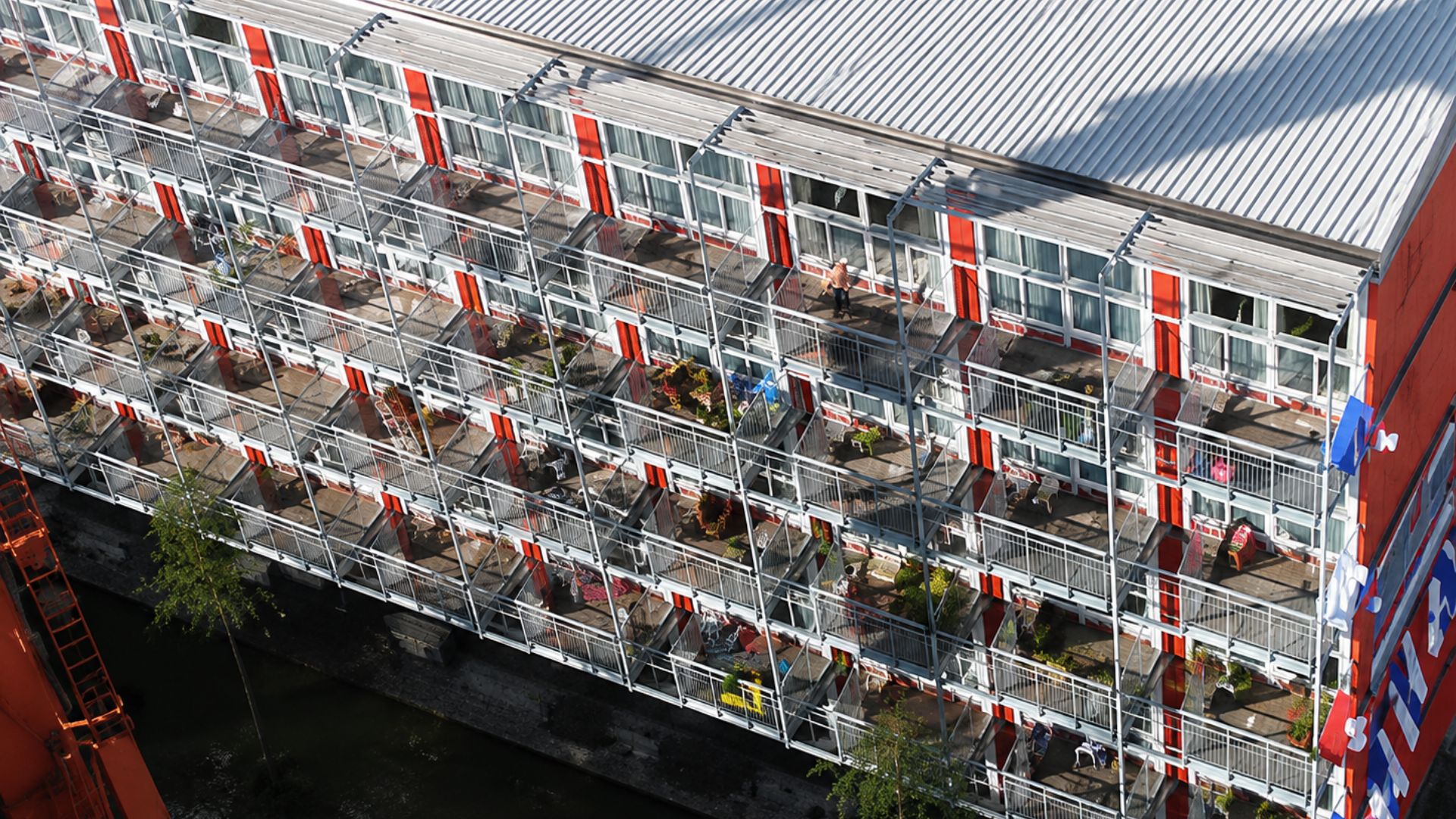

The largest container condominium in the world was Keetwonen, in Amsterdam. Built between 2005 and 2006 by the company Tempohousing in partnership with the local government and the real estate company De Key, it housed more than a thousand students in complete apartments for 15 years before being dismantled and relocated in 2020.
In the early 2000s, Amsterdam faced a student housing crisis with no solution in sight. Rents were skyrocketing, waiting lists for university housing were endless, and students found few affordable options in the Dutch capital. The answer to this impasse came from an unexpected place: the largest container condominium in the world, named Keetwonen, was assembled from 1,034 recycled shipping containers in an operation that involved production in China and rapid installation in the Netherlands.
The project was conducted by the Dutch company Tempohousing, in partnership with the Amsterdam government and the real estate company De Key. Construction began in September 2005 and was completed in May 2006, in just eight months, transforming a vacant lot into a vibrant student community. The complex remained in use for 15 years, far beyond the initially planned five years, and was only dismantled in 2020 for the relocation of the modules to other cities in the Netherlands.
How the idea for the largest container condominium in the world came about

The housing crisis in Amsterdam at the beginning of the 2000s was severe. The Dutch capital hosts some of the country’s main universities, and the growing influx of national and international students put pressure on an already tight real estate market. The consequences were evident in prices and the lack of vacancies.
-
U.S. City Builds Tiny Home Village on Water Company Land to House 136 Homeless People: Inside the Social Housing Units

-
Woman Turns Shipping Container into Home, Embraces Rural Life to Cut Monthly Expenses to Just Over $330
-
France Revamps 530 Social Housing Units with Large Balconies and Glass Facades Without Demolishing Existing Buildings

-
Facing high rent, couple transforms parents’ garage into a fully functional apartment, creating a complete home at a fraction of the market cost.




Conventional rents were out of reach for students, and traditional university residences had long waiting lists. It was in this scenario that Tempohousing presented a bold proposal: to build large-scale housing using repurposed shipping containers, instead of following traditional construction methods.
The choice of containers had practical and economic justification. These modules are standardized, robust, and can be mass-produced in factories. Instead of erecting a building piece by piece in Amsterdam, Tempohousing opted to import ready-made units and simply assemble them on-site, reducing the time and costs of the operation.
Production in China and Impressive Speed

To meet the necessary volume, Tempohousing set up a dedicated production line in China, capable of manufacturing up to 40 units per week. Each apartment was assembled inside the container at the Chinese factory, with electrical, plumbing, and basic finishing already included.
The installation pace in Amsterdam was also impressive. The project delivered about 150 houses per month in the Dutch capital, a speed impossible to achieve with conventional construction methods. The first 60 units were ready in September 2005, and by May 2006 the entire Keetwonen complex was completed.
The final complex occupied a 31,020 square meter plot, distributed in blocks that formed internal courtyards. The structure organized the 1,034 containers in a configuration that utilized every available square meter, while simultaneously creating circulation spaces and common areas for the resident students.
What the 28 Square Meter Apartments Were Like


Each apartment in Keetwonen had 28 square meters of private area, a size equivalent to a small standard studio in any major city in the world. The difference is that these modules came with everything a student needs to live comfortably.
The interior of the units included:
- Complete private bathroom
- Compact kitchen with stove and sink
- Study area with desk
- Large windows ensuring natural light entry
- Individual balcony in each apartment
Despite initial skepticism about living inside a container, students quickly adapted to the new format. The apartments were well insulated thermally, quiet inside, and bright, with many residents reporting that once settled inside the unit, they forgot they were inside a recycled shipping container in Amsterdam.
Community Life Inside the Amsterdam Complex
Keetwonen was designed for the student lifestyle and was not limited to offering just individual apartments. The complex included common areas that made it a small autonomous neighborhood within Amsterdam.
Residents had access to a café, laundry, supermarket, shared offices, and sports areas. The layout of the containers created enclosed courtyards, which served as safe spaces for bicycle parking and social gatherings among students. This architectural configuration reinforced the sense of community within the world’s largest container condominium, without compromising the individual privacy of each apartment.
The result was so positive that Keetwonen became the second most sought-after student housing complex in Amsterdam, with a waiting list of over a year for those interested in securing a spot. The demand strongly contrasted with the initial skepticism about the feasibility of offering dignified housing in containers.
Affordable rent and complete infrastructure
One of the central points of Keetwonen was the affordable price, especially by Amsterdam standards. In 2015, students paid around 400 euros per month to live in one of the complex’s apartments.
This amount included a range of services that would normally appear separately in the monthly budget. The rent covered internet, heating, and basic furniture for each apartment, which made Keetwonen a game-changer in the student housing market in the Dutch capital.
The combination of complete apartments, functional common areas, and affordable prices explained the high demand. For students coming from other cities or countries, Keetwonen offered a simplified entry point into a capital known for its high cost of living. Just arrive and start studying.
Sustainability as a pillar of the project
Keetwonen was also a pioneering project from an environmental standpoint. By repurposing shipping containers that might otherwise end up as scrap, Tempohousing drastically reduced the waste generated by a traditional construction of the same size in Amsterdam.
The units were also designed with energy efficiency in mind. The apartments featured high-performance insulation, double-glazed windows, and efficient heating systems, which kept energy costs low for students and reduced the environmental impact of the complex.
This package of solutions made Keetwonen a global reference in sustainable modular housing. Researchers, architects, and public managers visited the complex in Amsterdam over the years to understand how the concept could be replicated in other cities around the world facing similar housing crises.
Why Keetwonen lasted three times longer than expected
The original project of the world’s largest container condominium was intended to have a lifespan of five years. The idea was to offer a temporary solution to the housing crisis, with the removal of the structures as soon as the problem was resolved by other means.
But the success among students changed this plan. The high demand, the satisfaction of the residents, and the good maintenance of the structures led Tempohousing and its partners to extend the use of the complex far beyond the initial deadline, totaling 15 years of operation in Amsterdam.
In 2020, finally, the structures were dismantled. But the story of the apartments did not end there. All 1,000 container homes were relocated to other cities in the Netherlands, where they continue to offer affordable housing options to other audiences, including new students in different regions of the country.
The legacy of Keetwonen for the world
The success in Amsterdam opened doors for Tempohousing in other markets. The company expanded its modular housing solutions to different countries, showing that the model tested at Keetwonen can be applied in various contexts around the world.
Among the derived projects are 250 student residences in Diemen, a neighboring city to Amsterdam, prefabricated modular residences in Sion (Switzerland), luxury mini-hotel units for festivals in Denmark, and even a temporary school building delivered in Panama City. This last project was signed in mid-May 2017, with the requirement that the building be ready for the new school year in August, and Tempohousing completed the work by July.
Keetwonen remains proof that modular construction has real potential to solve urban housing challenges on a large scale. By reinventing shipping containers as comfortable and affordable apartments, Tempohousing set an important precedent for quick and sustainable solutions in any city in the world facing housing crises similar to Amsterdam’s in the 2000s.
The story of Keetwonen shows that unconventional solutions can solve structural problems when the traditional method falls short. The world’s largest container condominium housed more than a thousand students for 15 years in one of the most expensive cities in Europe, with complete apartments, an active community, and affordable prices.
And you, what do you think about this solution? Would you live in an apartment inside a recycled shipping container? Do you believe this model could work in large Brazilian cities with a housing deficit? Leave your comment, share your opinion, and tag someone who needs to know this story.









