





 Portuguese
  English
  Spanish
  3 min of reading
  0 comments


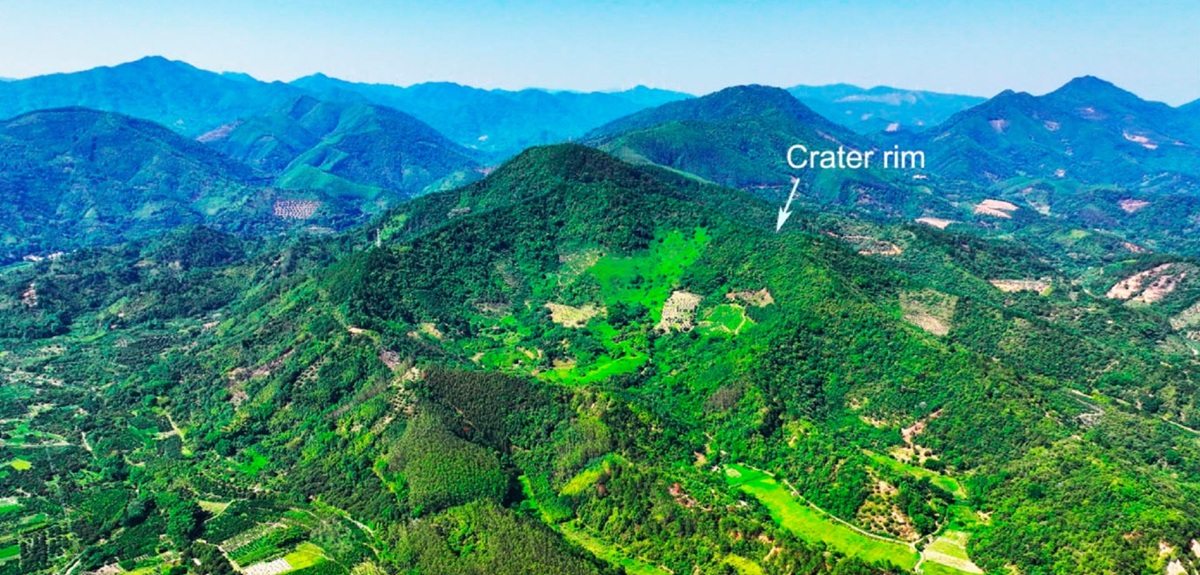
The Jinlin Crater, Discovered in a Mountainous Region of Guangdong, Impresses Scientists with Its Exceptional Preservation and Size, Redefining Understanding of Recent Meteorite Impacts on Earth
Researchers identified an impact crater formed on a granite mountain covered by a thick layer of weathering crust in southern China. The structure, located in Zhaoqing, Guangdong province, has been named Jinlin Crater and is part of a select group of about 200 recognized craters worldwide.
At less than 11,700 years old, the discovery enhances understanding of recent impacts in the Holocene.
Geological Context and Rarity of the Discovery
The Earth has accumulated numerous impact craters throughout its history. However, tectonic activity and intense weathering have erased, deformed, or buried much of these ancient marks. Currently, there are approximately 200 confirmed craters globally.
-
A worm frozen for an impressive 46,000 years in Siberia returns to life in a laboratory, reproduces after the Neanderthal era, and reveals an unbelievable scientific phenomenon that could change everything we know about survival on Earth and beyond.

-
New study finds that asphalt releases ultrafine particles and toxic compounds that increase with heat and pose health risks.

-
New scientific investigation debunks the theory of a hidden fault and reveals the true origin of a historical tsunami that occurred in Japan.
-
Study reveals that an ancient bacterium dormant for centuries silently shaped the genetics and immune system of modern humans




In China, only four had been reported before, all in the northeast. The south of the country, marked by tropical and subtropical monsoon climates, presents conditions that accelerate erosion due to heavy rainfall, high humidity, and elevated temperatures.
In this scenario, the Jinlin Crater stands out for emerging in a mountainous and rugged area in northwestern Guangdong, near the riverside village of Jinlin in Deqing County. The preserved structure surprises researchers because it withstands the harsh weather conditions that usually destroy geological evidence of this type.
Dimension and Scientific Importance
With a diameter of 900 m, the crater is the largest known impact structure of the Holocene. It far exceeds the 300 m Macha Crater, which was previously considered the largest of its time.
Dr. Ming Chen from the High Pressure Science and Technology Center stated that the discovery indicates that impacts from small extraterrestrial objects in the Holocene occurred on a larger scale than previously recorded.
Researchers identified that the impactor was a meteorite. A comet would have produced a much larger opening, with at least a 10 km diameter. The team has not yet determined whether the meteorite was made of iron or stone.
Evidence Found in Granite
The Jinlin Crater impresses because it maintains its structure despite monsoons and accelerated erosion. In the granite layers surrounding and protecting the site, researchers detected numerous quartz fragments with characteristics of planar deformation, considered direct evidence of violent impacts.
Dr. Chen explained that these structures form only under intense shock waves, between 10 and 35 gigapascals, a pressure that no terrestrial geological process can produce.
He emphasized that although each point on the Earth’s surface faces similar odds of impacts, geological differences cause distinct wear on the marks of these events, leading some to completely disappear. Therefore, the Jinlin Crater has exceptional value.
Contributions to Impact Studies
Dr. Chen highlighted that impact craters serve as direct records of the history of impacts on Earth. The discovery provides a more objective basis for understanding the distribution of these events, the geological evolution of the formed structures, and the dynamics of small extraterrestrial bodies.
The team’s study was published on October 15, 2025, in the journal Matter and Radiation at Extremes.





-

-

2 people reacted to this.