






 Portuguese
  Spanish
  5 min of reading
  1 comment


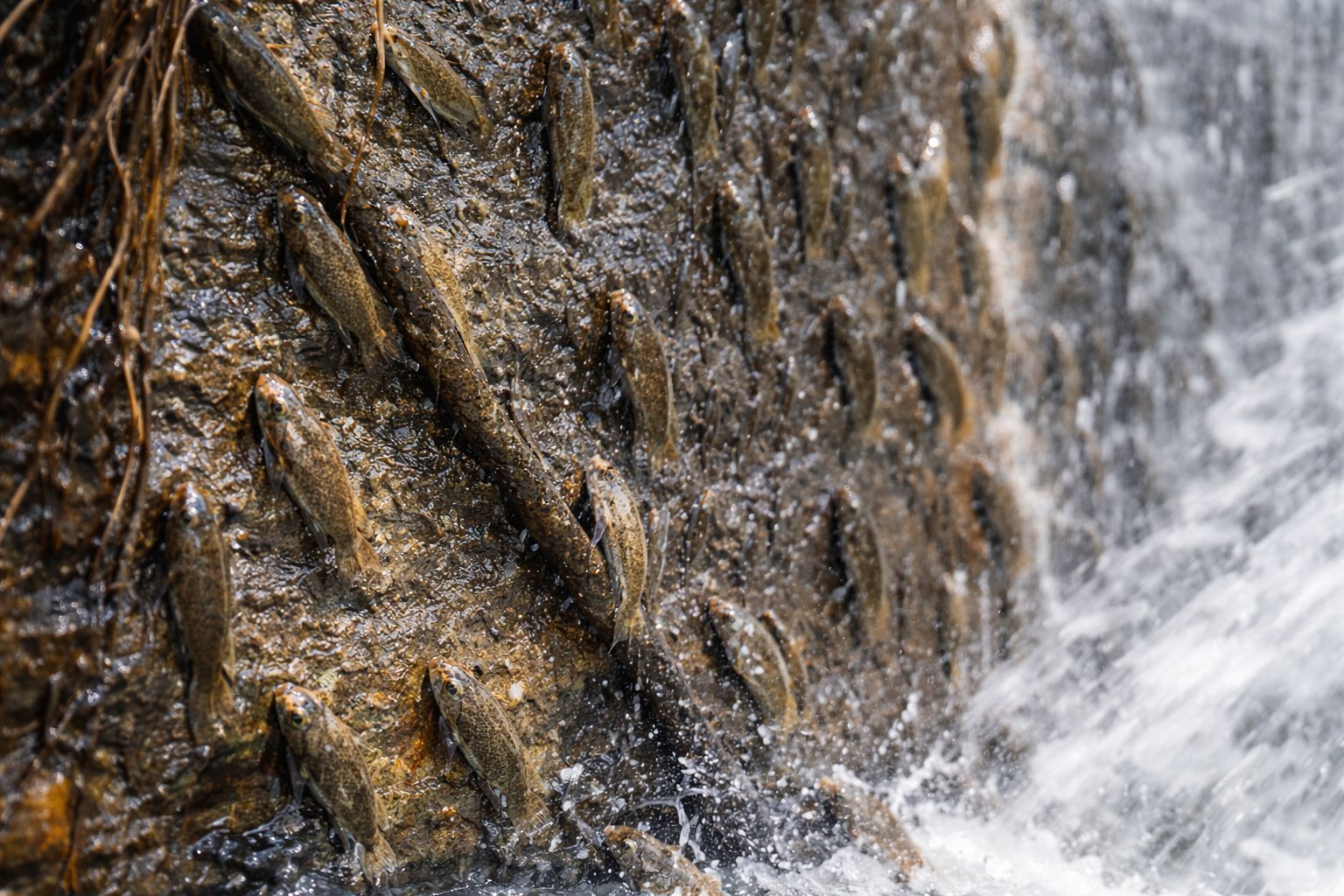


Researchers documented for the first time in Africa a species of fish scaling a 15-meter vertical waterfall at the Luvilombo Falls in the Democratic Republic of the Congo. The shell fish (Parakneria thysi) take almost 10 hours to complete the ascent using microscopic hooks on their fins called unculos. The study was published in the journal Scientific Reports.
Thousands of small fish were caught doing something that seems impossible: scaling a 15-meter vertical waterfall, without jumping, without swimming against the current, but literally climbing the rock wall as if they were miniature mountaineers. Researchers documented the behavior of the species Parakneria thysi, a shell fish that lives at the Luvilombo Falls in the upper Congo basin. The fish cling to the wet rocky surfaces using pectoral fins supported by pelvic fins and aided by tiny hook-shaped projections called unculos, which function as biological climbing equipment. The ascent takes almost 10 hours, with the fish moving in short bursts and resting frequently along the vertical wall.
The discovery is the first of its kind recorded in Africa and was published in the journal Scientific Reports. Researchers observed the fish climbing the waterfall during seasonal floods at the end of the rainy season, typically in April and May, and documented the behavior on four occasions between 2018 and 2020. Only small to medium-sized individuals, measuring about 3.7 to 4.8 centimeters in length, were seen climbing. Larger fish, which can reach 9.8 centimeters, are apparently too heavy for their fins to support the vertical journey.
How the fish manage to scale a 15-meter waterfall

According to information released by the CNN Brasil, the mechanism that allows fish to climb a vertical rock wall is a combination of specialized anatomy and climbing technique. The fish anchor themselves to the wet rock using their pectoral fins as footholds, while their pelvic fins provide additional support. The unculos, tiny hook-shaped projections on their fins, act like microscopic clamps that prevent the fish from slipping on the wet surface.
-
Survivor of 1966 SS Daniel J. Morrell Shipwreck in Lake Huron Recounts 38-Hour Ordeal in Extreme Cold

-
The Greatest Hoax in World Cup History? The Film That Denied Brazil’s 1958 Victory and Exposed How Fake Evidence Can Seem Convincing on TV
-
Fake South Korean Online Stores Offer Shopping Thrill Without Spending Money or Receiving Products
-
The War of Jenkins’ Ear: How a Severed Ear Sparked One of the 18th Century’s Most Unusual Conflicts


The climbing technique is as ingenious as the anatomy that allows it. The fish propel themselves upward by swinging their bodies from side to side, a movement that vaguely resembles a climber alternating footholds during an ascent. They do not ascend through the flowing water, but through the so-called splash zone, areas of rock kept moist by sprays from the waterfall without direct water flow. On a human scale, the feat would be comparable to a person climbing hundreds of meters vertically using only their hands and feet.
The risks fish face during climbing
The nearly 10-hour ascent is as dangerous as it is impressive. Sudden jets of water can hit the fish during the climb and knock them off the rocky wall, especially in sections where they need to turn upside down to navigate overhangs. Fish that fall at the base of the waterfall, where there is enough water volume to cushion them, are more likely to survive and try again.
However, the fall does not always end well. Fish that fall directly onto the rocks may not survive the impact, making each climbing attempt a gamble between reaching the top and losing their life. Only small to medium-sized individuals can make the ascent, suggesting that there is a weight and size limit beyond which fins and bodies cannot support the animal on the vertical surface. Natural selection favors the smaller ones on this specific journey.
Why fish risk their lives to climb a waterfall
The most obvious question is: why do fish do this? Researchers believe the motivation is ecological: by climbing the waterfall, fish reach sections of the river with less competition for food, fewer predators, and more suitable living conditions for their survival and reproduction. The waterfall acts as a natural barrier that separates two distinct environments, and fish that manage to overcome it access a less contested territory.
This behavior is an example of how evolutionary pressure can generate surprising solutions. Fish that have developed more efficient fins and stronger bodies over millions of years have had an advantage over those that remained at the base of the waterfall, where competition is greater and predators are more numerous. Climbing is not a behavioral accident; it is a survival strategy that evolution has refined over countless generations.
What the discovery reveals about the Congo rivers that almost nobody studies
The Congo basin is the second largest river system in the world and houses the second largest tropical rainforest on the planet, but research on fish behavior in the region is virtually nonexistent. “This discovery highlights the importance of maintaining the continuity of waterways, particularly in the context of the Congo Basin, where studies on fish behavior are practically nonexistent”, explained Pacifique Kiwele, a researcher at the University of Lubumbashi and the lead author of the study.
The lack of research means that behaviors like those of climbing fish may be occurring in dozens of other locations without ever being documented. “It is quite possible that other species of fish living in fast-flowing habitats are capable of overcoming similar vertical obstacles”, said Kiwele, adding that the team plans to conduct more fieldwork to investigate this possibility. Meanwhile, the fish that no one knew about continue to climb a waterfall that no one studied, in a river that almost no one researches.
The human threats that could endanger climbing fish
Despite having survived for millions of years climbing waterfalls, the Congo shellfish face two threats that evolution did not prepare them to confront. Illegal fishing with fine-mesh mosquito nets easily captures small fish, exactly the only ones capable of making the climb. The second threat is water extraction for irrigation, which in some years has depleted the Luvilombo River, eliminating the water flow that maintains the splash zone where the fish ascend.
Without the wet zone on the rock wall, climbing becomes impossible. If the river dries up or is diverted for irrigation, the fish lose not only their aquatic environment but also the vertical migration route that gives them access to the upper habitat of the waterfall. For a species whose survival depends on climbing 15 meters of vertical rock with microscopic hooks, the loss of the only viable path could mean local extinction even before scientists finish studying it.
Thousands of fish have been caught climbing a 15-meter waterfall in the Congo using microscopic hooks on their fins. Would you believe it without seeing? What other unknown species might exist in rivers that no one researches? Share your thoughts in the comments.





I have seen them do this in a river in zimbabwe that had a dam.They love to live in the deeper waters on the dam walls,when water rises then some gets washed over during spilling of dam.After living down stream they start going back against the current. hence climbing up that wall will be achieved when the water is flowing over but not with heavy current.they live in rock places.