






 Portuguese
  Spanish


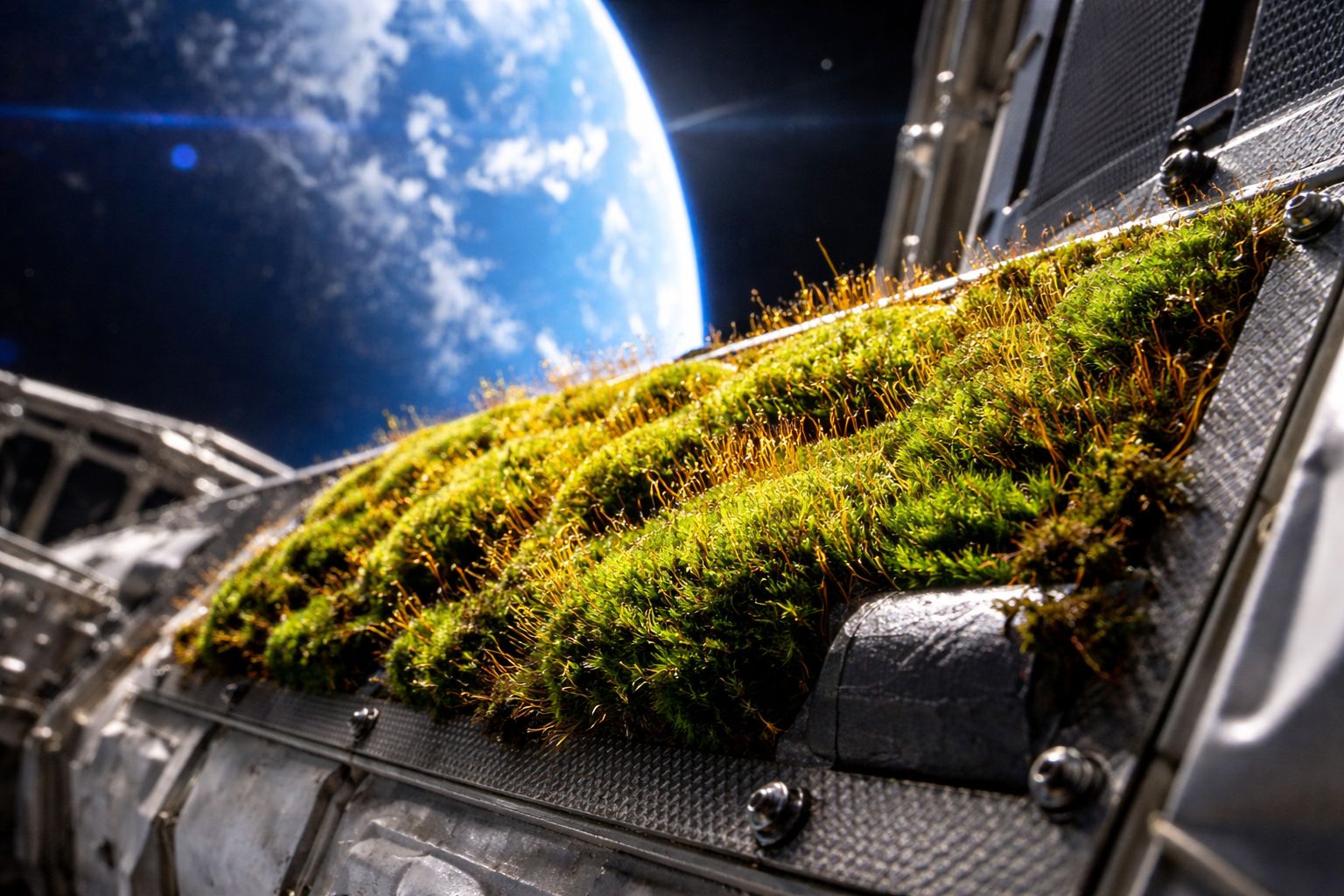


Spores of the moss Physcomitrium patens spent 283 days attached to the external part of the International Space Station exposed to vacuum, radiation, temperatures from -196°C to +100°C, and microgravity. More than 80% survived and successfully reproduced on Earth. Mathematical models suggest they could withstand up to 15 years in space, nurturing hopes for life on other planets.
A moss that grows in deserts and the Arctic has just proven that terrestrial life is more resilient than any scientist expected. Spores of Physcomitrium patens were placed on the external part of the International Space Station in March 2022 and left to their own devices for 283 days, simultaneously exposed to vacuum, cosmic radiation, temperatures ranging from -196°C to +100°C, and microgravity. When the moss spores were brought back to Earth, more than 80% managed to regenerate and reproduce successfully, a result that surprised even the researchers involved. “We expected a survival rate close to zero, but the opposite happened,” said Tomomichi Fujita from Hokkaido University.
The discovery goes far beyond a biological curiosity. The fact that a terrestrial moss can survive 283 days in space and then reproduce on Earth opens real possibilities for the search for life on other planets and for future colonization missions. If a primitive plant can withstand the conditions of space, it is possible that similar spores have traveled between planets in meteorites over billions of years, transporting life from one world to another. Mathematical models created from the data suggest that the moss spores could survive up to 5,600 days in space, equivalent to approximately 15 years.
What the moss faced during 283 days in space
According to information posted by the portal Xataka, the list of adversities that the moss spores endured outside the Space Station is impressive. Absolute vacuum, unfiltered cosmic radiation, extreme dryness, temperature fluctuations from -196°C to +100°C, and microgravity make up a set of conditions that, individually, would be enough to kill most terrestrial organisms. The simultaneous combination of all these factors is what makes the experiment particularly significant.
-
In Brazil’s backyard: Tesla, by Elon Musk, announces official operations in Uruguay, where electric vehicles already make up 20% of new cars but still leaves out the largest market in the region.

-
This Mars rover may finally reveal if life ever existed on Mars.
-
A nearly 70-year-old Chinese inventor has registered 90 patents and created a device that stores water in the roots, helping seedlings survive drought while trying to transform the arid slopes of the Loess Plateau into green areas without relying on heavy irrigation.

-
Researchers want to change the way of producing rare earth magnets, reducing purification steps and making better use of the elements found in Swedish deposits.


The researchers hoped that this combination would produce devastating results for the moss. “Although they may survive radiation, perhaps even in a vacuum, the chances of survival change drastically when all these stressful factors are applied simultaneously”, the scientists explained. This simultaneous biological stress is what separates theoretical resistance from real survival, and the moss has proven that its resilience is not just for difficult conditions; it is for the worst imaginable conditions.
Why more than 80% of moss spores survived
The survival rate of the moss surprised the scientific team because it contradicted expectations based on prior knowledge. The researchers attribute the extraordinary success to two biological mechanisms: highly efficient DNA repair systems and an outer shell-like structure that protects the interior of the spores from physical and chemical damage. This protective layer acts as a biological shield that keeps the essential components of the spore intact during exposure to space.
The DNA repair systems are particularly relevant. Cosmic radiation damages the genetic material of any organism, but moss spores have mechanisms that efficiently identify and correct this damage well enough that, when they return to favorable conditions, they can resume the growth and reproduction cycle. It’s as if each spore carries its own genetic first aid kit, capable of fixing what space tried to destroy.
What moss survival means for the search for extraterrestrial life
The discovery has direct implications for one of science’s oldest questions: is there life beyond Earth? If a terrestrial moss can survive 283 days in space and reproduce afterward, it is possible that spores of similar organisms have traveled between planets within meteorites over billions of years, a process called panspermia. This hypothesis suggests that life can spread throughout the universe not by spaceships, but by rocks ejected from a planet during asteroid impacts.
The mathematical models created by the researchers reinforce this possibility. The calculation indicates that moss spores could survive up to 5,600 days in space, approximately 15 years, although scientists emphasize that this value is an approximation and does not allow for definitive conclusions. Still, 15 years is enough time for a meteorite to travel between Mars and Earth, meaning that moss has demonstrated the theoretical capacity to complete an interplanetary journey and arrive alive at its destination.
What moss teaches about colonizing other planets
For future colonization missions, moss offers practical lessons. If spores from a primitive plant can withstand the conditions of space and regenerate in terrestrial soil, similar plants could be the first forms of life cultivated in extraterrestrial habitats, such as pressurized greenhouses on Mars or the Moon. Before planting tomatoes or wheat on another planet, it makes sense to start with organisms that have already proven capable of surviving space transit.
Researcher Tomomichi Fujita summarizes the significance of the discovery with a statement that connects moss to the broader vision of life in the universe. “This provides compelling evidence that life that evolved on Earth has intrinsic cellular-level mechanisms to withstand the conditions of space”, he stated, suggesting that resistance to the space environment is not an unlikely adaptation but an embedded capability in the biology of certain terrestrial organisms. Life, as the most famous science fiction character in cinema said, finds a way.
The story of the moss that went to space and came back to tell
The experiment began when samples of the moss Physcomitrium patens were placed in special containers and loaded into the cargo compartment of a Cygnus capsule launched to the ISS in March 2022. At the station, the moss spores were fixed to the outside and left exposed to the space environment for 283 days, with no protection other than their own biology. When they were collected and brought back to Earth, researchers found something they did not expect: most of the spores were alive.
The study published by the team is the first to prove that a primitive terrestrial plant can survive long exposure to space. Other creatures had already demonstrated similar resilience, such as tardigrades that also survived clinging to the outside of the ISS, but moss is the first plant to successfully complete this journey. For science, every organism that proves capable of resisting space expands what we know about the limits of life and the possibilities of finding it in places we do not expect.
A moss survived 283 days in space and reproduced on Earth. Do you think life could exist on other planets? Does this discovery change how you view the universe? Share your thoughts in the comments.







No wonder I can’t get rid of it in my lawn.