






 Portuguese
  Spanish


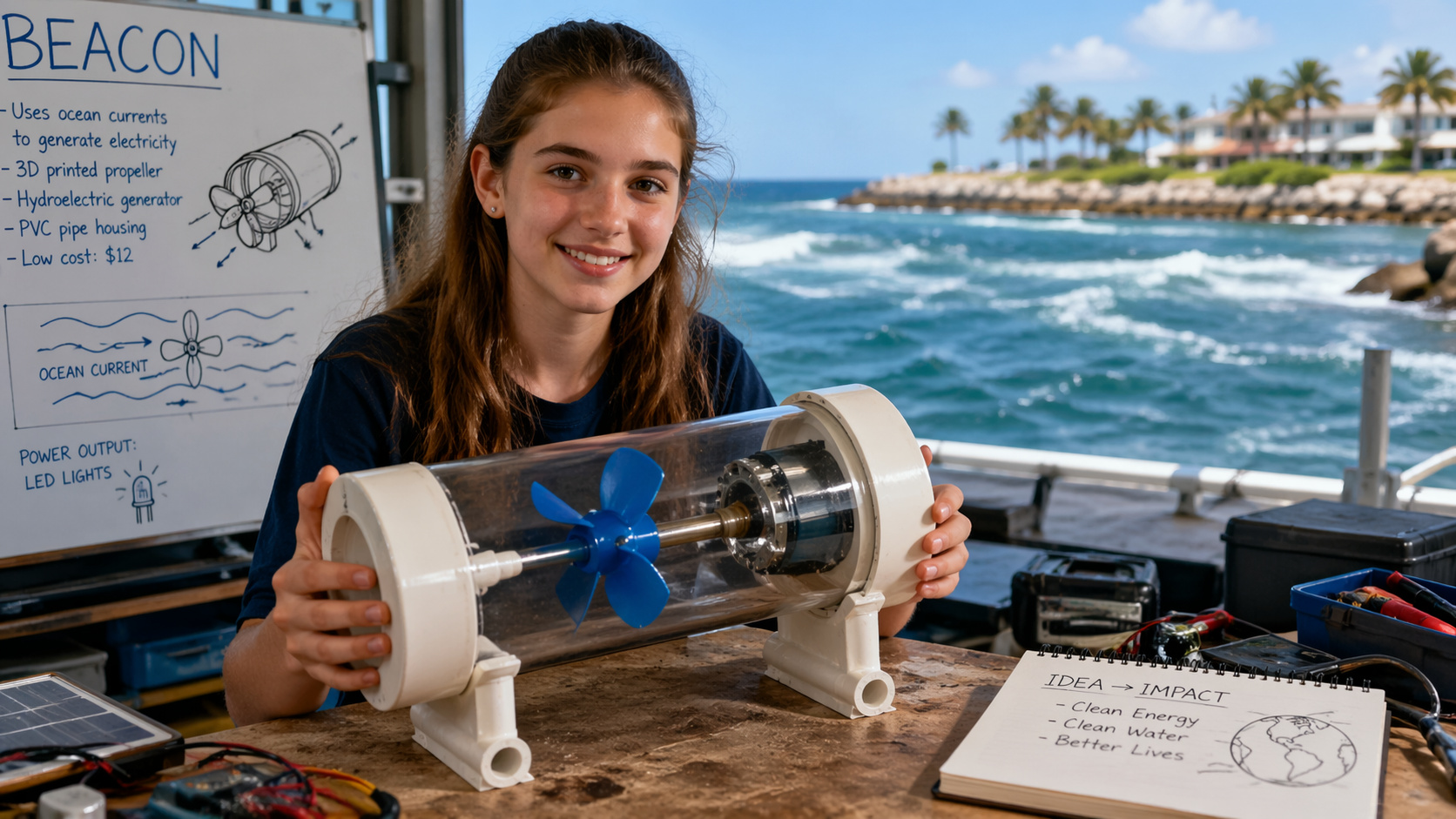


Simple, sustainable, and low-cost invention gains global attention by transforming continuous ocean movement into accessible clean energy, capable of powering homes, medical equipment, and desalination systems in remote areas
Young inventor Hannah Herbst surprised the world by developing a simple, accessible, and highly innovative solution to one of the biggest global challenges: access to electricity in isolated regions. With a budget of just US$12, she created a device capable of generating electricity from ocean currents — an abundant, continuous, and underexplored resource.
The information was disclosed by “Business Insider”, based on presentations and records from the 3M Young Scientist Challenge, highlighting how the young inventor’s idea gained international recognition and opened new possibilities for coastal communities around the world.
How the US$12 generator transforms ocean currents into continuous electricity

It all started during a boat trip in Boca Raton, Florida. While sailing with her family, Hannah noticed the strength of the ocean currents rocking the boat. From this, a simple but powerful question arose: why not transform this energy into electricity?
-
Workers renovating a playground in northern England uncover 176 World War II bombs buried underground; training artifacts still contained explosives.

-
Brazilian Architect Transforms Waste into Sustainable Homes with Solar Power and Rainwater Systems for 40 Years

-
Security Guard Becomes Doctor at Louisiana Hospital Where He Once Worked, Studied Chemistry Between Shifts

-
Woman Rescued from Luxury Complex in Brazil Worked Without Pay for 55 Years, May Be Entitled to Over $300,000




Thus was born the “Beacon,” an ingenious and low-cost device. The equipment uses a 3D-printed propeller connected to a hydroelectric generator installed inside a PVC pipe. When ocean currents move the propeller, mechanical energy is efficiently converted into electrical energy.
During tests conducted in the Intracoastal Waterway, in Boca Raton, the prototype was able to light LED lights, proving its functionality in practice. Furthermore, the major differential lies in its reliability: unlike solar or wind energy, ocean currents are always in motion, ensuring a more stable and predictable generation.
Solution can bring energy and potable water to the planet’s most vulnerable regions


The inspiration for the project came from a distant but impactful reality. Hannah’s pen pal, residing in Ethiopia, lived in a region with extremely limited access to electricity. Faced with this, the young inventor decided to create something that could truly make a difference.
And, indeed, the invention’s potential goes far beyond lighting lamps. If scaled up, the device can power desalination pumps — systems capable of transforming seawater into potable water. In this way, it not only generates energy but can also help solve another critical problem: the scarcity of clean water.
Furthermore, the generator can be used to power medical equipment, such as blood centrifuges, or to assist in coastal navigation systems. In regions where the construction of large power plants is unfeasible, compact solutions like this can represent a true revolution.
International recognition and the young scientist’s next steps

The invention’s impact was so significant that Hannah Herbst won the 3M Young Scientist Challenge in 2015, taking home a US$25,000 prize. As part of the recognition, she began working with scientist Jeffrey Emslander to refine the project and explore new applications.
However, what is most striking is her vision for the future. The young inventor planned to make the project open source, allowing anyone in the world to access the materials, data, and instructions needed to reproduce the device.
This decision reinforces the social nature of the initiative. More than an award-winning invention, the generator represents a concrete opportunity to democratize access to energy and improve the quality of life for thousands of people.
What if a simple device, costing only US$12 and using ocean currents, could bring energy and potable water to entire communities — do you believe this technology could change the future of isolated regions?


Young “Person”? She’s a Young Girl
Why wouldn’t it work in a stream?