





 Portuguese
  English
  Spanish
  3 min of reading
  2 comments


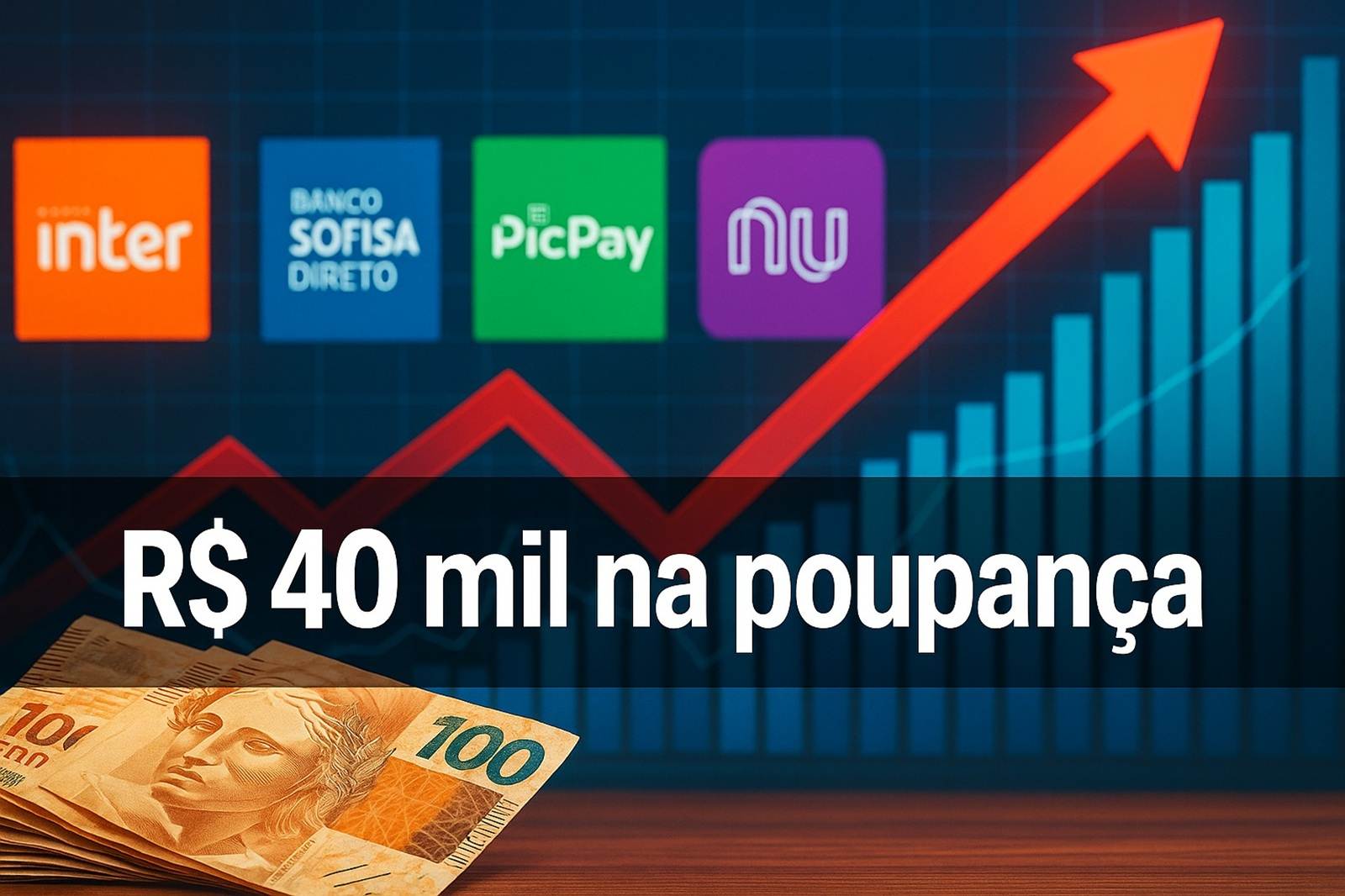


A Direct Comparison Reveals How Much Investing R$ 40 Thousand in Savings, Banco Inter, Banco Sofisa, PicPay, and Nubank Yields, Highlighting How Each Institution Provides Very Different Results in Monthly Earnings
The question of how much a monthly financial investment yields still guides millions of Brazilians looking for simple alternatives to increase their wealth.
In a scenario where digital banks are increasing competition with more attractive rates, a direct comparison between different institutions shows how the earnings can vary even when starting from the same applied amount.
Considering an investment of R$ 40,000, relevant contrasts can be observed between traditional savings accounts and accounts that pay based on the CDI.
-
The oil company Eni discovered a giant gas field at the bottom of the Indonesian sea with an estimated volume in trillions of cubic feet.

-
End of the Toyota era: beloved automaker in Brazil and owner of the Corolla, the best-selling car in history, the Japanese giant loses its position as the most valuable company in the country after a rival soars with an unusual bet: ChatGPT

-
Luciano Hang, owner of Havan, becomes a model entrepreneur in Brazil, but the harsh reality is rarely told: each new megastore requires up to R$ 100 million, takes about 5 years to break even, and can generate R$ 14 million annually per unit.
-
The INSS and the Ministry of Management set December 31, 2026, as the deadline for mandatory biometric registration, see who needs to do it.




Each modality demonstrates how small percentages make a difference in the accumulation over a month and, consequently, in the planning of those seeking consistent returns.
Differences Between Savings and CDI-Linked Products
Savings is still used by a large portion of the population because it does not tax earnings.
Nevertheless, its yield is significantly lower when compared to accounts that pay percentages of the CDI. The comparison becomes even more evident when analyzing how much the same amount of R$ 40,000 yields across different platforms.
The fixed and limited rate of the savings account results in reduced growth, while banks and digital wallets follow models more akin to the fixed income market, allowing for higher gains in the same period.
Savings Yield with R$ 40,000
With the current parameters, investing R$ 40,000 in savings would yield approximately R$ 200 per month.
This figure shows how the model suffers from lagging compared to market indices. Although the investor maintains exemption from Income Tax and daily liquidity, the final return is far from the alternatives that use the CDI as a reference.
This amount is the initial point of comparison that demonstrates how much each option yields.
Banco Inter with 100 Percent CDI Yield
In an account that yields 100 percent of the CDI, like the one offered by Banco Inter, the same R$ 40,000 would yield around R$ 468 in a month.
The leap compared to savings is direct and quite significant. The dynamics of percentages linked to the CDI allow for daily adjustments according to the basic rate of the economy.
This model also offers practical liquidity, making the return more advantageous without altering the availability of funds.
Banco Sofisa with 105 Percent CDI Yield
Among the options that seek to deliver above-average returns, Banco Sofisa offers a yield of 105 percent of the CDI.
Under these conditions, the R$ 40,000 invested would yield approximately R$ 488 in a month. The difference may seem small when analyzed in isolation, but over months it represents a real increase in wealth accumulation, reinforcing the importance of observing seemingly modest percentages.
PicPay with 110 Percent CDI Yield
Investing the same amount in a platform that pays 110 percent of the CDI, such as PicPay, would elevate the monthly yield to about R$ 512. This increase demonstrates how the percentage climb reflects in tangible gains.
The increase between ranges tends to widen the annual earning margin and can change the behavior of those closely monitoring how much each available option yields.
Nubank with 115 Percent CDI Yield
Among the evaluated options, Nubank shows the highest return. With a yield of 115 percent of the CDI, the R$ 40,000 invested would yield around R$ 532 in a month.
The difference compared to savings exceeds R$ 330 in the same period, revealing the direct impact of the platform choice.
The superior performance draws attention for combining liquidity with a competitive rate, reinforcing the contrast between traditional institutions and digital tools.
Monitoring how much each alternative yields is essential for those seeking consistent returns.
The comparison shows that, with the same invested amount, choosing between savings and accounts that follow CDI percentages significantly alters the monthly result.
While each institution has its internal policies, the difference in yield is clear. This ongoing evaluation allows for more strategic decisions aligned with short- and medium-term goals.






O ideal seria informar o rendimento líquido dessas aplicações.
O Master aplicava a 140% do CDI, quem vai pagar FGC até R$ 250.000,00.
Apesar de muitos acreditarem NÃO há milagre.