Portuguese
  Spanish


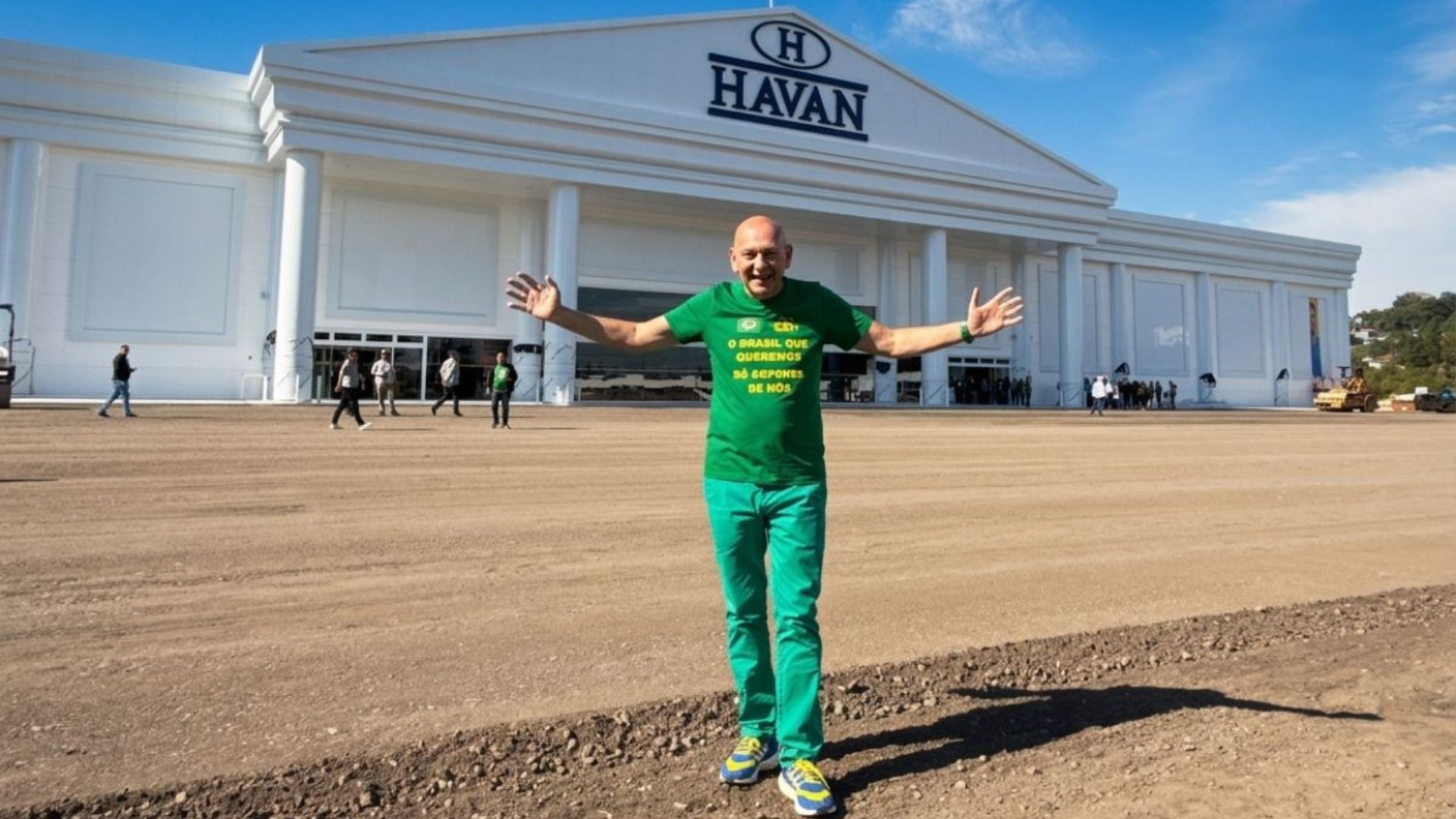

Havan’s expansion involves billion-dollar figures, long-term returns, and an operational account that helps explain why each megastore requires financial planning before becoming a concrete result for the network led by Luciano Hang.
Havan’s expansion requires high disbursements before a new megastore begins to generate significant returns, according to estimates attributed to businessman and investor Wisley Anderson Vieira and management specialist Roger Toshi.
According to these analyses, a network unit can cost between R$ 50 million and R$ 100 million, with an average close to R$ 70 million, considering the structure needed to put the store into operation.
The calculation presented by the specialists includes expenses with land or real estate implementation, construction, physical structure, equipment, initial stock, hiring, training, and operational preparation of the unit before opening to the public.
-
Brazilian City Makes Remarkable Leap, Becomes 4th Wealthiest in the Country with GDP of R$ 134.1 Billion

-
Controversial 6-day Workweek Elimination in Brazil Faces Economic Criticism Over Productivity Claims

-
Itaú to Refund Customers After 14 Years of Unauthorized Credit Card Charges; Agreement Includes No Interest or Adjustments, Deadline by 2028, with Potential Impact of Up to $6.5 Billion

-
Brazilian Company Grows from Bartering Soap for Food to Producing 30 Million Units Monthly, Challenges Global Giants with $100 Million Revenue and Expands into Premium Cosmetics



Although the brand has expanded its national presence in recent years, each new opening depends on high capital and a maturation period until the unit starts contributing to the company’s results.
Havan, led by Luciano Hang, had 189 stores in February 2026, according to an interview published by Forbes, and projected to reach 200 units by December of the same year.
Data from the official store portal indicated units in 24 states and the Federal District, with a more concentrated presence in Santa Catarina, Paraná, and São Paulo.
How much it costs to open a Havan megastore
The estimated cost of up to R$ 100 million per unit shows, according to market analysts, the financial weight of the expansion strategy adopted by the network in different regions of the country.
In 2026, the company announced an investment of up to R$ 1.2 billion to open 15 stores, indicating an average disbursement close to R$ 80 million per unit, within the range cited in the projections.
This average, however, does not mean that all units have the same cost, as the final value depends on the characteristics of each city, the land, the project, and local requirements.
The cost is also influenced by the size of the built area, the logistics structure, the standard of the work, the volume of goods initially put on sale, and the commercial conditions of implementation.
In addition to construction, the operation needs to absorb costs of personnel, technology, security, energy, maintenance, and working capital, elements that make up the routine of a large store.
Due to the megastore format adopted by Havan, with large sales areas and a diversified assortment, the need for capital tends to be greater than in smaller scale retail operations.
Operational result per Havan store
Estimates cited by analysts indicate that each Havan store can generate, on average, about R$ 14 million per year in operational result, based on consolidated projections.
This number has not been disclosed by the company as an individual store data, but appears in analyses that relate public information, operational indicators, and projections on the average performance of the units.
The indicator used in this type of calculation is EBIT, an acronym for earnings before interest and taxes, a common metric to evaluate a company’s operational performance.
In practice, EBIT measures the result of the main business activity, excluding financial expenses, tax effects, or other variations that might alter the final net profit.
The distinction between EBIT and net profit is relevant because a megastore can register positive operational performance and still have its final result impacted by interest, taxes, or non-recurring costs.
For this reason, the estimated value of R$ 14 million serves as a reference for operational capacity, and not as a public demonstration of the free cash generated by each unit.
Havan’s payback can reach five years
When comparing an average investment of R$ 70 million with an estimated annual operational result of R$ 14 million, the simple return period is close to five years.
This calculation, called payback, indicates how long the capital invested in a project would be recovered from the results generated by the operation itself.
The metric, however, is simplified and does not replace more comprehensive evaluations of cash flow, cost of capital, inflation, depreciation, taxes, financial expenses, and execution risks.
Even so, according to analysts, payback helps explain why the opening of stores can be treated by the company as a reinvestment alternative within the business itself.
In the cited evaluation, the return on capital employed, known as ROCE, would be around 20%, when comparing the operational result to the invested capital.
This indicator measures the efficiency of the money applied in the operation and allows observing how much return the company can generate in relation to the resources employed in physical expansion.
Selic enters the comparison with the return of the stores
The estimated ROCE of 20% was compared, in the cited analyses, to the Brazilian basic interest rate, used as a reference for financial investments and the cost of capital in the country.
The Central Bank reduced the Selic to 14.50% per year at the Copom meeting in April 2026, after a cut of 0.25 percentage points.
By directly comparing the indicators, the physical expansion would have an operational return superior to the gross yield associated with the Selic, according to the reading presented by analysts.
The interpretation, however, requires a difference in context, as the return of a store involves operational risk, maturation period, construction execution, local demand, and permanent costs.
Financial applications linked to the basic interest rate have a distinct dynamic, while a megastore depends on sales, inventory management, large teams, and adaptation to the market of each city.
Therefore, the comparison can serve as a reference for analysis, but does not represent an automatic conclusion about financial advantage between investment alternatives of different natures.
Havan’s Expansion Depends on Cash and Execution
Banco Safra evaluated, in April 2026, that Havan maintained a low-risk credit profile, comfortable net cash, and the ability to finance expansion without significantly increasing leverage.
In the same analysis, execution, margins, and family consumption were pointed out as monitoring points for the retailer, especially in an environment of still high interest rates.
According to the evaluation, Havan’s consolidated net revenue totaled R$ 13.7 billion in 2025, while EBITDA reached R$ 3 billion in the same period.
The report also recorded a drop in the EBITDA margin to 21.9%, a movement related to changes in the sales mix and the increase in commercial expenses.
In 2024, the group had recorded a net profit of R$ 2.69 billion and revenue of R$ 15.99 billion, according to the balance sheet released by the company and reported by Poder360.
In that fiscal year, the network went from 172 to 177 physical stores, maintaining the gradual expansion of the unit base before the new investment cycle announced for 2026.
Havan Does Not Disclose Individual Return per Megastore
Despite projections about cost, payback, and operational result, Havan does not publicly disclose a complete breakdown of financial return per unit.
There is also no standardized public detailing of operational costs store by store, which limits independent verification of the calculations attributed to analysts.
The available information allows for monitoring the company’s consolidated performance, expansion plans, and some credit metrics disclosed by financial institutions and the company itself.
The exact profitability of each megastore, however, depends on internal data, such as local sales, occupancy expenses, payroll, inventory, losses, delinquency, and market maturation.
Luciano Hang told Forbes that the financial restructuring allowed for an acceleration in store openings and said the goal was to reach 200 units by December 2026.
In the same interview, the entrepreneur stated that about 95% of Havan’s sales still came from physical stores, while e-commerce accounted for 5%.
Havan’s expansion model combines national scale, regional presence, and high initial investment, according to publicly available data and projections presented by analysts.
The five-year return estimate helps contextualize the store opening strategy, but the numbers should be read as market projections, not as official individual profitability data released by the company.