





 Portuguese
  English
  Spanish
  6 min of reading
  1 comment


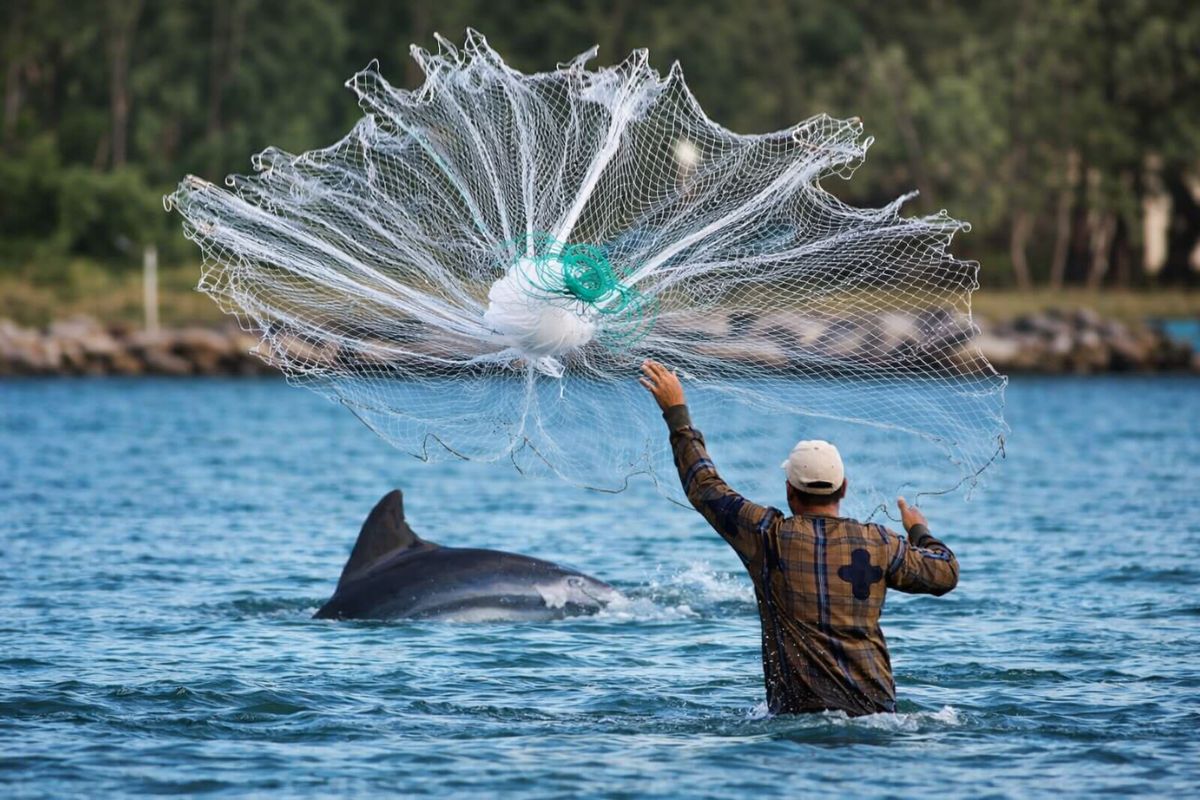


In Laguna, Dolphins Command Fishing in a Rare Fishing with Dolphins, Where Dolphins from Laguna Guide the Fishing of Mullet and Sustain the Threatened Artisanal Fishing
In a murky lagoon on the coast of Santa Catarina, dolphins command the fishing in a way that seems like a scene from a documentary: they push the school of mullets towards the beach, dive deeply, arch their backs, and in this gesture, signal to the fishermen that it’s time to cast the net. From there, the clock is ticking. The fishermen have about seven seconds to react, make the perfect circular throw, and turn the dolphin’s movement into fish in the canoe.
This is not a fisherman’s legend. It is a cooperation studied in detail by researchers, recorded in videos, sonars, and hydrophones. There, dolphins command the fishing and humans obey, in a partnership that has lasted for about 140 years. Both sides benefit: the fishermen increase their catches and family income, while the dolphins live longer, fish more efficiently, and stay away from the trawl nets that kill everything in their path. But the decline in the supply of mullet and illegal fishing are pushing this relationship to the limit.
Where Dolphins Command Fishing and Fishermen Follow the Signal
In the lagoon of Laguna, in southern Brazil, dolphins command the fishing in a choreography that has been repeating for generations.
-
Modern cars collect data about everywhere you go, who is in the vehicle, whether you wear a seatbelt, your facial expressions, and even your weight, and Mozilla analyzed 25 brands and classified automobiles as the worst product category in privacy they have ever evaluated, with none meeting minimum standards.

-
Ship with 1.7 tons of humanitarian aid from Mexico and Uruguay arrived in Havana this Monday as Cuba faces blackouts of up to 22 hours a day following the cut in energy supply by the United States, and tensions between the two countries increase with the possible indictment of Raúl Castro.
-
The United States, China, and the Emirates are funding a race for solar satellites capable of capturing light 24 hours a day in space and sending energy back to Earth via microwave beams.

-
Scientists discover “chemical fingerprint” that could help reveal extraterrestrial life without finding microbes or fossils, just by analyzing hidden patterns in amino acids and fatty acids from Mars, icy moons, and meteorites.


The sound of echolocation clicks blends with the noise of the waves and the movement of fishermen with their circular nets.
The wild bottlenose dolphins work hard to drive schools of mullet close to the shore, where the cast net fishermen remain alert, almost motionless, in the water.
The water is extremely murky. The fisherman sees no fish. He sees the dolphins.
That’s where cooperation comes in. When the dolphins command the fishing, they approach the fishermen, make a sudden and deep dive, arch their backs, or slap their heads and tails on the water. These signals have become a language. Those who fish there know: this is the cue to cast the net.
How Dolphins Command Fishing in Seven Seconds

Timing is everything. Research shows that, when dolphins command the fishing, the fisherman has a window of only seven seconds after the signal to cast the round net. If he misses the timing or position, the chance of success decreases.
The dolphins use echolocation to locate the mullet and compact the school into a dense block, pushing the fish to the exact area where the net can reach.
The nets play a crucial role: they break the structure of the school, leaving mullets isolated or disoriented.
After the net is cast, the second phase begins. The dolphins start emitting loud echolocation clicks again.
Researchers describe these sounds as resembling a door creaking underwater. In some cases, those in the water can even feel the clicks in their legs.
It is the moment when dolphins command the fishing and go after the fish that escaped or even take some directly from the net.
What Dolphins Gain from Commanding Fishing

This is not charity. It’s strategy. Studies show that in situations where dolphins command the fishing and the fishermen respond correctly to the signal, both sides have clear gains.
For the fishermen, the equation is straightforward: when dolphins are present and give the signal, the likelihood of capture and the quantity of mullets in the net skyrocket compared to throws made without this help.
In many cases, most of the fish that enter the nets throughout the season come precisely from these synchronized moments.
For the dolphins, the benefit shows up in survival. Individuals that cooperate with fishermen have about 13 percent higher chances of reaching old age than those who do not participate in this type of fishing.
They avoid areas of the ocean dominated by long illegal nets, where the risk of getting trapped and dying is much greater.
Another important point is that cooperative dolphins rarely leave the lagoon, even though they belong to a species that typically migrates over distances of up to 320 kilometers.
About 50 to 60 individuals maintain this behavior and, it seems, know that this environment offers a rare combination of food and safety.
When Dolphins Command Fishing, Communication Becomes Culture

The most impressive thing is the sophistication of the communication. Dolphins command the fishing using specific signals, such as the sudden dive with an arched back or the strong tail slap on the surface.
The local fishermen have learned to recognize these patterns over time, transforming animal behavior into work instruction.
This form of cooperation between humans and cetaceans is uncommon. Historically, there have been other cases in the world, such as dolphins cooperating with Indigenous peoples in Australia.
But many of these practices have disappeared with colonization, cultural change, and pressure from other forms of fishing.
In Laguna, what is seen is a rare example of shared culture, in which dolphins command the fishing and fishermen respond with precision.
This fine coordination, called foraging synchrony, is what ensures that the encounter is advantageous for both sides. Without synchrony, wrong throws wear out the fisherman and do not yield enough fish to keep the animals’ interest.
A 140-Year Tradition Under Pressure
The cooperation between fishermen and dolphins in Laguna has about 140 years of history and is part of the local identity. This artisanal fishing helped ensure food, income, and community belonging over generations.
Yet, despite all this cultural importance, the practice is at risk. The schools of mullet are dwindling, in part due to illegal fishing and pressure from other fishing modalities that operate outside the lagoon.
This reduces the reward for those who depend on synchrony with the dolphins and alters the balance of the relationship.
Moreover, many people are abandoning fishing as a primary activity. Some are taking up fishing more as a hobby, without the same precision in the moment of casting the net that veterans have.
When fishermen miss the timing or the location of the throw, dolphins command the fishing, but do not receive the expected return in the form of leftover fish for them. With that, they may simply lose interest in cooperating.
Illegal Fishing, Loss of Experience, and the Risk of Dolphins Giving Up

Researchers show that the system is under pressure from three main fronts: less mullet available, fewer experienced fishermen, and a higher risk of incidental capture in other fisheries.
The so-called cooperative dolphins, which stay closer to the interaction point with the fishermen, still manage to avoid much of the trawl nets and illegal gear that spread throughout the region.
On the other hand, non-cooperative dolphins, which roam larger areas, are more exposed and are more likely to die in nets that catch everything in their path.
If the supply of mullet continues to decline and dolphins command the fishing without seeing results, the trend is for both animals and fishermen to invest less in this practice.
Numerical models built on field data indicate that, in a scenario of sharp deterioration, this cooperation could move towards extinction over the next decades.
What Can Save the Place Where Dolphins Command Fishing
The good news is that there are still ways to prevent this outcome. Scientists suggest two main fronts of action.
The first is to value and incentivize the fishermen who maintain traditional practices, financially supporting those who continue to train, teach, and practice synchronized fishing with dolphins.
The second is to strengthen enforcement against illegal fishing gear and nets that result in high rates of incidental capture, reducing risk for animals that roam outside the interaction area.
Together, these measures can maintain fishermen’s interest in cooperation and preserve the safe refuge that the lagoon represents for dolphins.
Protecting this system is not just about saving a local curiosity. It’s about defending one of the last living examples of true cooperation between humans and wild animals, where dolphins command fishing, fishermen read the signal in seven seconds, and everyone comes out of the water with better chances of continuing to exist.
And you, if you had the chance to see up close a fishing where dolphins command the fishing and humans obey, what would catch your attention the most: the intelligence of the animals, the skill of the fishermen, or the harmony between the two?





La armonía entre ambos