






 Portuguese
  Spanish


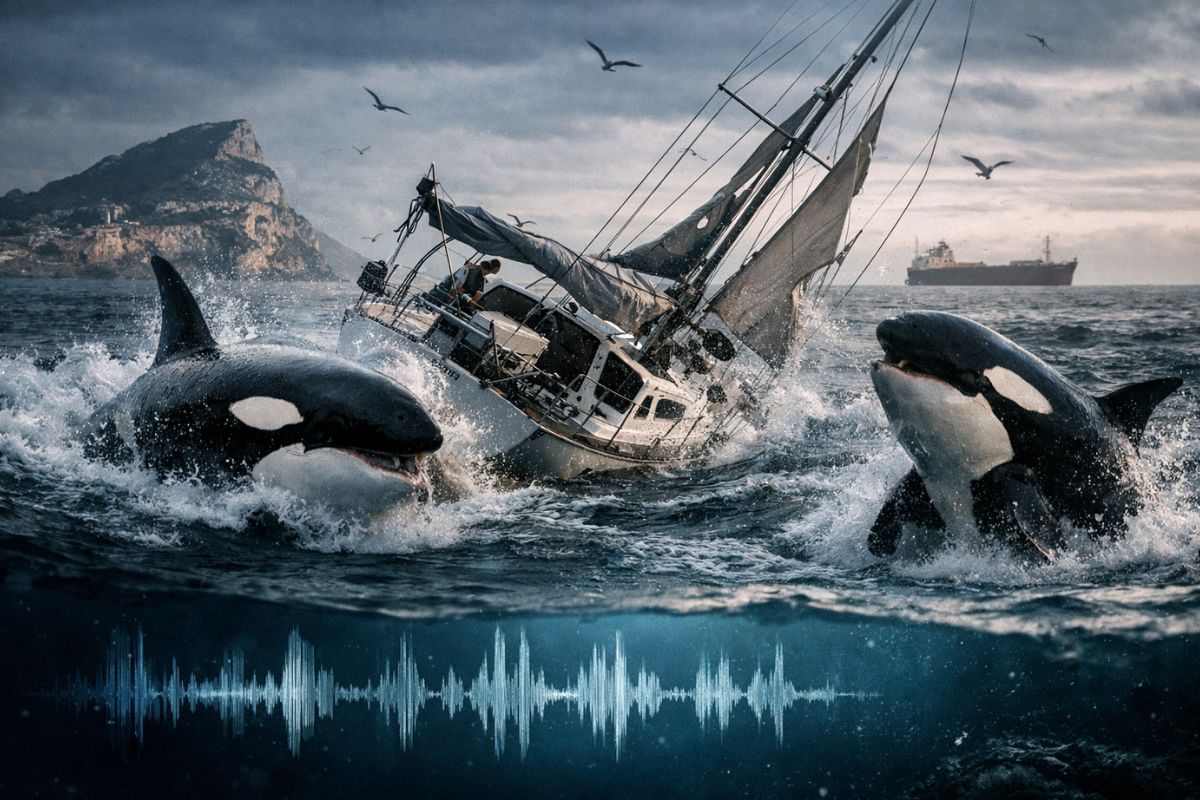


Recordings Made in Spanish Waters Captured up to 40 Orcas and a Set of Four New Calls Between Gladis White and Her Followers. The Group, Linked to Collisions with Vessels in the Last Four Years, Operates in the Strait of Gibraltar and Along the Iberian Atlantic Coast, Until Now Challenging 30 Years of Study.
The orcas that have been attacking vessels off the coast of Spain are now at the center of a finding that changes the tone of the investigation: a set of sounds that had never been recorded before for this group. The recordings were made while researchers navigated through Spanish waters and managed to capture the communication between the leader known as Gladis White and her companions.
What was heard there does not seem to be just a variation of “accent.” The sequence points to a distinct dialect, with four different sounds, associated with a group operating in the Strait of Gibraltar and also on the Atlantic coast of the Iberian Peninsula, with episodes on both the Spanish and Portuguese sides.
What Was Recorded and Why It Surprises
The recordings captured a unique set of sounds exchanged between Gladis White and her followers, as if it were a repertoire reserved for the group.
-
Alaska’s 1,287 km Pipeline Built on 78,000 Metal Supports to Prevent Thawing, Survives Earthquakes and Remote Forests, Highlighting the Challenge of Hot Oil in a Harsh Environment

-
Brazilian Student Innovates Sustainable Ceramic Tableware Using Rice Husks and Recycled Glass, Achieving Up to 60% Waste Composition and Comparable Performance to Conventional Materials
-
AI-generated fake doctors deceive elderly in Brazil, health videos go viral with nearly 300,000 views, turning disease fear into a global audience and money machine.

-
Innovative Thermal Battery in Brazil Can Store Renewable Energy for Weeks, Offering Cheap Electricity and Winter Heating




For those who have been observing this behavior for decades, the shock came not only from the novelty but from the contrast with the previous idea that they were extremely discreet.
The assessment is that the calls captured are completely different from any others previously recorded involving this species, precisely in a population that had already been monitored for 30 years.
In practice, the discovery breaks the comfort of thinking that “it is already known” how these orcas communicate in that region.
Gladis White and the “Students” at the Center of the Actions

Within the group, Gladis White appears as a reference, described as the fierce leader who initiates communication with the so-called “gladiator students.”
This core has been associated with the attacks on vessels and the pattern of persistent approach at sea, particularly in the maritime corridor of the Strait of Gibraltar.
The records indicate that it is not a case of one or two isolated encounters: up to 40 different orcas were recorded in the same regional context, with various suspects involved in recent occurrences, reinforcing the idea of a persistent and socially shared phenomenon.
Attacks, Collisions, and the Map Where Everything Happens

The described scenario is broad and repetitive: Strait of Gibraltar as the central stage, Spanish coast as the showcase of the problem, and Portuguese coast entering the same route of incidents.
By the presented cut, at least 15 of the recorded orcas are suspected of participating in some collision episode with a vessel in the last four years.

This detail matters because it places the behavior on a long enough timeline to become a pattern, but recent enough to still be treated as a “wave” that needs explanation, especially when talking about coordinated attacks and impacts on maritime safety.
What the “New Language” Suggests About This Group
The most straightforward interpretation is that the orcas might be using a specific repertoire to coordinate actions, maintain group cohesion, and transmit quick signals during interactions at sea.
The presence of four distinct sounds, repeated within the same social group, reinforces the hypothesis of something more structured than mere environmental noise.
The comparison made by the president of the Cetacean Conservation, Information, and Research Center (Circe) in Spain, Renaud de Stephanis, was impactful: as if, suddenly, a new language emerged in a place thought to already know the existing variations.
It is a way of translating, without exaggeration, the size of the scientific astonishment at what was captured.
Why This Changes the Way We Look at Conservation and Behavior

The finding does not remain only in the realm of curiosity.
It prompts a larger discussion about cultural conservation, because a particular communication may be part of what keeps the group united and functional in the environment in which it lives.
In other words: protecting is not just counting individuals, but understanding what sustains the social life of the orcas.
At the same time, the novelty increases the pressure to explain why this group attacks so frequently, as the attacks have motivated years of observation, attempts at interpretation, and the search for patterns.
When communication changes, the hypothesis of “why” also changes, because a possible internal coordination channel exists that had not been considered before.
Do you think these orcas are creating a dialect to teach attacks and coordinate actions, or could the new sounds have a completely different function?


