






 Portuguese
  Spanish


In an analysis published on July 1, 2026, by the Market Monitor, the Alaska pipeline returned to the spotlight for showing how permafrost, hot oil, and 78,000 metal supports sustain a 1,287 km route between Prudhoe Bay and Valdez, in the United States.
The project involves a challenge that goes beyond oil transportation: preventing the heat inside the pipe from compromising the frozen ground. With elevated sections, earthquake protection, and adaptation to the terrain, the project shows how engineering needed to treat the environment as a central part of the risk.
The problem was not just crossing Alaska
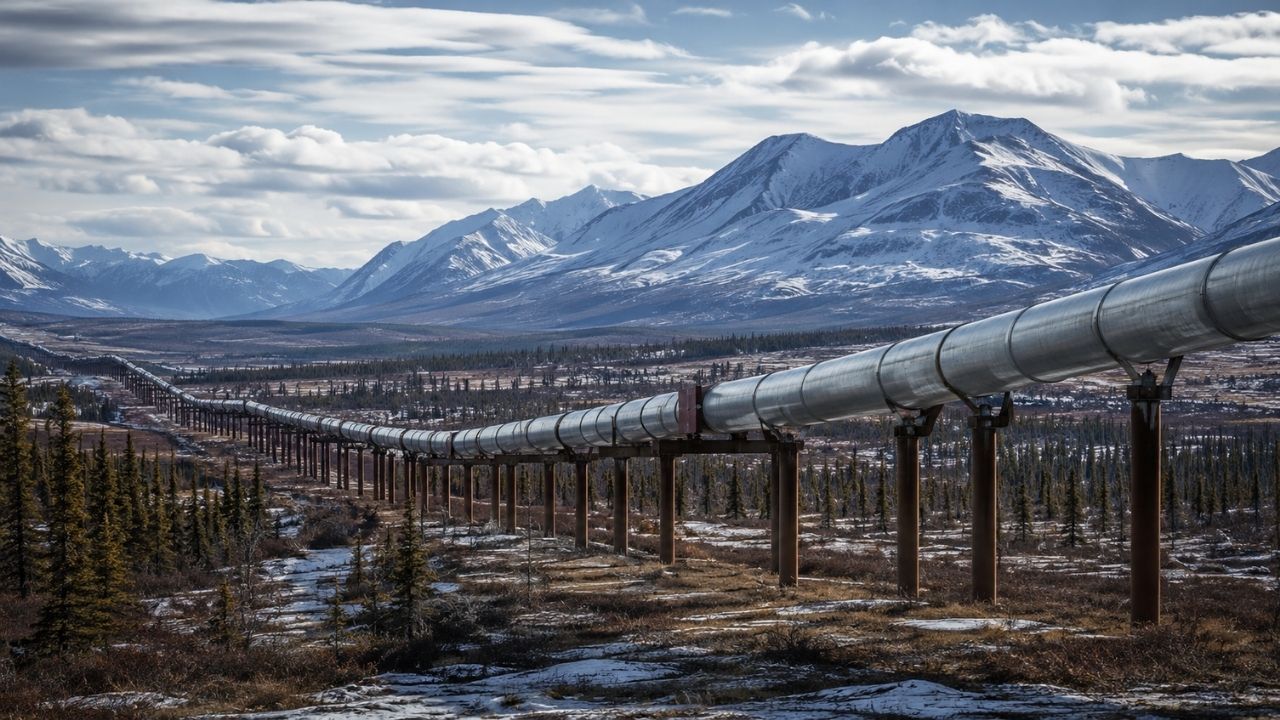
At first glance, a 1,287 km pipeline already impresses by the distance. In the case of Alaska, however, the size of the route was just part of the problem. The path needed to cross remote areas, forests, mountains, rivers, and seismic faults, without treating all these terrains as if they had the same behavior.
-
Brazilian Student Innovates Sustainable Ceramic Tableware Using Rice Husks and Recycled Glass, Achieving Up to 60% Waste Composition and Comparable Performance to Conventional Materials

-
AI-generated fake doctors deceive elderly in Brazil, health videos go viral with nearly 300,000 views, turning disease fear into a global audience and money machine.

-
Innovative Thermal Battery in Brazil Can Store Renewable Energy for Weeks, Offering Cheap Electricity and Winter Heating

-
High-End Imported Vacuum Targets Pet Hair, Deep Cleaning, and Odors, as Shark Model Gains Popularity in Urban Brazilian Homes with Carpets and Pets




The most delicate point was in the frozen ground. The oil transported by the pipeline did not experience the cold like the external environment. It remained heated inside the tubing, and this heat could be transferred to the ground. If the permafrost softened, the structure could lose stability precisely where it needed firm support.
Permafrost forced the project to rise above ground
In many sections, burying the pipeline would be a risky solution. The heat from the oil could alter soil conditions and cause settlements, that is, sinking and deformations capable of compromising the alignment of the structure. Therefore, an important part of the line was elevated.
The strategy allowed cold air to circulate underneath the tube, helping to reduce the thermal impact on the ground. The project made it clear that, in permafrost regions, the challenge is not just to support weight, but to prevent the structure’s own operation from destroying the base on which it rests.
The 78,000 metallic supports became a central piece of safety
The 78,000 metallic supports do not appear just as a grand number. They help explain why the pipeline needed to be designed differently from a common pipeline. These supports keep the tube away from the ground and distribute the load in areas where the soil requires thermal and structural care.
Instead of relying on a single solution, the project combined elevation, natural ventilation, and adaptation to the terrain. In sensitive areas, thermal elements also help transfer heat from the ground to the air, preserving stability. The logic was to prevent the hot oil from turning the frozen ground into the weak point of the project.
Hot oil changed the construction logic
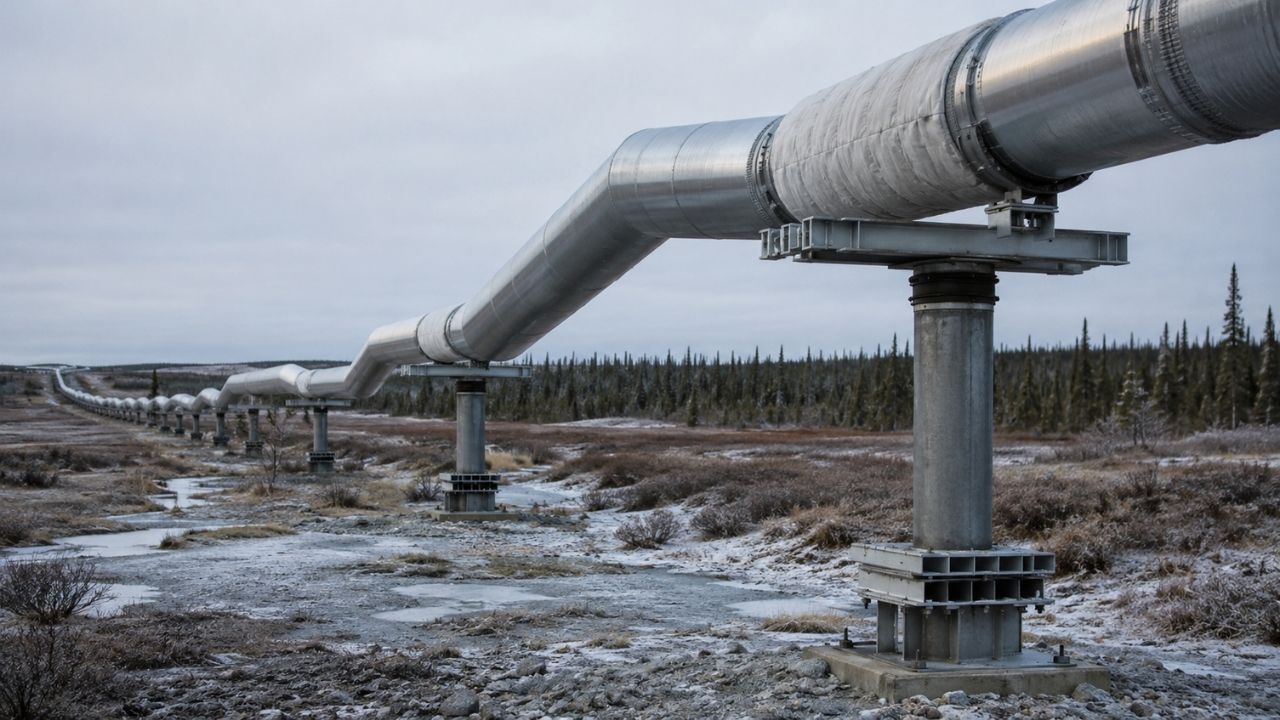
The pipeline needed to transport crude oil through an extremely cold region. This contrast created a counterintuitive engineering problem: the danger came not only from the external ice but also from the internal heat. The pipeline had to operate without excessively heating the surrounding soil.
Therefore, the Trans-Alaska project can be understood as a transportation work and, at the same time, as a thermal solution. It was not enough to carry oil from one point to another; it was necessary to control how the heat would behave along a 1,287 km route.
The pipeline does not follow a perfect straight line for a reason
Another important detail is that the pipeline was not designed as a rigidly straight line. The steel changes size according to the temperature. When the pipeline is empty, it can face intense cold; when it is in operation, it receives heated oil. This variation requires space for expansion and contraction.
For this reason, the zigzag path and calculated curves help absorb movements. In extreme engineering, allowing a structure to move in a controlled manner can be safer than trying to prevent any displacement. This logic also becomes essential in areas near seismic faults.
Earthquakes demanded a structure capable of yielding without breaking
Alaska did not impose only cold on the project. The pipeline route also crosses areas associated with geological faults, which forced engineers to consider ground displacements. At critical points, the pipeline can slide on special supports, accommodating movement without immediately breaking.
The seismic protection was put to the test in the 2002 earthquake at the Denali fault. According to the technical report cited by the source, the pipeline moved within the expected margin and no leak was reported. This result reinforces the importance of designing the structure to react to the environment, not just resist it rigidly.
Valves, monitoring, and clearances reduce operational risk
In addition to supports and curves, the pipeline has an operational control logic. Block valves allow isolating sections in case of failure, while monitoring pressure, flow, and temperature helps identify relevant changes during operation.
These measures do not eliminate all risks, but they reduce the chance of a localized problem turning into a major failure. The safety of the project depends on a combination of physical structure, adaptation to the terrain, and constant monitoring of operating conditions.
The route crosses mountains, rivers, and isolated forests
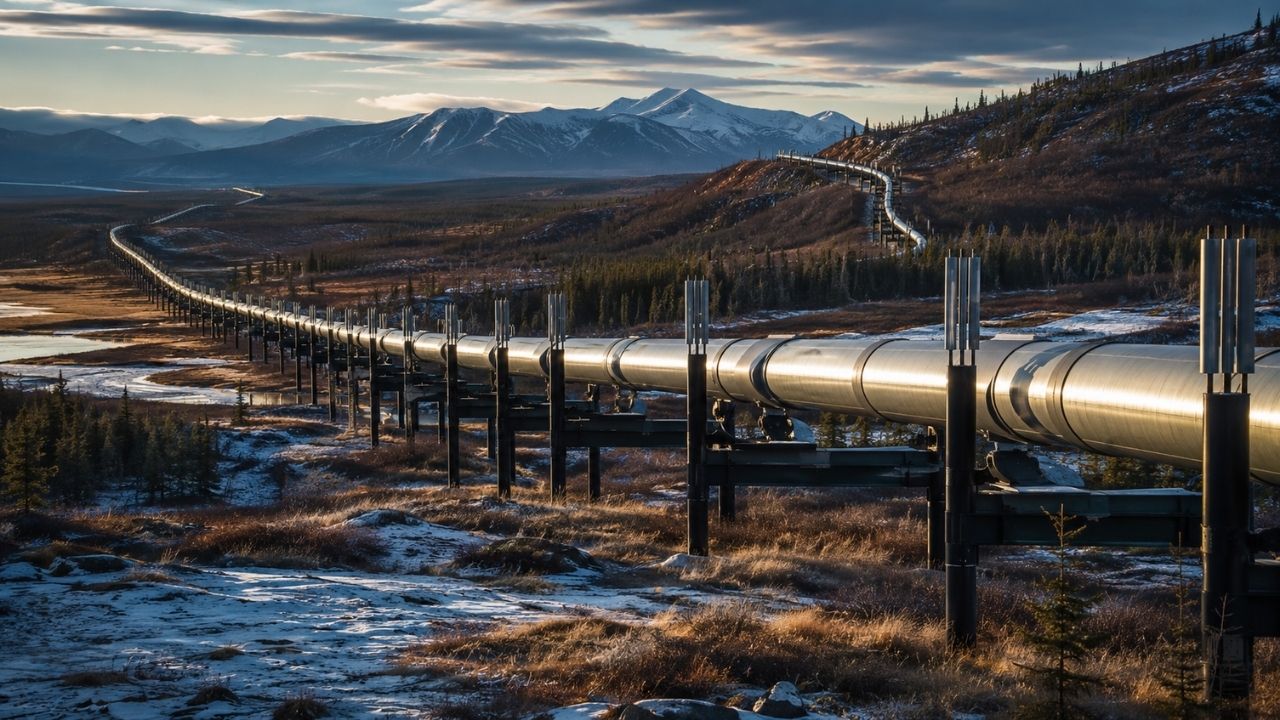
The scale of the project also appears in the type of landscape crossed. The pipeline traverses mountain ranges, rivers, forests, and hard-to-reach regions. In such an area, each section requires specific terrain reading, because the solution used in frozen soil may not be the same applied near rivers or faults.
This adaptation makes the project more complex. It’s not just about installing a long tube on the map. The route needed to be thought of as a sequence of different challenges, where cold, terrain, isolation, and seismic risk changed the way of construction.
Why this pipeline still draws attention today
The Alaska pipeline continues to draw attention because it demonstrates a central rule of engineering in extreme environments: brute force doesn’t solve everything. Instead of simply imposing a structure on the territory, the project had to consider how the ground freezes, how the steel moves, and how the Earth can shift the pipeline.
The image of a pipe crossing Alaska may seem simple from afar. Up close, it reveals a system calculated to cope with heat, cold, pressure, and movement. The greatest threat was not just the distance, but the sum of small failures that could arise if the environment was underestimated.
The warning for projects in extreme territories
The story of the pipeline shows that infrastructure works in sensitive areas require above-average planning. When there is permafrost, earthquakes, isolation, and thermal variation, any simplification can be costly. The environment ceases to be a backdrop and becomes an active part of the project.
This case also helps to understand why large projects need to respect the territory where they are implemented. In Alaska, the hot oil could alter the frozen ground; earthquakes could shift the line; the cold could affect materials and operation. The engineering response was to create a structure that did not try to conquer nature all at once, but to negotiate with it at each section.
A work that continues to provoke debate
The Trans-Alaska pipeline combines scale, risk, and technical solutions that still spark discussion. For some readers, it represents an example of engineering adapted to extreme conditions. For others, it also raises reflections on the limits of transporting oil through fragile territories that are difficult to recover in case of error.
The fact is that the work shows how infrastructure, energy, and environment intersect in a complex way. And you, do you think projects of this magnitude demonstrate the engineering capacity to adapt to nature or reveal risks too great for such sensitive regions? Leave your opinion in the comments.


