





 Portuguese
  English
  Spanish
  3 min of reading
  0 comments


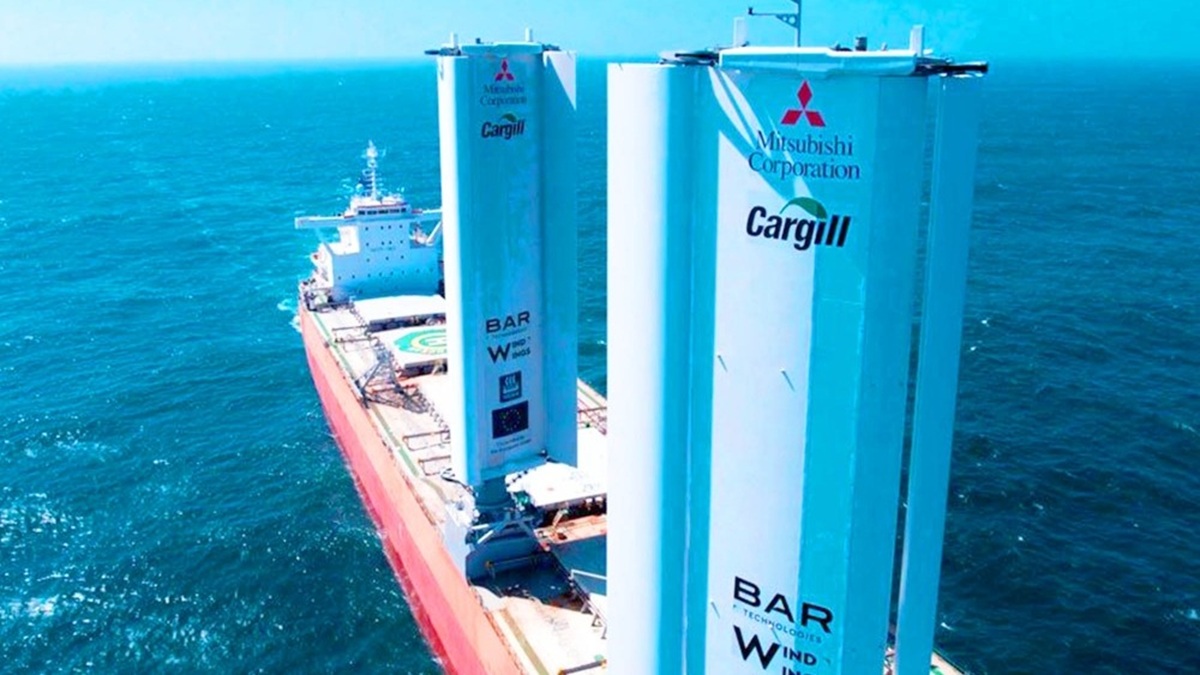
With Two Rigid Sails of 37.5 Meters and Automated Technology, the Cargo Ship Pyxis Ocean Arrives in Spain with 64 Thousand Tons and Marks a Revolution in Sustainable Maritime Transport.
Transporting 64,000 tons of soybean meal, the cargo ship Pyxis Ocean, from Cargill Ocean Transportation, recently docked at the Port of Tarragona in Spain, coming directly from Brazil.
The vessel gained international attention for being the first cargo ship in the world equipped with wind-assisted propulsion technology, a milestone in the search for cleaner solutions in global maritime transport.
The ship incorporates two enormous rigid structures known as WindWings, which function as vertical sails of 37.5 meters in height, 20 meters in width, and with a total area of about 750 m².
-
The Panama Canal stores water in Gatún and Alhajuela lakes to maintain 38 daily crossings and prevent a drought linked to El Niño from once again stalling ships, raising freight rates, and putting pressure on global supply chains as occurred in 2023 and 2024.

-
While the US Navy still relied for decades on the subsonic Harpoon and Tomahawk missiles for naval combat, the US Air Force reactivated the AGM-183A ARRW program on May 12, 2026, in an anti-ship version capable of making a Nimitz-class aircraft carrier disappear in minutes.

-
While commercial hydrogen fuel cells do not exceed 80 degrees Celsius due to the requirement of liquid water in the membranes, researchers at Monash University on May 18 made an ultrathin graphene and boron nitride-based membrane operate at 250 degrees Celsius without needing water.
-
While Boeing and Lockheed invest billions in more efficient turbofan engines, Texas startup CycloKinetics unveils a synthetic liquid fuel that increases the range of aircraft, missiles, and rockets by 32 percent just by swapping the tank without changing the turbine.




The goal is simple yet revolutionary: to harness the wind’s power to reduce fuel consumption and pollutant emissions, without compromising sailing speed.
Energy Efficiency and Environmental Gains
The sails operate entirely automatically and integrate with the ship’s operating system. From the bridge, sensors measure the speed and direction of the wind, while a touchscreen and a signaling system control when to raise or lower them.
This automation allows the Pyxis Ocean to maintain speeds similar to those of a traditional cargo ship, but with much lower demand on the main engine.
The result is considerable savings: fuel consumption reduction can reach up to 14% under average conditions.
In ideal scenarios, the ship can save more than 11 tons of fuel oil per day, which represents about 41 tons of CO₂ less released into the atmosphere. This amount is equivalent to removing approximately 480 standard cars from the streets daily.
From Prototype to Commercial Reality
The journey of the Pyxis Ocean began in August 2023, after six months of testing across the Indian, Pacific, and Atlantic Oceans, including passages through the challenging Cape Horn and the Cape of Good Hope. Since March 2024, the vessel has been operating on commercial routes connecting Asia, America, and Europe, establishing itself as a functional experiment and not just a technological prototype.
The stop at the Spanish port is strategically important. In addition to the symbolism of receiving the world’s first cargo ship with wind propulsion sails, Tarragona aims to establish itself as a sustainable logistics hub on the international stage, aligning with the decarbonization goals of the maritime sector.
A Sector in Transformation
The Pyxis Ocean represents a milestone in the convergence of technological innovation and sustainability. According to the International Windship Association, around 50 vessels worldwide already utilize some form of wind-assisted propulsion, signaling that this solution has moved from curiosity to operational reality.
Moreover, this evolution shows that decarbonization transcends land-based modes. It’s not just cars, buses, and trucks that seek to reduce emissions — ships, trains, and other means of transport are also in the race for cleaner solutions.
Challenges and Perspectives
The relevance of the Pyxis Ocean aligns with the plan outlined by the International Maritime Organization (IMO), which aims for a minimum 20% reduction in maritime transport emissions by 2030, 70% by 2040, and climate neutrality by 2050. Each ton of unburned fossil fuel represents financial savings and significant environmental benefits.
However, challenges remain significant. The technology needs to prove its effectiveness on larger fleets, with ships of different sizes, routes, wind conditions, and logistical demands. The high initial investment and the dependence on favorable winds are obstacles to overcome, along with the need to integrate hybrid or fully electric systems in the future.
A Sample of the Future of Maritime Transport
The arrival of the Pyxis Ocean in Spain symbolizes more than just a simple port operation: it is a concrete indicator of the direction the shipping industry is beginning to take.
The combination of cutting-edge technology and intelligent use of natural resources shows that maritime logistics can drastically reduce its carbon footprint without compromising efficiency.
In a sector historically dependent on fossil fuels, the Pyxis Ocean presents itself as a glimpse of the future, in which the winds may once again propel ships, not by tradition, but by necessity and innovation.





Be the first to react!