Portuguese
  Spanish


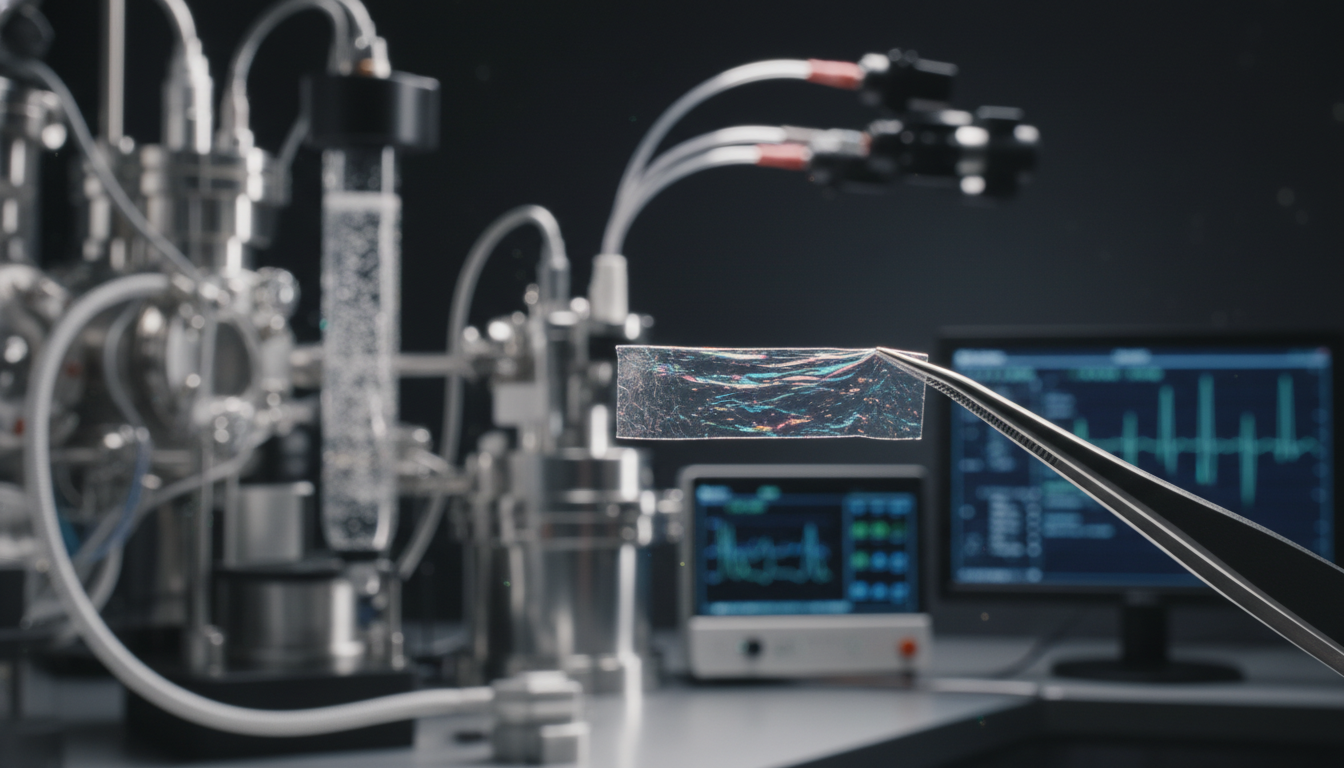

While commercial hydrogen fuel cells do not exceed 80 °C of operation due to the need for liquid water in the membranes, researchers at Australia’s Monash University managed on May 18, 2026, to make an ultrathin membrane based on graphene and boron nitride operate at 250 °C (482 °F) without needing water, according to a study published in the journal Science Advances and detailed by Interesting Engineering.
The breakthrough unlocks 4 applications that were out of reach for commercial hydrogen. Heavy trucks, cargo ships, agricultural tractors, and small airplanes now have a viable fuel cell engine without the water cooling system that weighs tons.
The research leader is Professor Huanting Wang from the Department of Chemical and Biological Engineering at Monash University.
-
Brazilian Port Expands Ship Capacity to 9.5 Meters, Boosting Cargo Transport and Reducing Logistics Costs

-
New Smart Radar Begins Issuing Fines to Solo Drivers in Carpool Lanes, Uses Cameras to Count Occupants, Changing Traffic Enforcement Rules on Busy European Roads

-
Why can the crane operator only obey the correct signalman on the construction site: among dozens of workers, a hand raised by the wrong person can confuse the maneuver and turn a load of tons into an immediate risk.
-
What changes with the new public transportation rules that can reduce pressure on fares and pave the way for zero fare in Brazil?



The discovery combines proton-conducting nanosheets with nanoconfined phosphoric acid in a 2-dimensional structure.
What Monash’s membrane does differently from commercial Nafion
The current market standard is Nafion, created by DuPont in 1972 and dominant in commercial fuel cells. According to technical data, Nafion operates at the limit of 80 °C because it needs liquid water to transport protons between the electrodes.
Above 100 °C, the water evaporates and the cell stops working. This limit forces heavy and complex cooling systems in any practical application.
In hydrogen buses, the water system occupies about 25% of the total volume of the powertrain.
Monash’s membrane eliminates the problem. As Professor Wang mentioned to Interesting Engineering, “by integrating proton-conducting nanosheets with nanoconfined phosphoric acid, we created a membrane that maintains rapid proton transport without relying on water.”
In parallel, the increase from 80 °C to 250 °C has a direct impact on 3 fronts. First, it dispenses with the water cooling system.
Second, it improves tolerance to impurities such as carbon monoxide in hydrogen. Third, it increases the power density per area of the membrane.
The numbers that expand practical application
The thermal leap opens up 5 markets that were blocked. Long-distance heavy transport is the main one. According to the International Energy Agency, transport accounts for 24% of global CO₂ emissions.
Heavy trucks alone account for 30% of that share.
Agricultural tractors form the second market. John Deere and CNH Industrial have been testing hydrogen-powered tractor prototypes since 2022. The current limit is the size of the fuel cell’s water tank.
With the 482 °F membrane, the tractor can reduce 40% of the powertrain weight.
Cargo ships form the third application. The global fleet moves 11 billion tons of goods per year and emits 940 million tons of CO₂.
The high-temperature fuel cell allows replacing 35% of marine diesel engines with hydrogen by 2040, according to DNV estimates.
In parallel, heavy industry with electric furnaces and water splitting to generate green hydrogen also benefit from the technology. Applications in CO₂ reduction cycles and ammonia synthesis for fertilizers complete the range of 5 main fronts mentioned by the researchers.

Technical reveal: graphene and boron nitride in 2D
In the background, the technical key is the two-dimensional structure of the material. Graphene is a carbon sheet with only 1 atom thickness.
It was discovered in 2004 by physicists Andre Geim and Konstantin Novoselov, who won the Nobel Prize in Physics in 2010.
According to the technical details of the paper published in Science Advances, the researchers combined graphene with hexagonal boron nitride.
This second material is a crystalline cousin of graphene, with boron and nitrogen atoms instead of carbon.
The combination creates nanometric pores with adjustable diameters between 0.3 and 1 nanometer. The pores act as exclusive routes for protons, leaving other ions and molecules out.
Above all, the membrane uses phosphoric acid in a nanoconfined state. The acid is trapped between the 2D layers and does not evaporate even at 250 °C.
This confinement is the innovation that replaces water as a medium for proton transport.
Who is Huanting Wang and the Monash group
The research leader is Professor Huanting Wang from the Department of Chemical and Biological Engineering at Monash University in Melbourne, Australia.
Wang holds a PhD in Materials Chemistry from the University of Cambridge and has been working in the field of membranes for 23 years.
According to academic records, Wang has published over 480 scientific articles with more than 47,000 citations on Google Scholar.
His h-index is 105, placing him in the top 1% of materials science researchers worldwide in 2026.
Monash University, founded in 1958, is one of the 8 universities of Australia’s Go8 group. The group is equivalent to the UK’s Russell Group or the American Ivy League.
Monash has 86,000 students across 8 campuses and is a reference in applied sciences research.
In parallel, Wang’s department has 14 principal researchers and about 80 PhD students in 2026. The annual research budget exceeds AU$ 28 million.
The group cooperates with universities in 12 countries, including Brazil via USP partnership.

How the hydrogen market grows until 2030
The global hydrogen market moved US$ 220 billion in 2025. According to the International Energy Agency, the projection is to reach US$ 600 billion in 2030 and US$ 1.4 trillion in 2050.
According to the IEA, 95% of current hydrogen is still fossil (gray), produced from natural gas with CO₂ emissions.
Only 5% is green hydrogen, generated by water electrolysis with renewable energy.
The European Union has set a target of 40 gigawatts of electrolysis capacity for green hydrogen by 2030. The US allocated US$ 9.5 billion in incentives through the Infrastructure Investment and Jobs Act passed in 2021.
In parallel, China and Japan lead the technological race. China has 6 of the 10 largest electrolyzer manufacturers. Japan leads in commercial fuel cells with the Toyota Mirai and Honda Clarity.
Brazil has a national green hydrogen route approved in 2024.

Human reveal: Wang’s bet on 23 years of membranes
The human face of the discovery is Huanting Wang, who dedicated 2 decades to membrane research for selective separation. According to Australian press coverage, Wang arrived at Monash in 2002 from the University of Texas.
According to his academic profile, Wang was born in Anhui, China, in 1969 and graduated in Chemical Engineering from the University of Science and Technology of China in 1990.
He went to Cambridge in 1996 with a British Council scholarship.
In parallel, Wang’s group holds 7 patents in functional membranes. The main patent of the 2026 discovery is in the process of being registered at the Australian Patent Office, with international extension via PCT expected for 2027.
On the other hand, Monash has already announced talks with 3 companies for commercial licensing. The names of the partners have not been disclosed but include 1 European multinational, 1 Japanese manufacturer, and 1 American startup specializing in hydrogen.
Future reveal: from lab to market in 5 to 8 years
The next step planned by the team is to scale the membrane from a laboratory prototype (5 cm × 5 cm) to commercial modules (30 cm × 30 cm or larger).
Monash’s public timeline aims for an industrial prototype by 2028.
In parallel, there are 3 critical milestones by 2030. Validation in a complete fuel cell in 2027. Demonstration in a heavy vehicle in 2028. First commercial application between 2029 and 2031, with priority for heavy transport and industry.
According to the IEA analysis, commercial success depends on 4 factors. Production cost at scale, durability in continuous operation above 20,000 hours, regulatory support from aviation and maritime agencies, and adoption by heavy equipment manufacturers.
It is worth remembering the coverage of comparable sectoral transformations in other fields.
- Publication: May 18, 2026, Science Advances
- University: Monash, Melbourne, Australia
- Leader: Prof. Huanting Wang, 23 years in membranes
- Material: graphene + hexagonal boron nitride + nanoconfined phosphoric acid
- Temperature: 250 °C (482 °F), 3.1× above the Nafion limit of 80 °C
- Advantage: dispenses with water cooling system
- Main applications: 5 (heavy transport, ships, tractors, industry, ammonia)
- Commercial timeline: 2029-2031

The points that still depend on industrial scale
Despite the leap, 3 fronts still depend on practical validation. The production scale needs to increase from a 25 cm² prototype to modules of at least 900 cm² in continuous manufacturing.
On the other hand, durability in real operation needs to be proven for 20,000 to 40,000 hours, equivalent to 5 to 10 years of commercial use.
Finally, the total cost per kW of the complete cell needs to drop from US$ 280 to US$ 80 to US$ 100, according to IEA targets by 2030.