





 Portuguese
  English
  Spanish
  4 min of reading
  0 comments


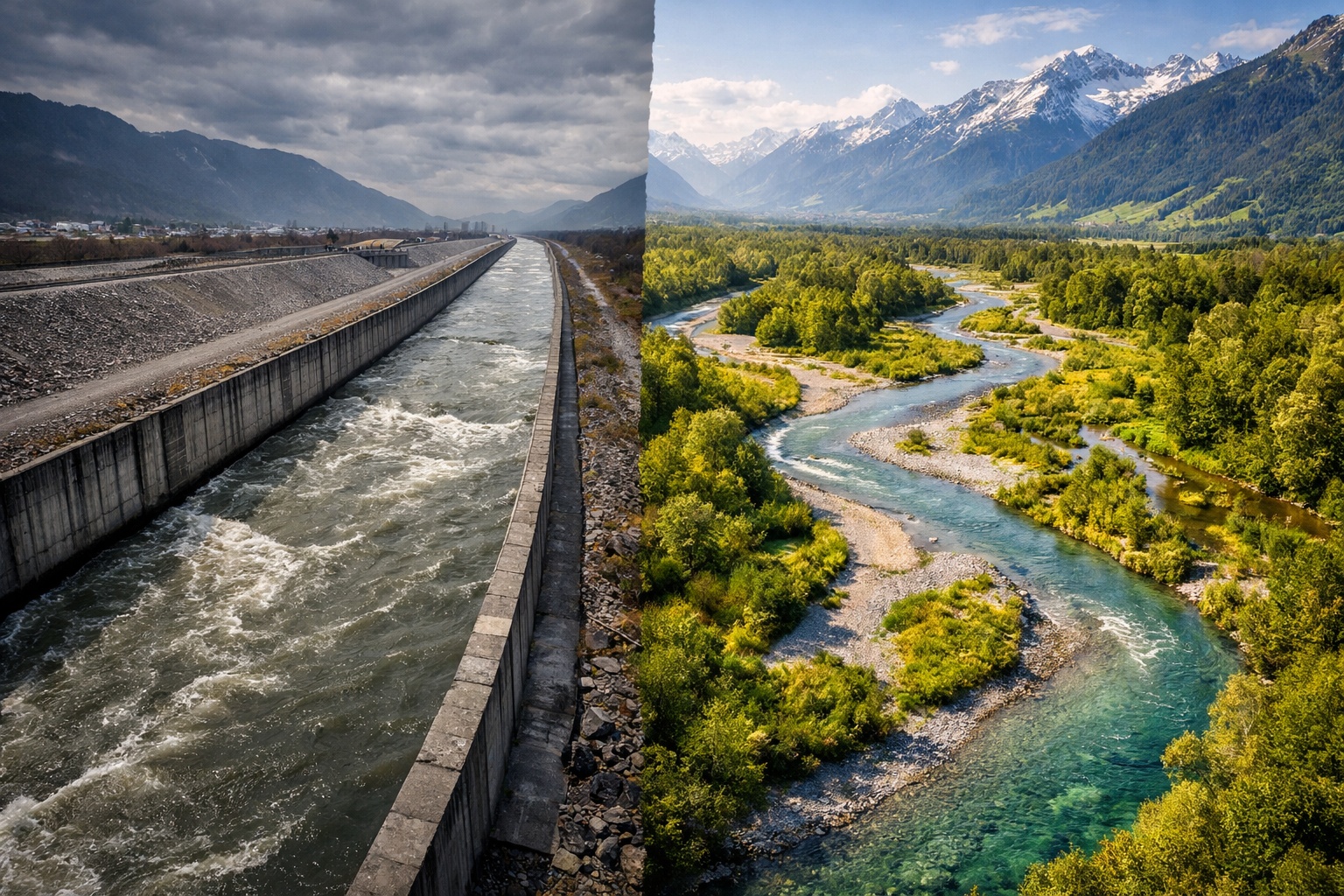
Trucks And Excavators Remove Dikes, Recreate Meanders And Redraw Alpine Rivers To Reduce Floods And Correct Decades Of Rigid Channelization In The Heart Of Europe.
For most of the 20th century, alpine rivers were treated as engineering problems to be tamed. Straight channels, raised dikes, and concrete-reinforced banks came to be seen as definitive solutions against flooding and erosion. Decades later, the outcome proved to be the opposite of what was expected: faster, higher, and more destructive floods, along with the near-total loss of the rivers’ natural dynamics. It is in this context that one of Europe’s largest river restoration projects emerges, known as Alpenrhein River Restoration.
The project involves a coordinated effort between Switzerland and Austria to undo part of the heavy engineering of the past and give space back to the Alpine Rhine River, a river system crucial for the safety of villages, agricultural areas, and entire towns in the Alpine Rhine valley.
The Historical Error: When Straightening Rivers Seemed Like Progress
Between the end of the 19th century and the mid-20th century, the Alpenrhein was intensely straightened, narrowed, and confined by continuous dikes. The goal was to accelerate water runoff, prevent overflow, and gain land for agriculture and urbanization.
-
A new airport will be built with an investment of R$ 1.8 billion, will have a 3.5 km runway, a 35,000 m² terminal, and will occupy a gigantic area of 30,000 hectares to transform logistics, tourism, and air transport in Gabon.

-
A 90-day modular home goes viral in Brazil with the promise of a kit starting from R$ 20 thousand, less waste, and a catch that many people only discover after starting construction on their own land.

-
656 apartments and units starting from R$ 234 thousand will build a new vertical neighborhood in Blumenau, transform Velha Grande in three years, and expand the Minha Casa, Minha Vida program’s investment in the city’s expansion.
-
WEG created a battery storage system that is transforming an old mine in Finland into a renewable energy hub. The project is one of the first hybrids in the Nordic country to combine solar generation with storage and helps stabilize the national electricity grid.




In practice, the river lost:
- its natural meanders
- lateral floodplains
- capacity to dissipate energy during floods
As a result, the water began to flow faster, carrying more sediments and reaching much higher flood peaks in less time. Floods ceased to be spaced-out and predictable events and became recurring crises.
Decades Of Floods Revealed The Limits Of Concrete
From the late 20th century onward, a sequence of extreme events showed that rigid dikes not only failed to protect but also increased the risk. When water levels surpass the containment, the impact is sudden and devastating, with no natural cushioning.
Moreover, the deep and artificial riverbed accelerated the erosion of the river bottom, lowering the water table and harming entire riparian ecosystems. Migratory fish lost spawning areas, and biodiversity plummeted.
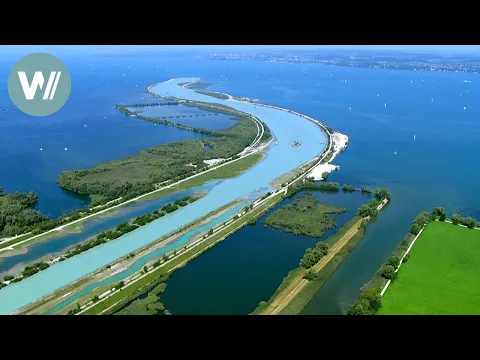

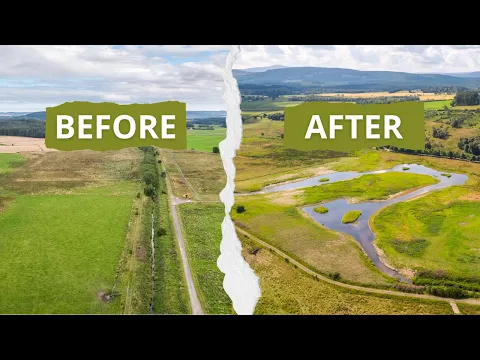
The Alpenrhein River Restoration stems from a simple and radical concept: the river needs space to function. Instead of raising the dikes even higher, the project aims to remove, retreat, or reconfigure structures to allow the water to spread in a controlled manner during floods.
This involves:
- selective removal of concrete dikes
- digging wider new riverbeds
- recreating winding meanders
- reconnecting floodplains
All of this is done using trucks, excavators, and dredges, operating on a kilometer scale.
Reverse Engineering On An Alpine Scale
Contrary to the image of “letting nature act on its own,” the restoration of the Alpenrhein is an example of heavy reverse engineering. Machines move millions of cubic meters of sediment to reshape the river course, adjusting slope, width, and depth to simulate natural conditions.
Each stretch is carefully calculated to:
- reduce water speed
- increase runoff time
- distribute energy along the valley
- minimize flood peaks downstream
The expected result is not to eliminate floods, but to make them less violent and more predictable.
Meanders Recreated To Save Villages
The new meanders are not decorative. Curves increase the river’s length, reduce hydraulic slope, and act as natural brakes. In flood events, the water occupies planned lateral areas, instead of advancing directly over urban centers.
Villages once threatened by sudden overflow now benefit from buffer zones, where the water can spread without causing structural damage.
The physical restoration of the river brings immediate positive side effects. Reconnecting floodplains creates habitats for birds, insects, and fish. Redistributed gravels on the riverbed allow the return of spawning areas, while secondary arms provide refuge during floods.
Species that had locally disappeared are beginning to reappear, and biological diversity increases without the need for artificial repopulation.
A River That Goes Back To Working For The Territory
Previously confined, the Alpenrhein acted as an aggressive drainage channel. With the restoration, it returns to function as a regulatory system, absorbing excesses, redistributing sediments, and stabilizing banks over time.
This change reduces the need for constant maintenance of dikes and emergency dredging, lowering public costs in the long run.
International Cooperation To Address Climate Risks
The project involves coordination between countries, states, and municipalities, which is essential in a context of climate change, where extreme events tend to intensify. The Alpenrhein has become a European laboratory to test how historically modified rivers can be adapted to a more unstable climate.
The experience has been observed by other alpine countries and regions facing similar problems after decades of rigid channelization.
A Model That Contradicts The Logic Of The Past
For more than a hundred years, the standard response to floods was to build more concrete. The Alpenrhein River Restoration shows that, in many cases, deconstructing is more effective than reinforcing.
By giving space back to the river, the project attempts to correct mistakes accumulated over the 20th century and create a more resilient river system for the 21st century.
Trucks and excavators continue to work throughout the alpine valley, not to dominate the river, but to relearn to coexist with it. Each recreated meander and each removed dike represents a profound change in how engineering views nature.
The Alpenrhein is not being “restored” to what it was centuries ago, but adapted to function again, balancing human safety, natural dynamics, and a climate that no longer follows the patterns of the past.






-

1 person reacted to this.