Portuguese
  Spanish


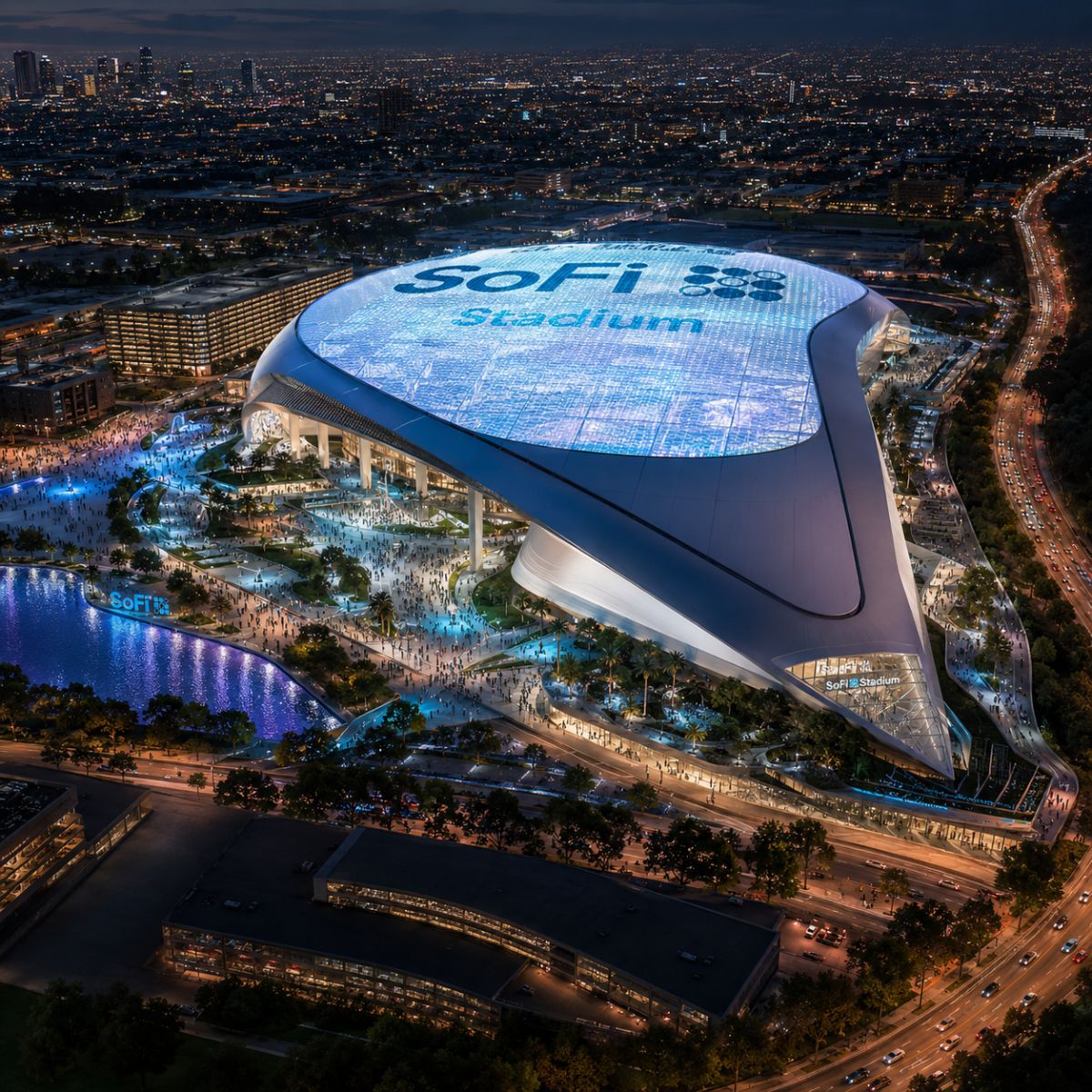


The SoFi Stadium, in Inglewood, Los Angeles, is the most expensive stadium ever built in the world: it cost approximately US$ 5.5 billion (about R$ 30 billion) and will host eight games during the 2026 World Cup, including the United States’ debut against Paraguay on June 12. The Infinity Screen, the stadium’s suspended big screen, is 110 meters long, five meters longer than the length of the FIFA standard playing field (105 meters), according to NSC. If all LED surfaces were laid on the ground, they would cover almost 6,500 square meters, an area equivalent to an entire football field.
The stadium that will host eight matches of the 2026 World Cup in Los Angeles is not just the largest and most expensive on the planet: it is a structure that defies the conventional logic of what a sports space can be. The SoFi Stadium, inaugurated in 2020, cost about R$ 30 billion and has a capacity for 70,000 people, but the most impressive number is not the number of seats or the money spent — it’s the big screen. The Infinity Screen is 110 meters long, which means it is physically longer than the sideline of the playing field in the FIFA standard.
And the spectacle doesn’t end with the suspended big screen. The roof of the SoFi Stadium also functions as a giant cinema screen: the material is covered by thousands of LED lights that project images to the exterior of the arena. As the stadium is on the landing route of Los Angeles International Airport, passengers approaching by plane window can see videos and advertisements projected on the roof as the aircraft descends to land, an experience that transforms arrival in LA into a preview of what awaits inside the arena.
The numbers that explain why SoFi is the most expensive stadium in the world

The cost of approximately US$ 5.5 billion (R$ 30 billion) makes the SoFi Stadium the most expensive sports structure ever built. To put it in perspective: the Maracanã cost about R$ 1.2 billion for the 2014 World Cup renovation, and the Allianz Arena in Munich cost approximately € 340 million when it was completed in 2005. The SoFi cost more than all 12 stadiums of the 2014 World Cup in Brazil combined.
-
On the world’s highest navigable lake, the Uros people have hand-built around 100 floating straw islands, living on them for 3,000 years without concrete or foundations.

-
Newly Completed Brazilian Highway in the Serra da Rocinha Becomes a 16.5 km Cycling Challenge and Boost for Local Tourism

-
Innovative Mortar Technique Enhances Porcelain Tile Stability, Reduces Buckling and Detachment Risks, and Provides Durable Finish Under Heavy Use

-
Giant Robots Build Entire Neighborhood of 100 3D-Printed Homes in the U.S., Showcasing Technology’s Impact on Construction Industry



The investment did not come from public money: it was largely financed by businessman Stan Kroenke, owner of the Los Angeles Rams (NFL) and Arsenal (Premier League). The stadium serves as home to both the Rams and the Los Angeles Chargers, and was designed to host the biggest events in American sports and entertainment. It has already hosted the Super Bowl in 2022 and concerts by artists like Taylor Swift, and is now preparing for the biggest of all: the 2026 FIFA World Cup.
The 110-meter big screen that is larger than the playing field

The Infinity Screen is the largest big screen in the sports world and serves as the centerpiece of the experience inside the SoFi Stadium. With 110 meters in length, it exceeds the standard FIFA playing field length for the World Cup (105 meters) by five meters, which creates the unusual situation of a big screen that does not fit within the sidelines of the pitch it displays.
If all the LED surfaces of the stadium were added up and placed on the ground, they would cover almost 6.5 thousand square meters of screen. An official soccer field is about 7.14 thousand square meters, which means the total image area is almost equivalent to the entire pitch. The suspended big screen in the center of the arena allows all 70,000 spectators to have a clear view of replays, statistics, and alternative cameras, regardless of where they are seated.
The roof that projects videos for those landing at the airport


The engineering of the roof is another element that separates SoFi Stadium from any other stadium in the world. The material covering the roof is translucent and equipped with thousands of LED lights that can be programmed to display images, videos, logos, and animations visible from outside the arena. The roof is not a conventional closed roof: it is an ETFE (ethylene tetrafluoroethylene) membrane that protects from rain but allows natural light to enter.
The stadium‘s location just a few kilometers from LAX (Los Angeles International Airport) transforms the roof into an involuntary aerial billboard. Aircraft in landing procedure pass directly over SoFi, and passengers can see the videos projected on the structure’s roof, creating a visual effect that no traditional advertising campaign can replicate. During the World Cup, this aerial visibility will be leveraged by Fifa and sponsors to amplify the event’s exposure.
The natural pitch that will be installed especially for the World Cup
SoFi Stadium normally uses artificial turf for NFL American football games, but Fifa requires natural turf for World Cup matches. The solution is to install a natural grass field over the existing surface, a procedure that other American stadiums will also adopt during the tournament. The process involves cultivating the turf in modular trays outside the stadium and assembling it inside the arena weeks before the games.
The adaptation is not trivial. Natural turf needs sunlight, irrigation, and ventilation, and SoFi’s translucent roof helps by allowing light to pass through, but maintenance during the tournament will require constant monitoring of humidity, temperature, and soil compaction. For players, the difference between artificial and natural turf affects traction, ball speed, and injury risk — which is why Fifa maintains the requirement for real grass even in stadiums designed for synthetic surfaces.
The eight games and the United States’ debut
SoFi Stadium will host eight matches of the 2026 World Cup, including the debut of the United States national team against Paraguay on June 12, valid for Group D. For the American public, the home opening game is the moment that can define the country’s engagement with the tournament, and hosting it in the world’s most expensive and technologically advanced stadium is a bet by Fifa to create a visual spectacle that amplifies the competition’s impact.
In 2024, SoFi already hosted Brazilian National Team games during the Copa América, serving as an operational test for what is to come in 2026. The experience showed that the stadium works well for soccer, despite having been originally designed for American football, a sport that uses a field with different dimensions and markings. The suites, acoustics, and visibility were praised by fans and the press, and the expectation is that the World Cup will take the experience to another level.
Would you watch a World Cup game in the most expensive stadium on the planet, or do you think R$ 30 billion for an arena is an exaggeration? Tell us in the comments what impresses you most about SoFi Stadium and if you believe Brazilian stadiums need investment in technology to compete with arenas like this.