Portuguese
  Spanish


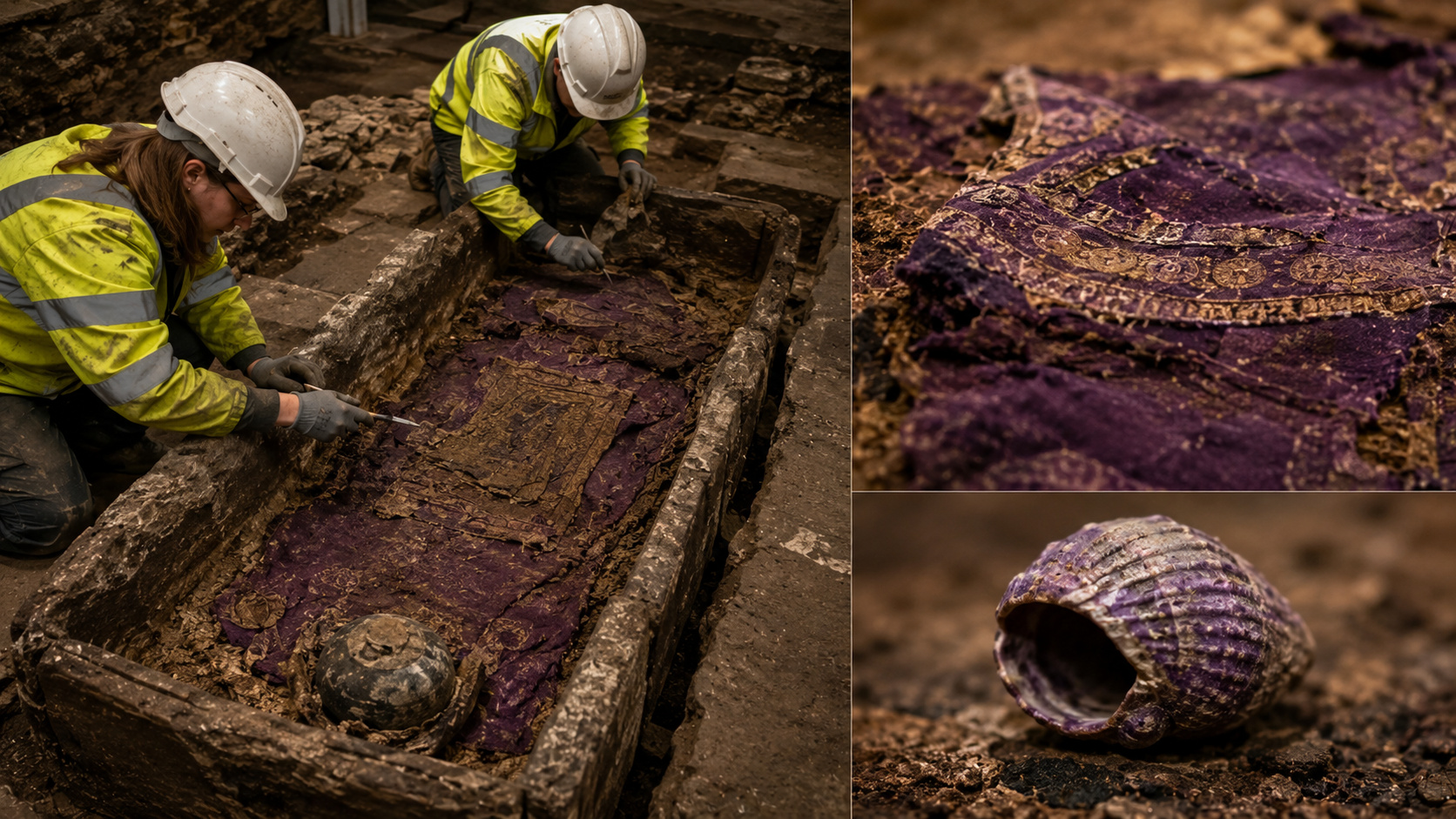


Archaeologists find Tyrian purple in 1,700-year-old Roman coffins in York and reveal funerary fabrics linked to the imperial elite.
In 2026, British researchers announced a rare archaeological discovery that revealed signs of extreme wealth hidden within ancient Roman coffins found in York, northern England. Using advanced chemical analyses, scientists identified traces of Tyrian purple in funerary fabrics preserved in burials dating back approximately 1,700 years. The pigment, considered one of the most expensive materials in the ancient world, was associated with the Roman imperial elite and often compared to the value of silver or even gold in Antiquity.
The find drew attention because the fabrics had practically disappeared over the centuries. What survived were tiny microscopic marks preserved in plaster casts inside the coffins. Analysis revealed that some individuals buried in York were wrapped in fabrics dyed with the legendary purple dye produced from thousands of Mediterranean sea snails.
Tyrian purple was one of the most expensive and exclusive materials in the Roman world
Tyrian purple, also called imperial purple or Tyrian purple, was produced from secretions extracted from marine mollusks of the Muricidae family, found mainly in the eastern Mediterranean.
-
Brazilian Senate Approves Bill to Automate Child Support Payments Directly from Debtors’ Accounts

-
Brazilian Student in the U.S. Helps Provide Clean Water to 50 Families in São Paulo Slum, Launches Year-Long Volunteer Project with National Expansion Plans
-
Daughter of Farmers from Brazil Uses Social Media to Highlight Rural Life and Promote Agriculture
-
Free Willy’s Orca, Captured as a Calf, Became a Global Star in a Mexican Tank and Was Part of the Most Controversial Attempt to Return a Captive Whale to the Wild


The manufacturing process was extremely complex. Thousands of mollusks had to be collected to produce small quantities of the pigment, which made the material extraordinarily rare.
Ancient authors even compared the value of purple to that of silver. During certain periods of the Roman Empire, the use of the pigment was controlled by laws that restricted its use to the highest classes of society.
Garments dyed with Tyrian purple were worn by emperors, aristocrats, and figures of high authority, transforming the color into a direct symbol of political power and social status.
Fabrics practically disappeared, but modern chemistry revealed the hidden pigment
One of the most impressive aspects of the discovery is that the funerary fabrics barely physically survived over time.
Archaeologists found extremely degraded fragments preserved as microscopic marks and residues adhering to the coffins and funerary molds.
To identify the pigment, researchers used sophisticated chemical analyses capable of detecting compounds associated with Tyrian purple, including brominated molecules characteristic of the dye extracted from mollusks.
Without modern chemical analysis technology, it would be practically impossible to realize that those burials contained imperial luxury fabrics.
Discovery occurred in York, an important city of Roman Britannia
The burials were found in York, ancient Roman Eboracum, one of the most important cities in Britannia during the Roman Empire’s rule.

York functioned as a strategic military and administrative center in the north of the Roman province. Roman emperors, including Septimius Severus, passed through the city during military campaigns.
This context helps explain how extremely valuable objects and fabrics reached the region. The presence of Tyrian purple in York indicates direct connections between the local elite of Britannia and the commercial and political networks of the Roman Empire.
Some fabrics were linked to elite child burials
Part of the discovery’s impact was due to some of the analyzed fabrics being associated with child burials.
Researchers believe that children buried with these materials belonged to extremely wealthy or influential families. In the Roman world, fabrics dyed with Tyrian purple were too expensive for everyday use by most of the population.
The fact that children were buried wrapped in this material suggests an exceptional level of wealth and prestige even after death.
Dye came from thousands of Mediterranean sea snails
The production of Tyrian purple was so laborious that it became legendary in Antiquity. The pigment was extracted from glands of marine mollusks popularly known as murex. To produce small quantities of dye, thousands of animals were needed.
In addition to the difficult process, the smell of manufacturing was described by ancient authors as extremely strong due to the decomposition of the secretions used.
The final result, however, produced an intense color that did not fade easily and could even become more vibrant over time, further increasing its symbolic value.
Funerary luxury reveals extreme inequality within the Roman Empire
The discovery also reinforces how the Roman Empire presented profound levels of social inequality. While much of the population wore simple clothes made of wool or undyed linen, elites could import extremely rare fabrics dyed with valuable materials from the eastern Mediterranean.

Being buried with Tyrian purple meant carrying status and prestige to the grave, something reserved for a minimal portion of society.
The findings from York show that this logic of funerary luxury also existed in peripheral regions of the empire, far from Rome.
Chemical archaeology is transforming the way ancient textiles are studied
For a long time, ancient textiles were extremely difficult to study because organic fibers rarely survive intact for centuries.
The advancement of chemical and microscopic techniques began to change this scenario. Today, researchers can identify pigments, proteins, and residues invisible to the naked eye.
This allows for the reconstruction of clothing, funerary customs, and even ancient trade networks using microscopic fragments of material. In the case of York, it was precisely this combination of archaeology and chemistry that revealed the presence of imperial purple.
Discovery reinforces York’s importance as a high-status Roman center
York was already considered one of the most important Roman cities in Britannia, but the discovery further expands this perception.
The presence of textiles associated with the imperial elite indicates that the city had access to rare materials imported from distant regions of the empire.
Furthermore, the find suggests that local families maintained enough wealth to import extremely expensive luxury goods.
This transforms York not only into a Roman military center but also into a hub for the circulation of imperial wealth and prestige.