






 Portuguese
  Spanish
  5 min of reading
  0 comments


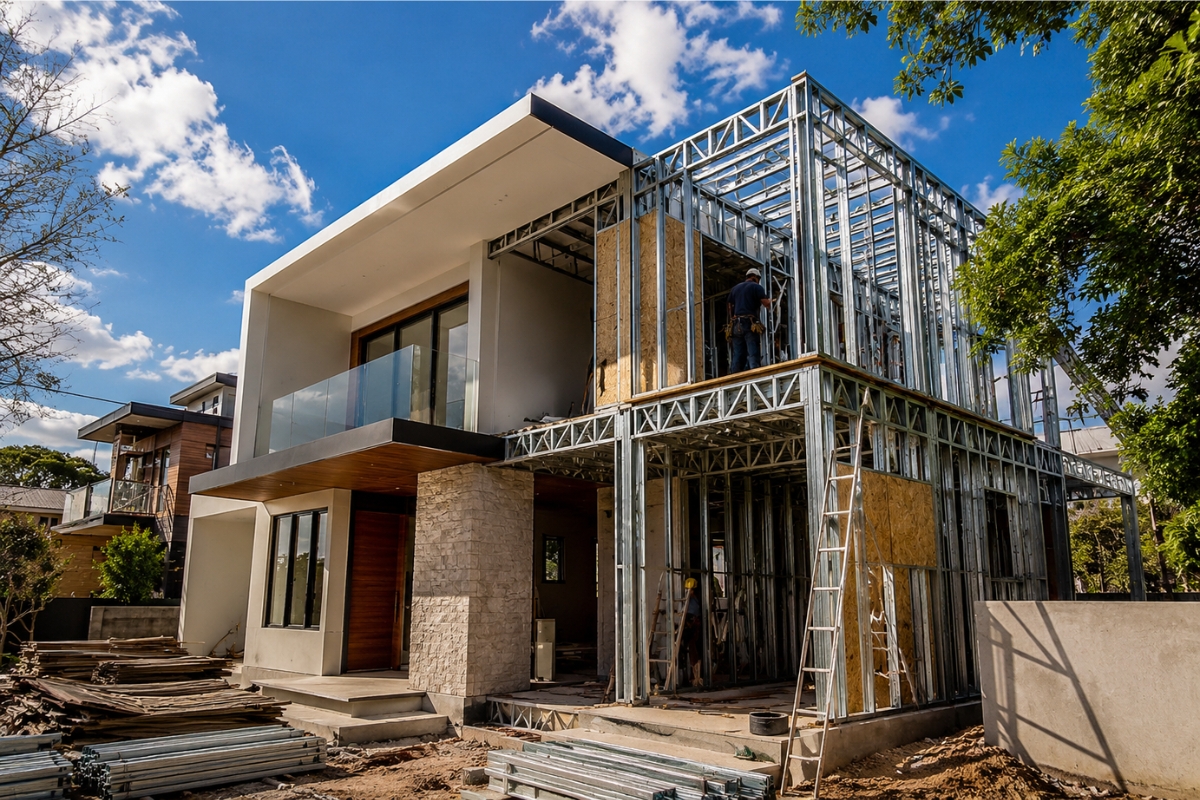
Modular construction promises shorter deadlines, cleaner work, and less waste, but the final cost depends on land, foundation, transportation, labor, finishes, and regularization.
A novelty that seems straight out of a futuristic movie has started to gain attention in Brazil: the house to assemble in up to 90 days, sold as a structural kit, with the promise of faster construction, less mess, and an initial cost that can be lower than the price of a popular car.
The idea is simple and powerful: instead of building walls the traditional way, with bricks, cement, sand, rubble, and months of headaches, the buyer receives a prefabricated structure, designed to be assembled on the land in a reduced time. According to information released by Terra Brasil Notícias, some compact models can be ready in about 60 to 90 days.
But the detail that changes everything is this: the lower price does not necessarily mean a complete house ready to live in.
-
Goodbye, concrete in the backyard: the 60s trend is back in full force and has become an alternative in construction

-
Without tiles, grout, or demolition: laminated panels that click onto the wall promise to speed up bathroom renovations by up to 5 times, cover old surfaces, and eliminate joints where mold, dirt, and germs usually accumulate.

-
He got tired of renting, bought an old school bus, removed the seats, modified the roof, reinforced everything with steel, and created a two-story mobile home that looks small on the outside but houses two bedrooms inside.

-
How the right choice of blocks reduces construction costs by up to 30%, eliminates beams and pillars, and prevents structural failures that can lead to rework, material waste, and significant losses over the years.


The house that promises to change the construction game in Brazil
The model gaining traction is based on systems such as modular construction, prefabricated house, metal structure, and Light Steel Frame. In practice, much of the house is built off-site, in a more controlled environment, and then transported for assembly.
This reduces improvisation, speeds up stages, and decreases waste. For anyone who has faced conventional construction, the appeal is enormous: less rubble, fewer delays, less wasted material, and much greater budget predictability.
Companies like Minha Casa Box already offer compact and modular models with galvanized steel structures, advocating for a fast, recyclable construction proposal with less waste. It is precisely this type of solution that is fueling the curiosity of those who dream of owning a home but cannot keep up with the prices of traditional construction.
R$ 20k structural kit: a finished house or just the beginning?

The most striking point is the promise of a structural kit with an initial price far below the cost of traditional construction. In times when even a zero-kilometer popular car is already a burden on Brazilians’ pockets, the idea of starting a modular house for around R$ 20,000 immediately sparks curiosity — but also requires caution. This amount, in most cases, does not represent a house ready to live in.
And that’s where the main point lies: R$ 20,000 may represent only the initial structure, not a complete dwelling. This amount generally does not include items such as land, foundation, labor, transportation, electrical installations, plumbing installations, finishes, documentation, permit, and occupancy certificate.
In other words: the price is realistic as a starting point for certain kits, but it should not be confused with the final cost of a finished, furnished, and regularized house. The promise is attractive, but the buyer needs to examine the contract closely.
How much can a real modular house cost?
When talking about a house ready to live in, the prices go up significantly. Some estimates released in the sector indicate that a finished compact house can range from R$ 50,000 to R$ 150,000, depending on the size, finishes, region, and what is included in the package.
NAFRAME, for example, states that they work with Light Steel Frame houses between 24 m² and 36 m², with prices that can vary per square meter. This shows that the technology can be faster and more efficient, but it does not eliminate all construction costs.
Even so, the model attracts attention because it allows starting small. For those who own land and are looking for a compact dwelling, a modular house can be a more predictable alternative than facing conventional construction without knowing where the budget will end up.
Less waste and cleaner construction: the big advantage
Another point that drives this type of construction is the promise of reduced material waste. As the pieces are cut, sized, and planned before assembly, there is less excess, less breakage, and less debris on the construction site.
Some claims mention 20% less waste compared to masonry. While this number largely depends on the project, the company, and the standard of the work, the logic makes sense: industrialized systems tend to be more precise than a construction built entirely on-site.
Companies in the sector, such as Casa Frame, highlight benefits such as faster construction, less waste generation, and lower water consumption. For an audience seeking economy and sustainability, this combination has become a powerful argument.
It’s not just buying and assembling on any plot of land
Despite the name “assembly house,” no one should imagine that it’s enough to buy the kit, call some helpers, and install everything anywhere. In Brazil, this type of property also needs to follow rules.
It is necessary to have a project signed by a qualified professional, approval from the city hall, a construction permit, and final regularization. The structure also needs to comply with technical standards, especially when involving systems such as Light Steel Frame.
The ABNT NBR 16970 specifically addresses requirements for constructions structured with light steel profiles. This advancement helped provide more security to the market and paved the way for greater acceptance of the system.
Financing also entered the radar
An important point is that Light Steel Frame has gained more traction in the financial market. According to ABCEM, the Brazilian standard helped the system be treated as conventional construction in financing analyses, especially by Caixa.
This changes the game because many people don’t have the money to pay for a house upfront. If the technology becomes better accepted by banks, modular homes cease to be just a curiosity and begin to compete with traditional masonry.
The price of traditional construction is frightening
The comparison becomes even stronger when looking at the cost of common construction. **SINAPI**, a reference used by Caixa and IBGE for civil construction costs, shows that the square meter in Brazil already exceeds **R$ 1,900** according to recent data from IBGE.
This means that building with traditional methods has become burdensome for millions of Brazilians. In this scenario, any solution that promises **shorter deadlines**, **less waste**, and a **more predictable cost** naturally becomes a topic of discussion.
The promise is real, but requires caution
The **90-day assembly house** can be an interesting alternative for those who want to avoid long, expensive, and unpredictable construction projects. The modular system has clear advantages: speed, planning, less waste generation, and the possibility of future expansion.
But the buyer needs to understand the difference between a **cheap structural kit** and a **complete, ready-to-move-in house**. The R$ 20,000 price tag might open the door, but the final cost depends on everything that comes after.
In the end, technology isn’t magic — but it can be a silent revolution. For those who research well, compare suppliers, and calculate all expenses, the **modular home in Brazil** can cease to be an internet promise and become one of the smartest ways to achieve the dream of homeownership.






Be the first to react!