





 Portuguese
  English
  Spanish
  7 min of reading
  0 comments


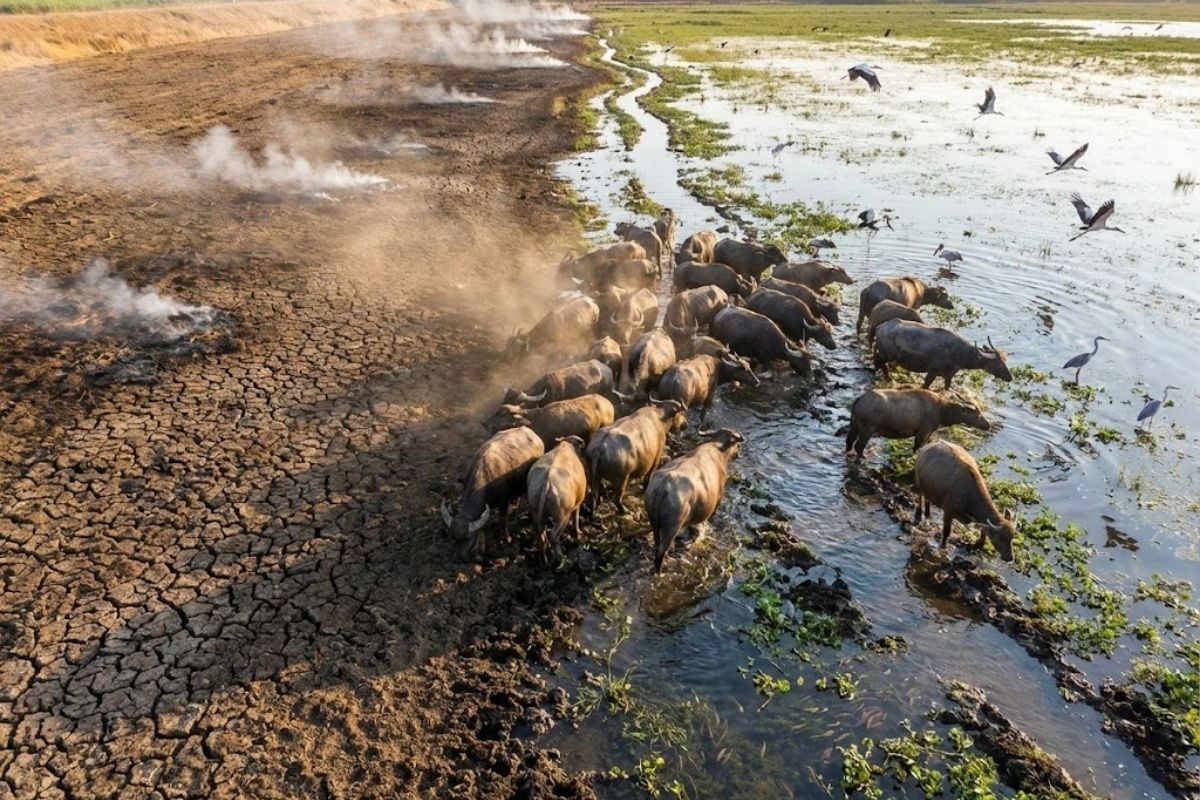
Discreetly Loose, Water Buffalos Began to Keep the Peat Moist in the Hula Valley, Between Golan and Upper Galilee. After the Drainage of 1951 and 160 km of Canals, the Soil Cracked and Burned. With Dikes, Agamon Lake, and Trails, the Water Returned and the Ecosystem Reacted Again
The Hula Valley became a real restoration laboratory: water buffalos, an exotic species in the region, began to be used as a living tool to reopen water paths and reduce the collapse of a peat soil that cracked and burned after historic drainage.
The sequence of decisions has clear dates and effects. In 1951, Israel drained swamps, excavated about 160 km of canals, and diverted the Jordan River, generating 57 km² of dry land; years later, cracks, underground fires, and loss of ecological function followed, until restoration was resumed from 1990, with dikes, blocking of drains, and Agamon Lake.
The Hula Valley Before Drainage: Shallow Lake, Swamps, and Vital Corridor for Birds

Between the Golan Heights and Upper Galilee, the Hula Valley was described as a shallow lake and a vast area of swamps formed by the Jordan River.
-
The seemingly endless sand is disappearing: the world extracts 50 billion tons per year from rivers and beaches, a volume comparable to 19,000 pyramids of Giza, while mafias profit, islands disappear, and city concrete is threatened until 2050.

-
Rice in space becomes a scientific bet for China to understand how microgravity can alter the genetics of the most important grain for Asian food security and reveal if future generations of the plant can be born, grow, and maintain their biological identity away from Earth.

-
Bolivia requests a plane from the Lula government to distribute humanitarian aid amid protests, roadblocks, fuel shortages, and food scarcity in cities like La Paz.
-
Turkey is building a billion-dollar shortcut to channel billions of dollars by sea with a 45 km long canal, 275 meters wide and 20.75 meters deep, which promises to relieve the Bosphorus amid the crisis in the Strait of Hormuz.


The ecological importance lay in the corridor function, with fish in the murky waters and the seasonal presence of herons and pelicans.
The turning point was migratory.
The valley was noted as a stop for more than 1 billion migratory birds coming from Europe to Africa, which used the area to rest, feed, and breed.
Researchers warned that if the valley disappeared, the route would lose a vital point of survival.
1951: Total Drainage, 160 km of Canals, and the Promise of Immediate “Success”

In the mid-20th century, with Israel still young and looking for agricultural land, swamps began to be seen as waste and as breeding grounds for malaria-carrying mosquitoes.
In 1951, the government decided to completely drain the region to convert it into farmland.
The execution was straightforward: about 160 km of canals were excavated, the course of the Jordan River was diverted, and the lake’s water was removed.
When approximately 57 km² of dry land emerged, reports described the move as a success, with reduced mosquitoes, disappearance of malaria, and beginning of harvests.
The Collapse: Dry Peat, Deep Cracks, and Fires That Start “Underground”
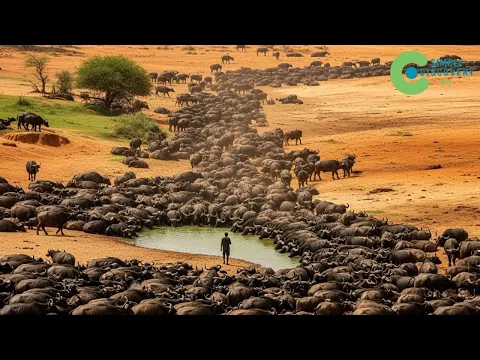

The negative turnaround came a few years later.
The soil dried up, opened deep cracks, and began to catch fire spontaneously in several areas.
Peat, when it loses moisture, enters a risk zone, with slow combustion underground and release of toxic gases, in addition to falling groundwater levels.
The chain effect impacted wildlife.
Without flooded areas and without food, migratory birds were forced to leave.
This was followed by a drastic decline in populations of fish, frogs, and native species that depended on the food chain linked to birds and swamps.
1985: The Scientific Diagnosis That the Valley No Longer Fulfilled Ecological Function
The degradation consolidated to the point that a cited study from 1985 concluded that the valley “no longer fulfills any ecological function.”
This phrase summarizes what happened when drainage engineering was faster than the natural system’s ability to reorganize.
In addition to biological losses, the described scenario included peat and carbon dust spread by the wind, craters, flooding in winter, and cracked soil in summer, a typical set of instability in drained peatlands.
1990: Dikes, Blocking of Canals, and Creation of Agamon Lake to Return Water with Control
After years of debates among hydrologists, agronomists, and ecologists, in 1990, Israel decided to correct the error and return water to the valley.
The process began with the construction of dikes, blocking of drainage canals, and gradual return of flow to specific areas.
As water alone did not solve the decomposing peat, data describe the creation of Agamon Lake and a new system of control channels to regulate the level.
With the soil once again flooded, oxygen decreased, microbial activity slowed, and the subsidence process practically stopped, but there was still the challenge of maintaining the ecosystem functioning day by day.
Why Water Buffalos Enter the Equation as “Engineers” of the Swamp
The choice fell on water buffalos for a functional reason: they are described as ideal for flooded areas.
An adult weighs between 800 and 1,000 kg, has a robust body, strong muscles, and wide hooves that distribute weight like “snowshoes,” preventing the animal from sinking into the mud.
Their behavior is also compatible with peatlands and swamps.
As body temperature easily rises, they spend hours submerged in water and mud.
This habit, which seems merely instinctual, becomes a mechanism for maintaining soil moisture, the critical point to prevent the peat from drying out and entering underground combustion.
Control of Reeds: 25 kg Per Day and the 2019 Report on Biomass
According to the FAO, water buffalos act more efficiently than cattle in flooded terrains and soft soils.
They move in groups, create natural trails, and feed continuously, preferring aquatic plants that are difficult for humans to control.
Data indicates that a single adult buffalo can consume more than 25 kg of vegetation per day, especially in areas dominated by reeds.
A 2019 ecological report concluded that no other large herbivore processes as much reed biomass as the water buffalo, while cattle, goats, and sheep cannot operate in this type of terrain.
How They Arrived at the Valley: Discreet Transfer and Ecological Risk Test
Before bringing the species to the valley, the text describes a legitimate concern: introducing a foreign species could generate ecological disaster, citing examples of invasions in other countries.
The difference noted is that, in the Hula Valley, water buffalos did not become invaders, did not compete with native species, did not harm commercial agriculture, and did not spread beyond the controlled area.
The origin of the group used in the test is linked to the post-Six-Day War period.
In the Betsaida region, ecologists found water buffalos living semi-wild, surviving in the mud without human care.
Part of the herd was transferred by truck and discreetly released, without official campaigns or media attention, already with the valley replenished by Agamon Lake and the system of canals.
Tracks That Reopen Water: Trails, Clearings, and the Return of Oxygen and Light
When the water returned, reeds and boards grew rapidly, forming green walls that blocked flow, reduced oxygen, and kept birds away.
As they began to feed and move around, the water buffalos opened trails following their own tracks.
The trails created clearings in the dense vegetation, allowing light to reach the water and enabling the return of algae and small aquatic organisms.
Then came fish and, subsequently, birds such as herons, ducks, and kingfishers.
The logic is simple and powerful: the animal’s movement becomes a water infrastructure.
Evidence Observed in the Field: More Birds, More Aquatic Reproduction, and More Seed Dispersal
Field observations showed areas with activity from water buffalos exhibiting waterfowl density up to three times greater than areas without them.
Each step gently stirred the mud, helping the soil retain moisture and avoiding compaction, a process described as “soil respiration.”
By creating small puddles during their movement, they formed ideal places for breeding frogs, insects, and young fish.
A local study cited registered an increase of over 40% in aquatic breeding sites in areas where they were active.
Furthermore, seeds stuck to their fur and hooves were transported over long distances, forming natural corridors of vegetation.
Recovery of the Hula Valley Today: Mass Birds and Flamingos Changing Behavior
In the current picture, water is back, stable ponds, and the ecosystem functioning.
The clearest signal appears in the sky: flocks of birds returning in large numbers.
According to Israel’s parks and nature authority, more than 400 bird species have already been recorded there, and over 1 billion migratory individuals pass through the region every year.
The case of flamingos is presented as a change in pattern.
Before 2025, they made quick stops, but in more recent summers, more than 100 individuals began to stay year-round, indicating more stable water and food sources.
Rediscovered Frog and Reconstituted Vegetation: Signs of a System That Supports Life Again
The recovery is reinforced by a biological example: the frog described with spotted patterns, considered extinct for over 50 years.
Recent surveys identified about 230 adult individuals distributed across 22 ponds, suggesting a return to a state capable of sustaining life.
The vegetation is also regarded as part of the stability mechanism.
Eight native species reintroduced, helping to anchor soil, filter nutrients, and reduce erosion.
As a result, the area now hosts 340 species of wild plants, including 57 rare and eight endangered, reducing the risk of dominance by reeds and invasive plants as in the past.
Coexistence and Control: Herd Grows, But Economic Impact Is Described as Null
In the early 2000s, with the ecosystem more stable, the herd of water buffalos reached around 60 to 80 individuals.
Today, according to reserve management, it varies between 120 and 150 animals. With growth, there has been contact with humans, with some coming close to agricultural edges, trampling vegetation on the banks, or damaging fragile fences.
Still, data from the parks and nature authority indicates an absence of significant damage to commercial crops.
The cited reason is dietary: water buffalos feed almost exclusively on reeds and aquatic plants, which have no economic value for farmers.
The described solutions are of low complexity: ecological fences, water channels, herding dogs, and regular patrols by park rangers to keep the animals in the flooded areas and away from inhabited zones.
The history of the Hula Valley shows a complete cycle: drainage in 1951, accelerated peat degradation, scientific alert in 1985, planned return of water starting in 1990, and the entry of water buffalos as a practical tool to maintain moisture, open trails, and sustain biological processes that machines and people could not execute in deep mud.
It is an example of nature-based restoration where the decisive detail was not a work, but a repeated behavior: the footprint.
In your opinion, using water buffalos as “engineers” of the swamp is a smart and replicable solution, or a risk that only works because the area is controlled and monitored?







-

-

3 people reacted to this.