Portuguese
  Spanish


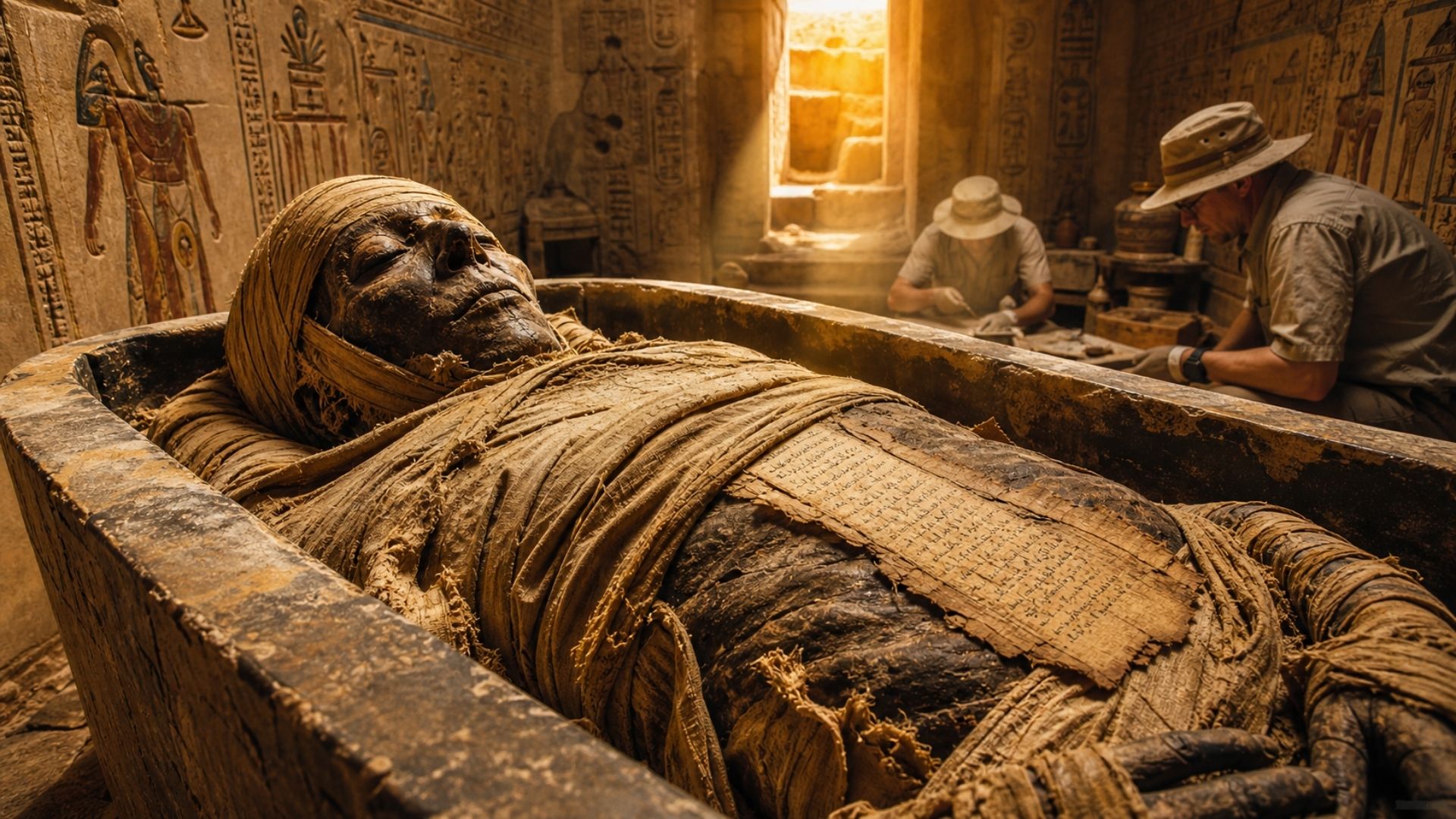

Found during excavations in Oxyrhynchus, Egypt, the mummy surprised archaeologists by revealing a fragment of the Iliad attached to its body, something unprecedented for the Roman period and which may mark the first use of a literary text in a local funerary ritual.
Found in the ancient city of Oxyrhynchus, modern-day Al Bahnasa, south of Cairo, a mummy approximately 1,600 years old caught archaeologists’ attention due to a rare detail: a papyrus with excerpts from Homer’s Iliad was attached to the body’s abdomen. The find was identified by researchers from the University of Barcelona during excavations in Roman-period limestone tombs.
According to the Olhar Digital portal, what makes the discovery even more important is that it is not a common ritual text, nor an embalming instruction, as specialists usually find in these contexts. This time, the fragment belongs to a classic literary work of the Greek tradition, which opens up the possibility of being faced with the first record of literature used in a funerary ritual in the region.
The most striking detail of the find lies in the text attached to the mummy

The most impressive element of the discovery is the content of the papyrus itself. According to researchers, the fragment preserves excerpts from Book II of the Iliad, more precisely from the part known as the Catalogue of Ships, one of the most well-known passages of the epic poem attributed to Homer.
-
Ancient Stone City in the Desert, Once Home to 30,000, Puzzles Scientists with Nabateans’ Water Mastery 2,000 Years Ago

-
Ancient Creature Thought Extinct Since Dinosaur Era Reappears, Baffling Scientists

-
India Deploys Giant Fabric Tubes Filled with Sand to Combat Coastal Erosion and Rebuild Disappearing Beaches

-
China Unveils Most Human-Like Humanoid Robot for Public Sale, Featuring Silicone Skin and 88 Joints, Priced from $17,600



Until now, funerary finds in the region typically revealed religious formulas, inscriptions related to the protection of the dead, or technical guidelines for the mummification process. The presence of a literary work on the embalmed body changes this pattern and elevates the discovery to another level, as it suggests a much more sophisticated symbolic use than previously imagined.
The curious twist is that literature may have entered the ritual of the dead
It is precisely this point that transforms the discovery into something greater than an archaeological curiosity. The Iliad was not, in principle, a funerary text. Yet, it appeared incorporated into the body of a mummy, in a position that indicates ritual intent and not mere chance.
Experts still do not know why that particular passage was used. Among the hypotheses raised, the papyrus could function as a kind of embalmer’s identification mark or have been chosen for some symbolic protective function. In any scenario, the use of classical literature in such a funerary process is seen as unusual and potentially revealing about the mixture of cultural references during that period.
The context of the tombs shows that this was no ordinary burial

The discovery of the papyrus did not appear in isolation. Excavations in three limestone tombs revealed other indications of elaborate and high-cost funerary rituals, which helps to understand the environment in which this mummy was prepared.
In the same location, archaeologists found mummies with gold or copper leaf tongues, jars with cremated remains of adults and infant bones, and even feline heads wrapped in fabric. The collection suggests complex practices and a community with sufficient resources to invest in detailed burials, possibly linked to families of high social standing.
This scenario reinforces the idea that the Iliad fragment was not placed there without purpose. In such a meticulously prepared funerary environment, each element seems to carry a specific function, be it religious, symbolic, or social.
Why the discovery could change the understanding of Roman Egypt
The find also broadens the discussion about the coexistence of cultures in Egypt under Roman rule. Oxyrhynchus is already known for bringing together important vestiges of the encounter between Egyptian traditions and Greek influences, but the presence of a passage from the Iliad on a mummy takes this integration to a more concrete and unexpected level.
If the ritual hypothesis is confirmed, the discovery will indicate that texts from the Greek tradition did not circulate merely as literature or intellectual formation, but could also find a place in practices related to death and the sacred. This would change the way the Greek presence in the region is interpreted, showing a deeper cultural fusion than just administrative or linguistic.
In practice, the mummy found could become a key piece for understanding how symbols, beliefs, and texts crossed cultural boundaries and were reinterpreted in one of the most striking funerary scenarios of Antiquity.
What still needs to be confirmed about the papyrus
Despite the relevance of the find, the researchers themselves treat the discovery with caution. The papyrus is fragmented and quite fragile, which limits analyses at this initial stage. To avoid damage to the material, the team opted for visual examinations, without resorting to more invasive or advanced techniques for now.
This means that the exact function of the text still remains open. Specialists need to clarify whether the fragment was placed there with ritual meaning, whether it played a practical role linked to embalming, or whether it represented some kind of more personal symbolic choice. It will also be necessary to better understand how this use fits into the religious and cultural context of Oxyrhynchus during the Roman period.
The mummy found in Egypt, therefore, is already one of the most intriguing finds of the year not only because of its antiquity, but because of what it carries with the body: a text that has crossed centuries and can now reveal a new layer about the relationship between literature, death, and symbolic power in the ancient world. If new analyses confirm this interpretation, the discovery will cease to be merely rare and become a landmark in the archaeology of the region.