






 Portuguese
  Spanish
  3 min of reading
  0 comments


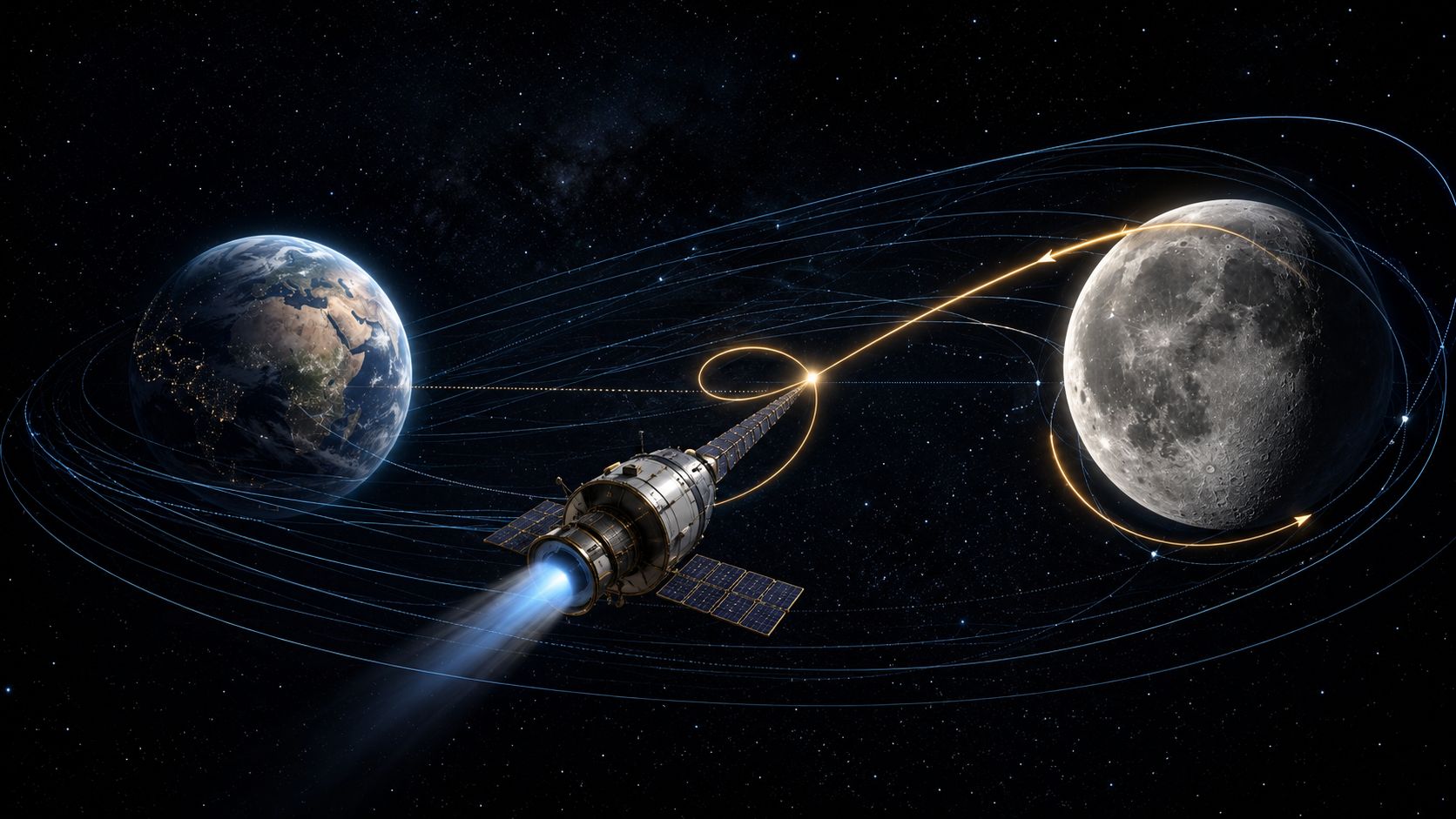
Study published in the journal Astrodynamics evaluated millions of trajectories between Earth and the moon and identified a route that saves fuel by using the L1 point as a gravitational stop, although the route is slower and more suitable for cargo.
58.80 meters per second can decide how much fuel a mission saves on the way to the moon. A study published in the journal Astrodynamics evaluated tens of millions of trajectories and found an efficient, though slow, route between Earth’s orbit and the lunar orbit.
Route to the moon trades speed for economy
The proposal does not aim to repeat fast trips in the style of Apollo or Artemis. The modeled route takes 31.9 days because the spacecraft approaches the moon and enters a Lyapunov orbit around the Earth-Moon L1 point.
This point is in a region of gravitational equilibrium between the two bodies. In the studied scenario, it functions as an intermediate stop before the final transfer to a 100-kilometer lunar orbit.
-
Helicopter Drops 180 Tons of Sand and Gravel on Swedish River to Revive Ecosystem Damaged by Decades of Exploitation

-
Brazilian Company Launches Retro Smartphone with 48 MP Camera, T9 Keyboard, and Privacy Features for Social Media-Free Use

-
Self-Taught Chinese Farmer Builds 5-Ton Submarine from Scrap, Launches It in Anhui River
-
Invisible Induction Technology Enables Wireless Power for Blenders, Coffee Makers, and Air Fryers, Reducing Countertop Cables





The estimated saving of 58.80 meters per second compared to similar routes in the literature seems small. But in space flights, a smaller change in speed can reduce fuel, lighten launch mass, or make room for cargo.
Allan Kardec de Almeida Júnior, from the University of Coimbra and lead author, stated that each meter per second in space travel equates to large fuel consumption. Less propellant can make missions flexible.
How mathematics reduced millions of possibilities
The team used the theory of functional connections to incorporate mission constraints directly into the equations. With this, they managed to reduce the computational cost of the search and analyze a larger volume of alternatives.
Previous works cited had simulated about 280,000 trajectories. In this research, only the first stage examined 24 million possibilities, from Earth’s orbit to the stable variety leading to the L1 region.
The best initial cost reported was 3,342.96 meters per second, after a transfer of 3.69 days to the stable gravitational path. The complete transfer, passing through L1 and reaching the moon, cost 3,991.60 meters per second.
The most unexpected result appeared at the entry point of the gravitational route. Instead of using the branch closest to Earth, the most economical solution approached the moon and entered from the opposite side.
Vitor Martins de Oliveira, postdoctoral researcher at the University of São Paulo and co-author, said that quick methods allow for searching non-trivial solutions, without assuming that the path closest to Earth is always the easiest.
Slow path may favor cargo and communication
For astronauts, a journey of almost 32 days would require more food, water, life support, and attention to radiation. For cargo, however, time usually weighs less than mass, cost, and fuel.
Therefore, the route may make more sense for equipment, supplies, or robotic infrastructure. With a permanent presence in lunar space, economical routes can be useful for refueling.
The passage through L1 can also improve communication. Oliveira mentioned that Artemis 2 lost contact when it was behind the moon, while the proposed orbit could maintain uninterrupted communication.
The authors acknowledge limitations. The simulations considered Earth and the moon, but not the Sun or other bodies. The final route of a real mission would depend on the launch date, orbital geometry, and maintenance at L1.
Study available in Astrodynamics.





Be the first to react!