






 Portuguese
  Spanish


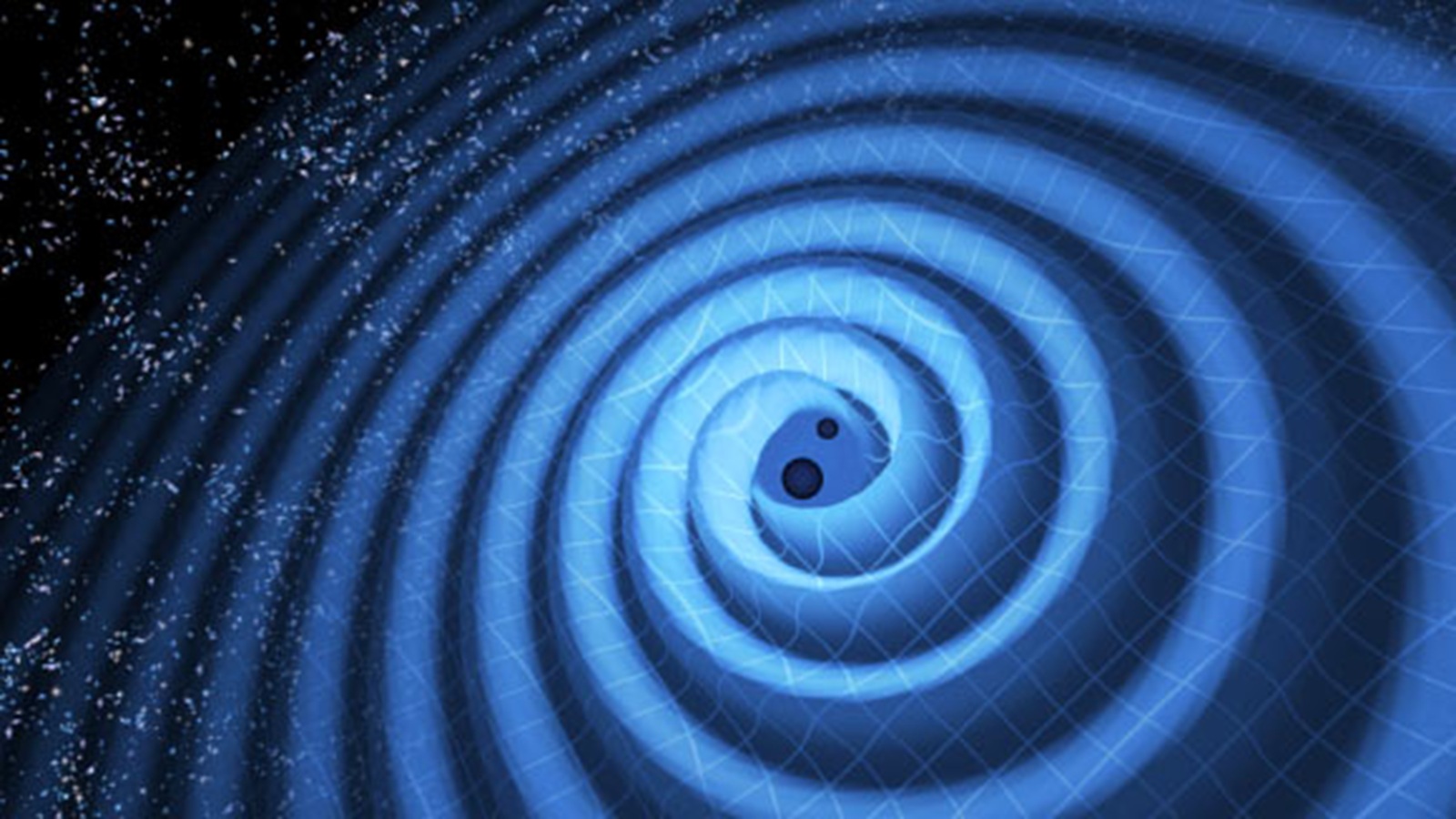


Research published in Physical Review Letters developed a model to identify possible dark matter signatures in gravitational waves emitted by colliding black holes, after analysis of LIGO-Virgo-KAGRA signals indicated provisional evidence in specific events, still without sufficient statistical confirmation
Study published in Physical Review Letters proposes a model to search for dark matter signatures in gravitational waves generated by black hole mergers, after analysis of LIGO-Virgo-KAGRA signals indicated possible hints in specific events, still without sufficient statistical confirmation.
More than 85% of the Universe’s matter may be dark matter, and a study published in Physical Review Letters suggests that black hole mergers may carry signals of this invisible component in gravitational waves detected on Earth.
Dark matter may leave marks in cosmic collisions
Dark matter does not interact with light, magnetic fields, or forms of electromagnetic energy. Therefore, its existence is inferred by gravity, especially by the curvature around distant galaxies.
-
Iraq floats and sinks under an arm of the Euphrates 10 giant concrete boxes of 46,000 tons and 125 meters each to assemble a 2.4 km submerged tunnel and open a new land route between Asia and Europe.

-
Scientists use more than 20,000 artificial birds and solar speakers to “trick” seabirds, reactivate nesting routes, and revive a colony on an island that seemed abandoned.

-
She spent 73 years breathing inside an iron lung, survived the aftereffects of polio, and became the last woman in the United States dependent on the equipment before dying at 78 years old.
-
Brazilian students created a $1 filter using pine bark, cotton, and 3D-printed parts to clean cassava wastewater, reduce the toxicity of a hazardous waste, and transform contaminated water into biofertilizer.




One of the hypotheses analyzed involves light scalar particles, much less massive than electrons. Near rapidly rotating black holes, they could behave as coordinated waves and gain density through superradiance.
In this process, part of the black hole’s rotational energy would be transferred to dark matter. At high densities, this scalar environment could alter the dynamics of the merger and imprint marks on the gravitational waves.
MIT model analyzed LIGO-Virgo-KAGRA signals
To search for these signatures, Josu Aurrekoetxea and colleagues developed a semi-analytical waveform model for binaries in scalar environments. The method was validated with numerical relativity simulations.
The team applied Bayesian analysis to the LIGO-Virgo-KAGRA catalog, gravitational wave observatories. Among 28 clear signals from the first three observation runs, 27 were compatible with mergers in a vacuum.
The GW190728 signal showed possible hints of an environment associated with dark matter. The study summary also mentions GW190814, in which the vacuum was outside the 95% confidence region.
Researchers treat result as provisional
The authors emphasize that there has been no confirmed detection of dark matter. The statistical significance does not yet allow for a discovery claim, and independent verifications are necessary before any confirmation.
Even so, the method opens a path to investigate dark matter on smaller scales, using black holes as natural amplifiers and upcoming LVK data to search for new physics.


