Portuguese
  Spanish


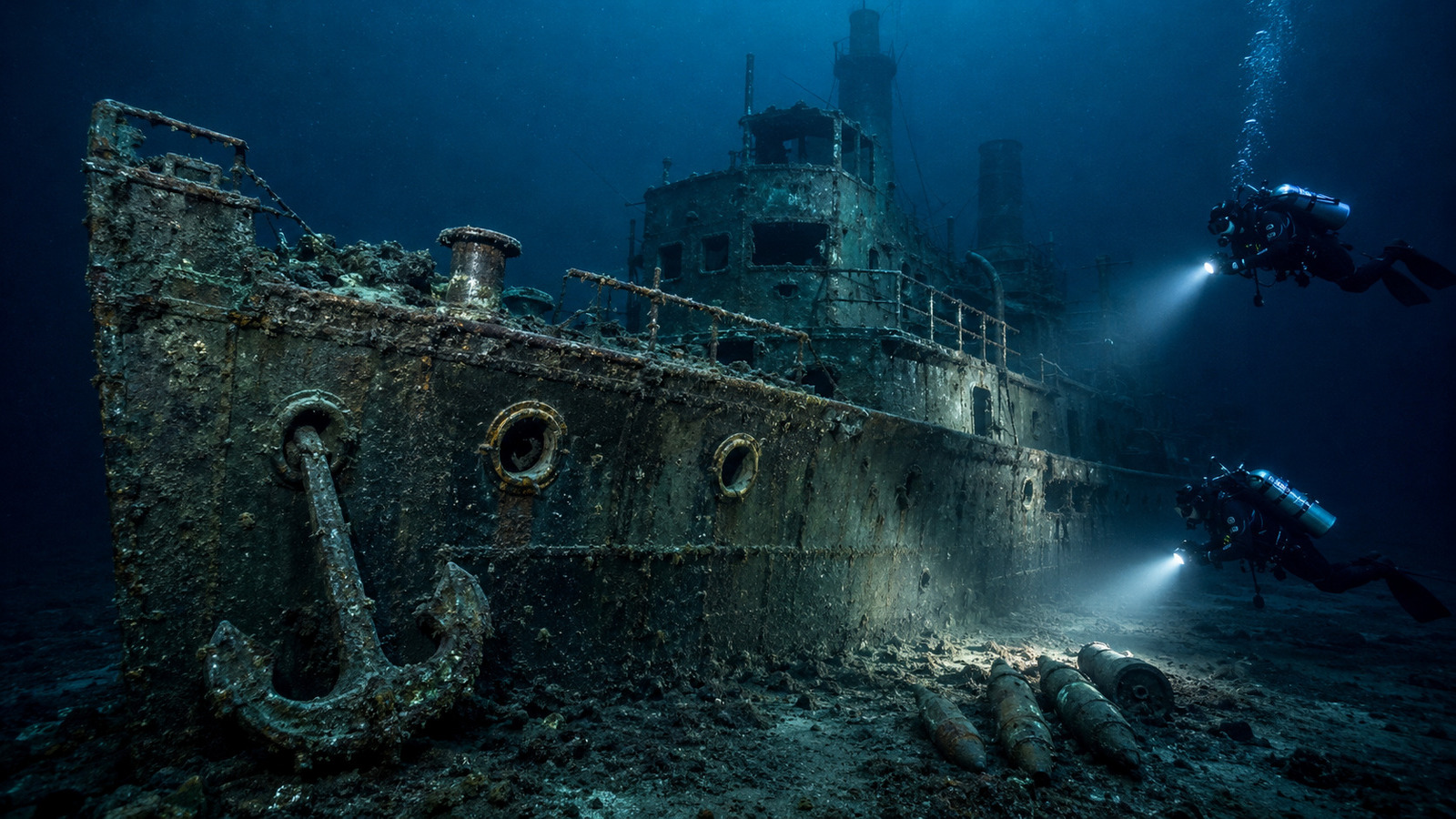

Volunteer divers located, at almost 95 meters deep in the Atlantic, the probable wreck of the Tampa, a ship torpedoed in 1918 during World War I, in a tragedy that killed all 131 people on board
The greatest loss of life in American naval combat during World War I returned to the forefront of history after volunteer divers located the probable wreck of the Tampa, a ship torpedoed in 1918 while escorting convoys through the Bristol Channel, killing all 131 people on board.


Wreck of the Tampa was found after three years of searching
The location was made by Gasperados, a group of volunteer divers from southwest England specializing in identifying World War I wrecks.
The team spent three years cross-referencing archival documents, ship records, and war period reports.
-
She spent 73 years breathing inside an iron lung, survived the aftereffects of polio, and became the last woman in the United States dependent on the equipment before dying at 78 years old.

-
Brazilian students created a $1 filter using pine bark, cotton, and 3D-printed parts to clean cassava wastewater, reduce the toxicity of a hazardous waste, and transform contaminated water into biofertilizer.

-
Astronaut from Artemis II steps down after mission to the Moon and decision surprises after a record of 406,771 km, a historic 10-day journey, and an unprecedented achievement for Canada.

-
A fossil kept for years in a small museum in Montreal concealed 450-million-year-old soft tissue, a discovery that has only happened once before in history.


The tenth and final dive in the search area led the divers to a point in the Atlantic, almost 95 meters deep.
The descent was described by team leader Steve Mortimer as a gradual approach amidst the darkness.
The inspection time on the seabed was short. The divers had only a few minutes to observe the site before beginning a long ascent, necessary due to decompression after the deep dive.
Ship details helped reinforce the identification
The team found features compatible with the Tampa, including portholes, artillery shells, bridge equipment, anchors, and fire extinguishers.
These elements were compared with archival records provided by Coast Guard historians.
Diver Dominic Robinson reported quickly noticing signs associated with a warship.
He cited well-preserved bridge equipment and an anchor similar to that seen in historical photographs of the vessel.
Another important indication was the boiler system. Barbara Mortimer, a researcher at Gasperados, explained that the divers located a water-tube boiler, a type used in warships like the Tampa. Merchant ships of the time usually used fire-tube boilers.
Brass portholes were also observed scattered around the site. According to Steve Mortimer, much of the hull deteriorated over time, while brass fittings remained practically intact on the seabed.
The ship disappeared during a night mission
The Tampa was escorting Coast Guard convoys after the United States entered World War I in 1917.
Historical records indicate that the vessel completed 18 missions between Gibraltar and Great Britain in eleven months.
On September 26, 1918, the ship was low on coal during an escort. Captain Charles Satterlee requested permission to leave the formation around noon, but the request was denied because sailing alone during the day was considered dangerous.
A second request was approved in the late afternoon. Hours later, the Tampa headed north on a moonless night, with the lights off to avoid detection. A German submarine spotted the vessel in the Bristol Channel.
Shortly after, a nearby radio operator reported feeling an underwater explosion. The Tampa never reached the port.
Debris, life jackets, and bodies of some unidentified officers were later recovered.
Discovery rekindles memory of the 131 victims
All 131 people on board died, including 111 members of the Coast Guard, four from the United States Navy, and 16 members of the British Navy and civilians. Most of the victims were never found.
The loss had a significant impact on the Coast Guard, which had fewer than 4,000 people at the start of the war. William Thiesen, historian of the Coast Guard’s Atlantic area, stated that the service suffered a higher percentage of casualties than any other American military branch in the conflict.
Among the dead were young sailors, such as Irving Alexander Slicklen, who was 15 years old when he enlisted, and Joseph Lieb, who was preparing to reunite with his family before the ship’s disappearance.
After the announcement, relatives of crew members contacted Gasperados. Some families said they always knew their relatives died on the Tampa, but did not know the location of the wreckage.
The divers intend to return to the site to gather new evidence. Steve Mortimer stated that a team member believes they saw the word “Tampa” on a fire extinguisher, and the expectation is to photograph the item on a future expedition. If there is official confirmation, the site will be treated as a war grave.
This article was prepared based on information from Gasperados, the United States Coast Guard, and Smithsonian magazine, with data, numbers, and statements preserved as per the consulted material.