






 Portuguese
  Spanish


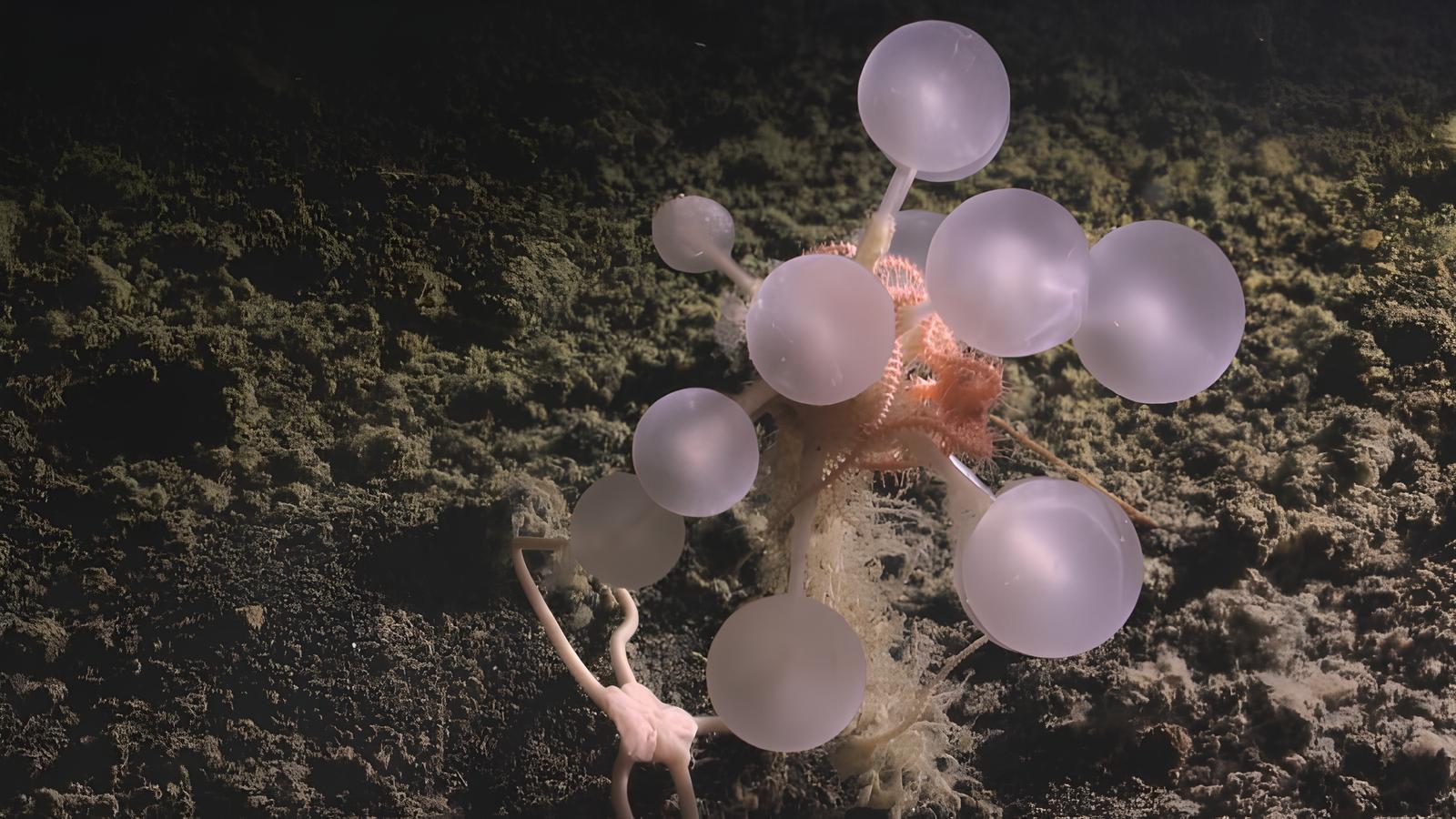


Carnivorous Sponges of the Weddell Sea Feed on Bones, Form Deep Colonies, and Withstand Temperatures Below 0 °C Under the Antarctic Ice. “Death Ball” Sponge: Discovered in the Antarctic Ocean, in an oceanic trench about 3,600 meters deep.
The bottom of the Antarctic Ocean has always been depicted as a submarine desert: cold, dark, nutrient-poor, and hostile to life as we know it. However, recent expeditions using remotely operated vehicles have revealed that this environment is much more complex. In the Weddell Sea, beneath kilometers of ice and at temperatures that can reach −1.8 °C, scientists have recorded giant colonies of carnivorous sponges and other specialized invertebrates capable of digesting bones and surviving without common resources like sunlight and abundant food.
This finding surprises the scientific community not only due to the uniqueness of the species but also for what it suggests about the resilience of life in extreme environments, a theme that extends from marine biology to astrobiology.
Weddell Sea: The Natural Laboratory of Antarctica
Located in the western sector of the Antarctic continent, the Weddell Sea is known for harboring some of the coldest and clearest waters on the planet. It is a region covered by sea ice for much of the year and marked by the presence of the Filchner-Ronne Ice Shelf, a floating ice structure that stretches for hundreds of kilometers.
-
Welder Discovers 16th-Century Diamond Ring in England After 7 Hours with Metal Detector; Gold Jewel Linked to Edward I Pattern Auctioned for £17,000

-
Former Merchant Marine Captain Invents Fuel-Free Barrier, Removes 20,000 Tons of Trash from Chennai Rivers
-
14-Year-Old Maxim Harris Turns School Project into Anti-Rage Gaming Accessory, Sells 1,000 Units Across 46 U.S. States, Donates 20% of Profits to Charity
-
Brazilian Health Agency Approves First Oral Medication for Cancer Patients



In these deep waters, sunlight disappears just a few meters below the surface. Starting at 200 meters, the aphotic zone begins, where there is no photosynthesis. Below 3,000 meters, the environment is dominated by darkness, extreme pressure, slow currents, and temperatures near the freezing point of seawater.
For decades, it was believed that this type of scenario functioned as a biological desert. But scientific expeditions conducted by Germany, the United Kingdom, and other nations in the past two decades have shown that the Weddell Sea is home to a specialized biodiversity, including:
- cnidarians
- echinoderms
- crustaceans
- cold-adapted fish
- carnivorous sponges
- filtering colonies
The discovery of carnivorous sponges has added an entirely new layer to this picture.
Carnivorous Sponges: Who Are They and How Do They Live


Unlike the common image of sponges as simple filtering organisms, some species have developed predatory and carnivorous strategies. These organisms mainly belong to the family Cladorhizidae and were first described in the 19th century, but were truly understood only with the advent of deep-sea exploration technologies.
Carnivorous sponges:
- lack a traditional digestive system
- do not filter phytoplankton
- do not rely on photosynthesis
- use siliceous spicules as hooks
- capture microcrustaceans and small invertebrates
- digest prey through endocytosis
The most unusual aspect is their ability to digest animal tissue, including bones in certain specific scenarios, when they colonize the carcasses of marine animals that sink to the bottom, such as whales.
In the case of the Weddell Sea, cameras installed on ROVs recorded sponges adhering to organic and inorganic structures, often associated with discrete sources of organic matter that descend from the surface.
How Do They Feed on Bones in a Lightless Environment
The phrase “feed on bones” may sound exaggerated, but the phenomenon is documented. When carcasses of large marine animals sink, they create a “biological oasis” on the seabed, a process called whale fall in scientific literature.
In this context, carnivorous sponges can attach and consume:
- muscle remains
- connective tissue
- organic compositions present in bones

They do not “chew” bones in the vertebrate sense but extract nutrients with the help of microbial communities and enzymes. In environments like the Weddell, where surface productivity is low, any source of nitrogen and carbon is valuable.
The ability to process complex organic material is one of the reasons why these sponges can persist for long periods without food, slowing their metabolism and growing slowly.
Negative Temperatures and Slow Metabolism: The Biology of the Limit
One of the central questions of the discovery was: how do these organisms survive at such low temperatures?
Seawater can reach −1.8 °C without freezing due to salinity. At these levels, proteins and cell membranes face serious challenges. However, carnivorous sponges exhibit adaptations such as:
- membranes stabilized by special lipids
- cold-resistant proteins
- extremely slow metabolism
- modular growth forms
The slow metabolism, in particular, is an advantage. Unlike fish and mammals, which need constant oxygen and food, carnivorous sponges spend little energy, allowing them to survive on sporadic captures.
This type of evolutionary strategy is common in Antarctic environments, also observed in:
- deep-sea echinoderms
- cold-source bacteria
- ice-adapted annelids
ROVs and Submersibles: The Technology That Made the Invisible Visible
None of these discoveries would have been possible without underwater robots and manned submersibles. As the Weddell Sea is covered by ice and subjected to extreme weather conditions, the use of ROVs (Remotely Operated Vehicles) is essential.
These vehicles:
- descend to 5,000 meters
- use manipulator arms
- illuminate the environment with high-intensity LEDs
- record videos in 4K
- collect biological samples
- map the seabed with sonars
Thanks to expeditions of this type, scientists observed entire colonies, not just isolated individuals. This changed the paradigm: where scarcity was expected, organized ecological structure was found.
Some records showed sponges growing on geological and organic structures, accompanied by:
- amphipods
- polychaetes
- echinoderms
- symmetric microorganisms
In other words: there is a functional food chain, even in extreme environments.
Why This Discovery Matters Beyond Antarctica
Scientific interest goes far beyond the biology of sponges. It encompasses:
Ecology of Extremes:
These organisms demonstrate that life does not depend on sunlight, reinforcing the role of chemosynthesis-based food chains.
Cryobiology:
Negative temperatures force molecular adaptations that can inspire studies in cryogenics, biomaterials, and cell preservation.
Astrobiology:
Environments like the Weddell are often compared to possible habitats on Europa (Jupiter’s moon) and Enceladus (Saturn’s moon), where subsurface oceans may exist beneath layers of ice.
Climate Change:
The Weddell Sea is one of the most sensitive locations to the melting of ice shelves, which can alter the entire structure of these ecosystems.
The giant colonies of carnivorous sponges in the Weddell Sea remind us that life does not need comfort to flourish, only possibilities. In a dark, silent, and icy bottom, where most would imagine absence, complex communities arise that digest bones, withstand the cold, and build complete ecological niches beneath kilometers of ice.
If such extreme environments host so much diversity, it is legitimate to ask: what else exists in the 80% of the ocean that we have not yet explored?






3.600 m is about 12ft. you mean 3600 m