Portuguese
  Spanish


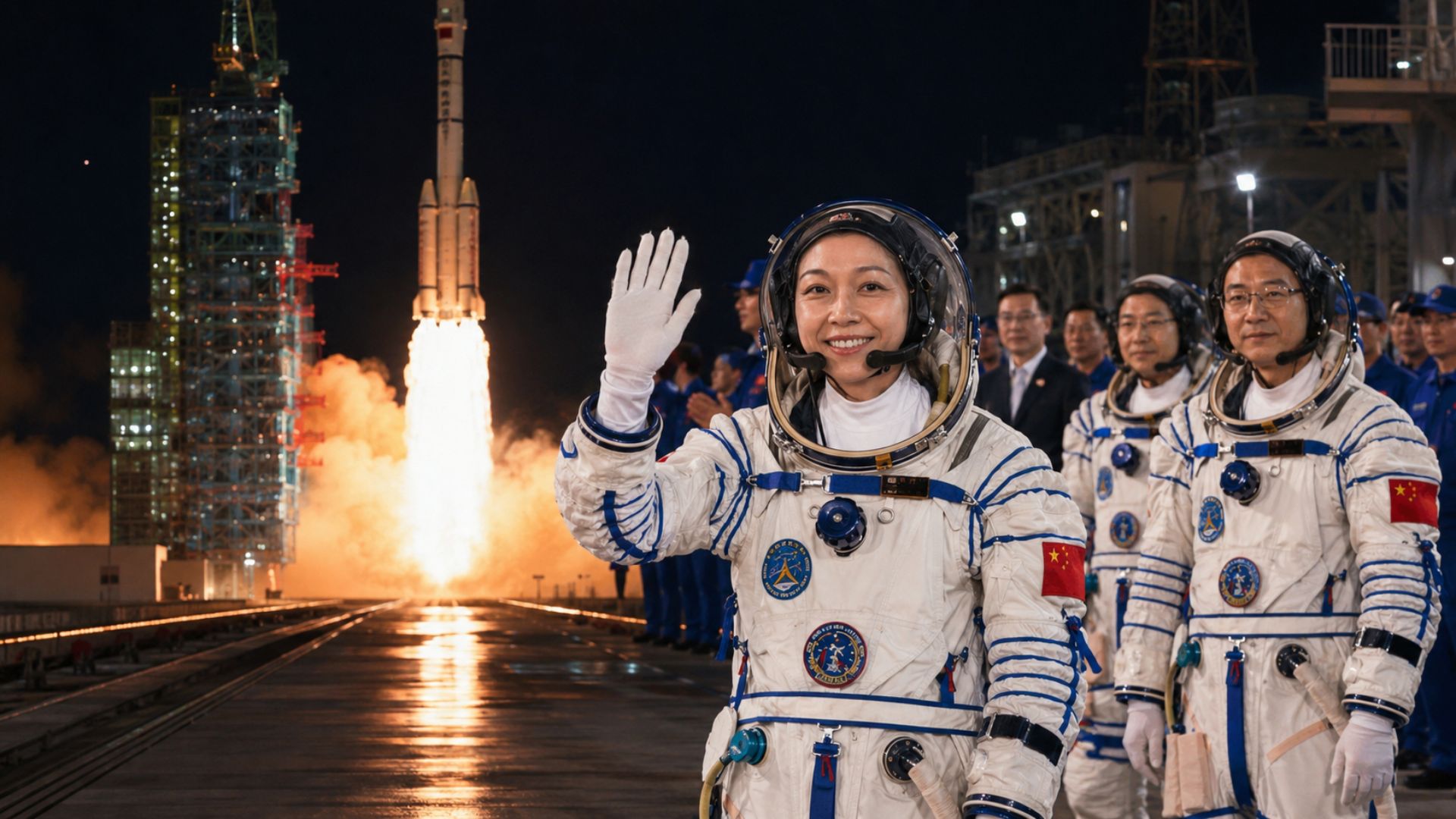


China launched the Shenzhou-23 mission this Sunday (24) with three crew members heading to the Tiangong space station, including Li Jiaying, 43, the first astronaut from Hong Kong to go to space. According to G1, the Long March 2F rocket took off at 12:08 PM Brasília time from the Jiuquan Center in the Gobi Desert. One of the crew members will remain in orbit for an entire year, the longest stay ever planned by China, to study the effects of prolonged microgravity in preparation for lunar missions.
China has just sent to space the first astronaut born in Hong Kong, along with a mission that will test the limits of the human body in orbit. Li Jiaying, 43, a former police officer from the Chinese semi-autonomous territory, embarked on Shenzhou-23 alongside commander Zhu Yangzhu and astronaut Zhang Zhiyuan, both 39. The Long March 2F rocket took off at 11:08 PM local time, 12:08 PM Brasília time, from the Jiuquan Launch Center in the Gobi Desert, carrying the spacecraft and its three crew members to the Tiangong space station.
The most significant milestone of the mission is not the presence of the first astronaut from Hong Kong, but the planned duration. One of the three crew members will remain at the station for an entire year, double the usual six-month stays. The selection of which astronaut will stay for the full period will be made during the mission, depending on health conditions and the progress of experiments, according to the China Manned Space Agency. The 365-day stay is a crucial step in preparing to send Chinese astronauts to the Moon by 2030.
Who is the astronaut from Hong Kong who made history

Li Jiaying, known by the Cantonese romanization Lai Ka-ying, is the first astronaut from Hong Kong to travel to space. Before being selected for the Chinese space program, she worked as a police officer in the semi-autonomous territory. The inclusion of an astronaut from Hong Kong in the crew has political and symbolic significance for Beijing, which seeks to strengthen ties between the special administrative region and the rest of the country.
-
Oceanographer Turns Abandoned Fishing Nets from Brazilian Waters into Bags, Creating Jobs and Earning Over $7,000 Monthly

-
Australia deploys poisoned sausages and uses traps, shooting, and fences in a battle against invasive cats that kill over 1.5 billion native animals annually, threatening more than 200 species.

-
NASA Rover Captures “Tired Face” on Mars, Highlighting Human Brain’s Tendency to See Faces in Rock Formations

-
Ancient Stone City in the Desert, Once Home to 30,000, Puzzles Scientists with Nabateans’ Water Mastery 2,000 Years Ago





The crew is completed by Zhu Yangzhu, the mission commander, a 39-year-old aerospace engineer with experience in the space program, and Zhang Zhiyuan, a former air force pilot of the same age who is traveling to space for the first time. The three astronauts went through a farewell ceremony at the Jiuquan launch center before liftoff.
The challenges of keeping an astronaut in orbit for a year
A year-long stay in space poses challenges that go far beyond spacecraft engineering. Richard de Grijs, an astrophysicist at Macquarie University in Australia, listed the main risks for the astronaut who will remain in orbit: loss of bone density, muscle atrophy, exposure to radiation, sleep disturbances, and behavioral and psychological fatigue.
Until now, Chinese crews have stayed on the Tiangong for a maximum of six months before being replaced. Doubling this time puts both the crew and the equipment in a different operational regime. De Grijs emphasized the importance of the reliability of water and air recycling systems, as well as the ability to manage medical emergencies far from Earth. China has already demonstrated competence in these areas, but the duration is the factor that turns the known into the uncertain.
The experiments that Shenzhou-23 will conduct
In addition to the extended stay, the Shenzhou-23 crew will conduct dozens of experiments in the areas of life sciences, materials science, fluid physics, and medicine. The data collected during the year in orbit will provide evidence on how the human body adapts, degrades, and eventually recovers after prolonged exposure to microgravity.
The results are essential for the Chinese lunar program. A manned trip to the Moon, planned for before 2030, requires scientists to accurately understand the effects of prolonged periods in space. The mission also tests the continued operation of the Tiangong systems in an extended use scenario, validating whether the station supports an astronaut’s demand for 12 consecutive months without the need for external on-site maintenance.
The space race between China and the United States
The Shenzhou-23 mission positions China increasingly closer to the United States in the race for the Moon. Beijing plans to land astronauts on the lunar surface by 2030 and build the first segment of the International Lunar Research Station, a scientific base inhabited on Earth’s natural satellite, by 2035.
The Mengzhou spacecraft, nicknamed “Dream Ship,” is scheduled to conduct its orbital test flight later this year. It will replace the Shenzhou in manned missions to the Moon. China has invested billions of dollars over the past three decades to match its space program with those of the United States, Russia, and Europe, and the results are visible: in 2019, it landed a probe on the far side of the Moon, an unprecedented feat, and in 2021 placed a robot on Mars. The country’s exclusion from the International Space Station in 2011 led China to build the Tiangong, which now serves as a platform for the next stage of human space exploration.
Did you know that a former Hong Kong police officer has just become an astronaut and that one of the crew members will stay in space for an entire year? What impresses you the most: the duration of the mission, the risks to the body, or China’s advancement towards the Moon? Share in the comments.