





 Portuguese
  English
  Spanish
  3 min of reading
  0 comments


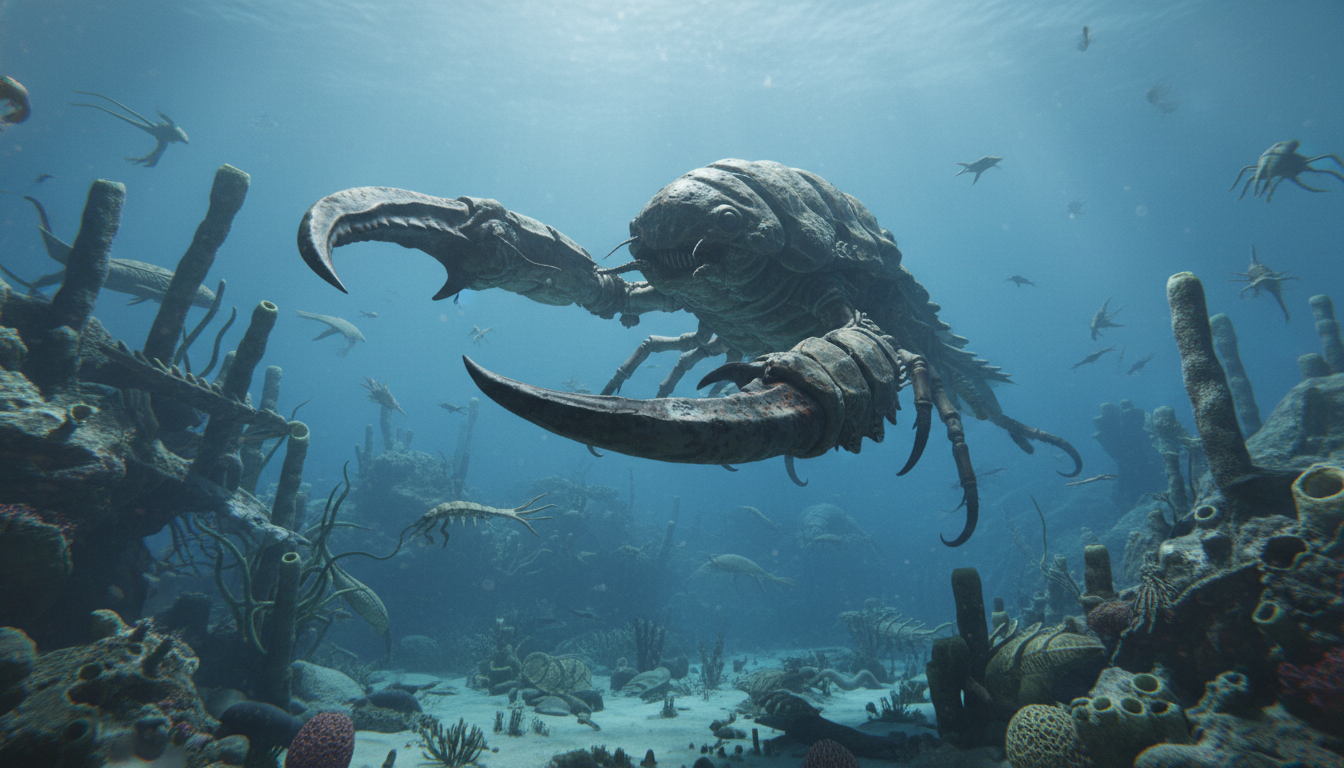
A 500-million-year-old predator with giant claws has just been identified as the oldest ancestor of spiders and scorpions, pushing the group’s origin back by 20 million years
Harvard paleontologists have just identified the oldest chelicerate ever found: a 500-million-year-old marine predator that lived during the Cambrian Explosion.
The fossil, named Megachelicerax cousteaui in honor of explorer Jacques Cousteau, was published in the journal Nature on April 1, 2026. The discovery pushes the origin of spiders and scorpions back by 20 million years.
The animal measures 8.1 centimeters long and has exceptionally large chelicerae with three pincer-like segments. These frontal claws are the signature of the chelicerate group.
-
Processors can become 1,000 times faster with a new device that uses light pulses, operates in 40 picoseconds, and reduces the heat that stalls data centers.

-
Noise in the sky frightened residents: NASA confirms that a meteor exploded over New England with a force equivalent to 230 tons of TNT
-
The invisible flaw that protects banks, passwords, and messages may be numbered after a quantum experiment transforms imperfect randomness into numbers impossible to predict.

-
China has ceased to be just a factory for cheap products and now challenges health giants: Chinese laboratories are advancing in medicines, while other countries recalculate their medical dependence.




Until now, the oldest known chelicerates came from the Fezouata Biota in Morocco, dating back 480 million years. Megachelicerax filled a 20-million-year gap.
Collected 40 years ago and overlooked: how a Utah fossil rewrote the history of spiders
The fossil was collected in the 1980s in the Wheeler Formation, in the Utah desert, but remained unidentified as a chelicerate for over 40 years.

Dr. Rudy Lerosey-Aubril, Harvard paleontologist and lead author, described the moment of discovery: “It took me a few minutes to realize the obvious: I had just exposed the oldest chelicerate ever found.”
The animal had six pairs of head appendages for feeding and sensing. Lamellar respiratory structures under the body resembled the gills of modern horseshoe crabs.
Dr. Javier Ortega-Hernández, associate professor of evolutionary biology at Harvard, explained: “Megachelicerax shows that chelicerae and the division of the body into two regions evolved before the appendages became like the legs of spiders today.”
What the spider ancestor reveals about the Cambrian Explosion

Ortega-Hernández added: “This tells us that, in the middle Cambrian, when evolutionary rates were remarkably high, the oceans were already inhabited by arthropods with anatomical complexity rivaling modern forms.”
As reported by G1, the fossil documents the Cambrian origin of chelicerates and shows that the spider body plan was already emerging 500 million years ago.
According to ScienceDaily, chelicerates took millions of years to ecologically dominate. Trilobites initially overshadowed them, and only later did they colonize land.
From marine claws to terrestrial webs: the long evolutionary journey of chelicerates

Megachelicerax reconciles several competing hypotheses about chelicerate evolution. “In a way, everyone was partially right,” said Ortega-Hernández.
The transitional species links Cambrian arthropods to Ordovician synziphosurines. It shows that chelicerae, body division, and gills emerged shortly after the Cambrian Explosion.
However, there are caveats. Only one specimen is known, limiting generalizations. Soft parts were inferred via reconstruction, and future fossils may refine interpretations.
According to Sci.News, the study is recent and subject to revisions. Still, Megachelicerax cousteaui has already become the key piece to understanding how spiders and scorpions emerged in the primitive oceans — 500 million years before building webs and hiding under rocks.






Be the first to react!