Portuguese
  Spanish


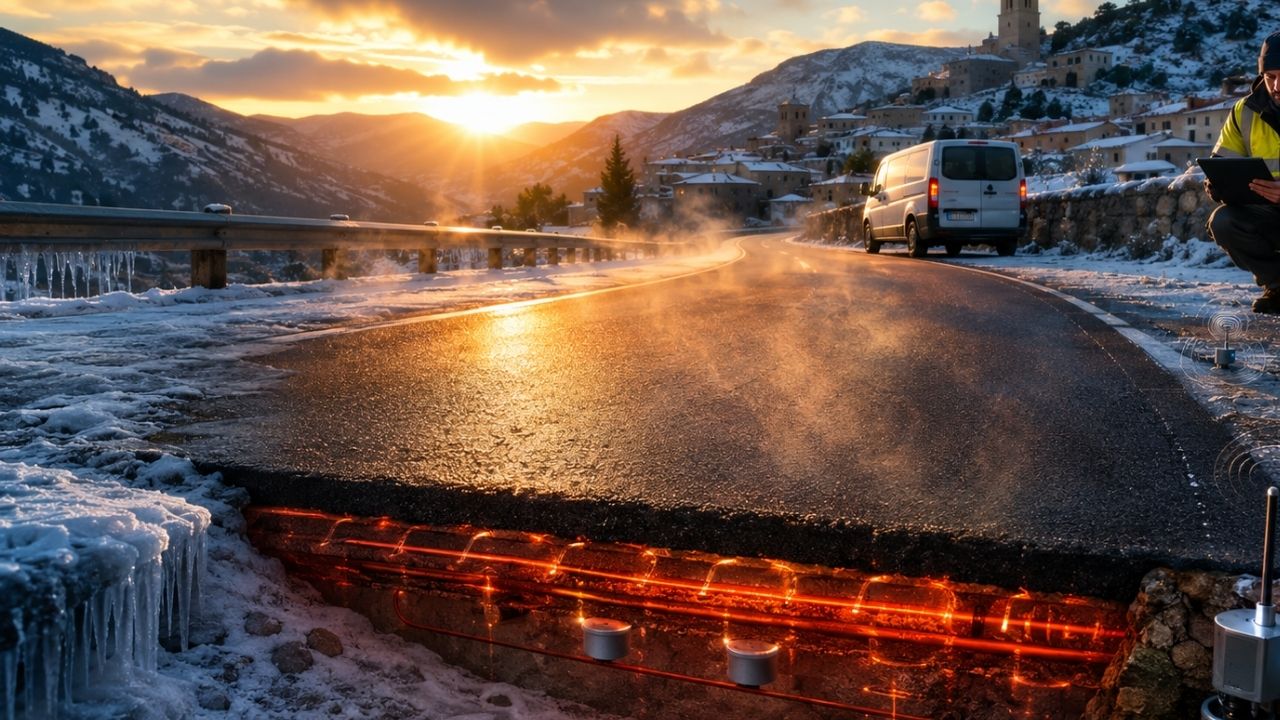

In Spain, roads with passive geothermal energy use copper under the asphalt, IoT sensors via LoRaWAN, and ground heat to reduce ice and decrease dependence on salt, pumps, and external electricity. The test in Ávila raised the pavement by 1.5°C to 2°C on cold winter nights.
Roads may gain a new solution against ice in winter: passive geothermal energy under the asphalt, monitored by IoT sensors and designed to reduce the use of salt. Researchers tested the system in Spain, without pumps, external electricity, or conventional chemicals.
The experiment was conducted in Ávila, one of the cold regions of inland Spain, in a controlled outdoor environment. The proposal is not to melt snow like a traditional heater, but to raise the asphalt temperature by a few degrees, enough to reduce the chance of black ice formation in conditions close to 0°C.
How the asphalt uses ground heat without external electricity
The technology works on a simple principle: the subsoil maintains a more stable temperature than the surface during winter. The system uses this natural heat to transfer energy to the underside of the pavement.
-
Kazakhstan’s Torysh Valley Holds Thousands of Giant Stone Spheres, Intriguing Scientists with Ancient Oceanic “Cannonballs”

-
Egypt Discovers 18 Ancient Tombs with Gold Tongues, Unveiling Unusual Funeral Rituals and Amulets Believed to Give Voice to the Dead

-
Nigeria Dumps 120 Million Tons of Sand into Atlantic to Build Massive City with 8.4 km Sea Wall for Protection Against Ocean Waves and Erosion
-
German Engineer Developed Diesel Engine Running on Vegetable Oil Decades Before Electric Cars Became Popular; Can This Forgotten Idea Work in 2026?



In the prototype, the researchers installed vertical copper exchangers about 1 meter deep, connected to a thermal diffusion grid positioned just below the asphalt layer. Copper was chosen for its high heat conduction capacity.
The major difference compared to other heated systems is that there is no active pumping. The heat rises by conduction, taking advantage of the natural gradient between the ground and the road surface.
This makes the solution interesting for critical sections of roads, such as bridges, shaded areas, dangerous curves, and points where ice tends to appear before drivers notice.
Test compared two sections of pavement side by side

To measure performance, the researchers built two test sections, each approximately 2 meters by 1 meter. One was made as conventional pavement, without thermal reinforcement. The other received the passive geothermal system.
The two sections were placed side by side, exposed to the same conditions of cold, wind, humidity, and temperature variation. This allowed for a more precise comparison of each one’s behavior.
The goal was to understand if the ground-heated section could maintain higher temperatures than the common section, especially on cold nights when the risk of ice is greater.
The study makes it clear that this is a pilot-scale prototype, still without real traffic on the pavement. Therefore, the technology needs to advance to larger tests before being applied on operational roads.
IoT sensors monitored the track in real-time,

Besides the physical part, the system was equipped with temperature sensors at different depths. The network used LoRaWAN technology, common in low-consumption IoT applications, to transmit data in real-time.
The sensors measured the temperature near the surface, in the intermediate layer, and at a greater depth. There was also ambient temperature measurement, allowing the behavior of the pavement to be cross-referenced with external conditions.
This continuous monitoring is an important part of the proposal. Instead of treating all roads the same way, managers could monitor specific sections and act more precisely in times of risk.
The data was also validated with contact thermometers and thermal images, reinforcing that the experimental section really maintained warmer areas above the diffusion grid.
Pavement rose from 1.5°C to 2°C on cold nights
During the monitoring period, the section with the geothermal system showed an average gain of 1.5°C to 2°C near the surface on the coldest nights, compared to the control section.
This increase may seem small, but it is relevant in situations close to freezing. When the surface is near 0°C, a few degrees can separate a wet road from a road with almost invisible ice.
In frost events at the end of December, the conventional section reached about -3°C on the surface, while the experimental section was closer to -1°C. The technology did not completely eliminate the cold, but reduced the likelihood of ice formation.
For roads in regions with moderate winter, this type of thermal gain may be sufficient to increase safety at critical points, especially during early mornings and the first hours of the morning.
System aims to reduce salt use on roads

The study addresses a known problem: the use of salt and other chemical agents to combat ice on roads is efficient in many cases, but brings environmental and economic costs.
De-icing salts can contribute to the corrosion of vehicles, metal structures, and reinforced concrete. They can also contaminate soils, surface waters, and aquifers, as well as affect vegetation near the roads.
The geothermal proposal aims to reduce this chemical dependency. By passively heating the pavement, the system could decrease the need for frequent salt applications on sensitive sections.
This does not mean replacing all winter maintenance. The idea is to complement existing strategies, especially where recurring ice increases the risk of accidents and requires constant interventions.
Passive Geothermal Energy is Not a Magic Solution
Despite promising results, the study points out limitations. Performance depends on soil characteristics, moisture, local climate, and the duration of intense cold periods.
In regions with very severe winters and extremely low temperatures for long periods, the heat available underground may not be sufficient on its own. In these cases, researchers suggest that future hybrid solutions, combining passive heating and low-energy systems, could be evaluated.
There is also the challenge of scale. A 2-meter by 1-meter section in a controlled environment is very different from a real highway, with heavy traffic, repeated loads, wear, drainage, and operational maintenance.
Therefore, the next phases should involve testing in larger areas, durability assessment, cost analysis, and study of the structural behavior of the pavement under real service conditions.
Bridges, Curves, and Shaded Areas May Be the First Targets

The most likely application would not be to heat thousands of kilometers of entire roads, but rather critical points. Bridges, viaducts, shaded curves, and areas where black ice frequently appears are more realistic candidates.
These locations concentrate risk because they cool faster, receive less sun, or accumulate moisture. In these areas, a passive technology that raises the pavement temperature can have a greater impact.
The system also aligns with the idea of smart roads. IoT sensors could alert when the temperature approaches the critical point, allowing for quicker decisions on maintenance and safety.
With real-time data, managers could avoid unnecessary treatments in sections without risk and focus resources where the condition truly requires attention.
Spain Tests Path for More Sustainable Winter Maintenance
The experiment in Ávila shows that road engineering is seeking cleaner alternatives to deal with ice. Instead of relying solely on trucks, salt, and mechanical removal, the research bets on heat stored in the ground itself.
The technology is still in its early stages, but the results indicate that small thermal gains can make a difference in road safety. The challenge now is to prove economic viability, durability, and efficiency on a larger scale.
For European countries subject to frost, snow, and black ice, solutions like this could become part of a new generation of climate-adapted infrastructure. Instead of reacting to ice after it appears, the road could reduce the risk before it forms.
And you, do you think roads with passive geothermal energy could replace some of the salt used in winter, or does this type of technology still seem too distant to reach common highways? Share your opinion.