





 Portuguese
  English
  Spanish
  5 min of reading
  0 comments


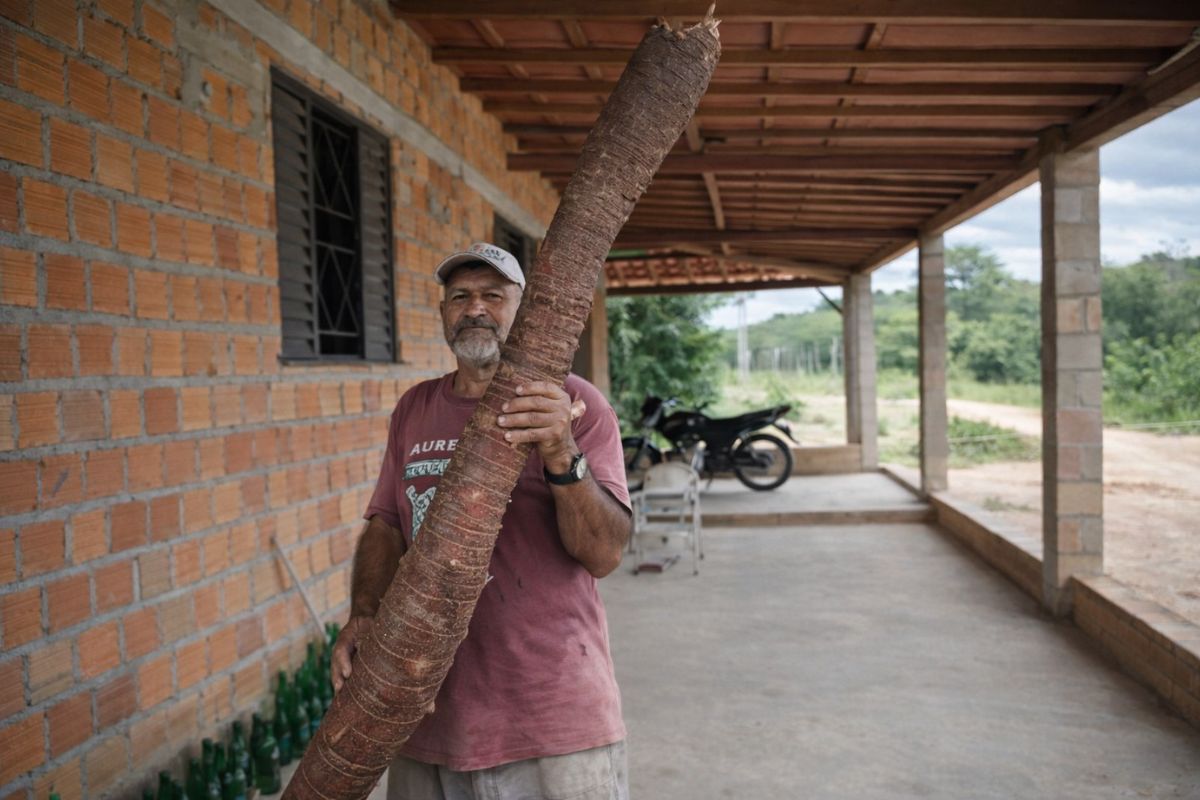
A 70-year-old farmer harvested a cassava approximately 3 meters long and weighing 10 kilograms in Pimenteiras, in Northern Piauí. The root was taller than the farmer himself and was divided into four equal parts among family and neighbors, maintaining the decades-old habit of those who have never stopped planting.
The retired farmer Raimundo Gonçalves, 70, a resident of Pimenteiras in Northern Piauí, harvested on Monday (6) a cassava that left the neighborhood in awe. The root measured approximately 3 meters in length and weighed about 10 kilograms, dimensions that made the plant surpass the height of the farmer who cultivated it. The scene, recorded by his son Francisco Chagas, quickly spread throughout the region and became a source of pride for a family that has lived off the land for generations.
The most revealing part of the story is not the size of the cassava, but what Raimundo did with it. The farmer divided the giant root into four equal parts and distributed it to four families in the neighborhood. “We don’t keep it; we consume it fresh,” Francisco told g1. The piece that went to his son alone weighed more than 2.5 kilograms, enough to feed an entire family for several days. For Raimundo, who has worked with farming for decades and maintains the habit even in retirement, generosity with the harvest is as natural as the act of planting.
How a retired farmer managed to grow a cassava of that size
According to the G1 portal, Raimundo’s giant cassava is not the result of any special cultivation technique or modified seeds. The farmer planted the cutting last winter, in a small plot near his home that he maintains solely for personal consumption. The combination of favorable soil, regular rains during the growth period, and the knowledge accumulated over decades of farming did the rest. In regions of Piauí where the soil is clayey and moisture is retained longer, cassava roots can reach sizes that surprise even experienced farmers.
-
Stamping on pork may seem strange, but it reveals an important detail about food safety that many people overlook at the butcher shop.

-
China recognizes Brazil as free of foot-and-mouth disease without vaccination and unlocks a new phase for Brazilian meat in the Asian market.
-
El Niño advances over Brazil and puts rural producers in the face of 4 climate threats in the second half of the year, with forecasts of extreme heat, prolonged drought, severe storms, and impacts that already concern crops and livestock.
-
China presents the country’s first robot capable of harvesting fresh grains in the field with a success rate of over 90%, using computer vision and robotic arms with force sensors that grasp delicate pods without damaging them even amidst dense vegetation.


The fact that the cassava grew for an entire cycle, from one winter to the beginning of the next, also contributed to its exceptional size. The longer the root remains in the soil without being harvested, the larger it tends to grow, although this can also compromise the texture and flavor in some varieties. In Raimundo’s case, the harvest was done at the right time: the cassava was enormous, but, according to the family, perfectly suitable for consumption. The farmer knows the exact point because he has been doing this for over five decades.
The farmer who never stopped planting even after retiring
The story of Raimundo Gonçalves goes beyond a giant cassava. At 70 years old, the retired farmer maintains the cultivation routine he practiced his entire life, even without needing the production for financial survival. The small plot near his home serves as an extension of an identity that does not disconnect with retirement: that of a man who understands the land, respects its cycles, and harvests what he plants to share with those nearby.
This practice is common in rural communities in Piauí and other states in the Northeast, where retirement does not mean abandoning work with the land. For farmers like Raimundo, planting is not just about producing food; it is maintaining a bond with a way of life that defines who they are. The backyard becomes a garden, the garden becomes a small farm, and what comes from there feeds not only the household but also the network of neighbors and relatives that make up the community. The 3-meter cassava is the most visible result of this habit, but not the most important.
The generosity of the farmer who shared the harvest with the neighbors
Raimundo’s gesture of dividing the giant cassava into four equal parts for four different families says as much about the farmer as it does about the rural culture of Piauí. In communities like Pimenteiras, the surplus from the harvest is not stored for sale nor wasted; it is distributed. The logic is simple and ancient: those who have in excess share with those in need, and reciprocity functions as a social safety net that does not depend on government programs.
Francisco Chagas, the son who recorded the harvest and shared the story with g1, emphasized that the consumption is always fresh. “We don’t keep it; we consume it fresh,” he repeated, reinforcing a dietary pattern that values what has just come from the earth. Cassava is one of the most versatile foods in Northeastern cuisine: it can be boiled, fried, made into cakes, tapioca, or flour. Ten kilograms of root distributed among four families means guaranteed meals for days, at no cost and with the quality that only home cultivation offers.
Why giant cassavas frequently appear in Piauí and the Northeast
Raimundo’s cassava is not the first to attract attention in Piauí, nor will it be the last. Roots of exceptional size frequently appear in states of the Northeast, where soil and climate conditions favor the prolonged growth of cassava. Piauí, in particular, has areas with fertile soil and rainy periods that, when well utilized by experienced farmers, allow for harvests that defy productivity expectations of small properties.
Cassava is one of the most important crops in Brazilian family farming and is present in almost every state in the country. In the Northeast, cassava, as the table variety is called, is a staple food and raw material for dozens of traditional recipes. Farmers like Raimundo, who cultivate on a small scale for personal and community consumption, are responsible for keeping alive an agricultural tradition that feeds millions of Brazilians without most of them even knowing where the food that reaches their table comes from.
A 70-year-old farmer harvested a 3-meter and 10-kilogram cassava in Piauí and shared it with neighbors. Have you ever seen a root this size? Do you have a similar story in your family or community? Share in the comments.







-

1 person reacted to this.