Portuguese
  Spanish


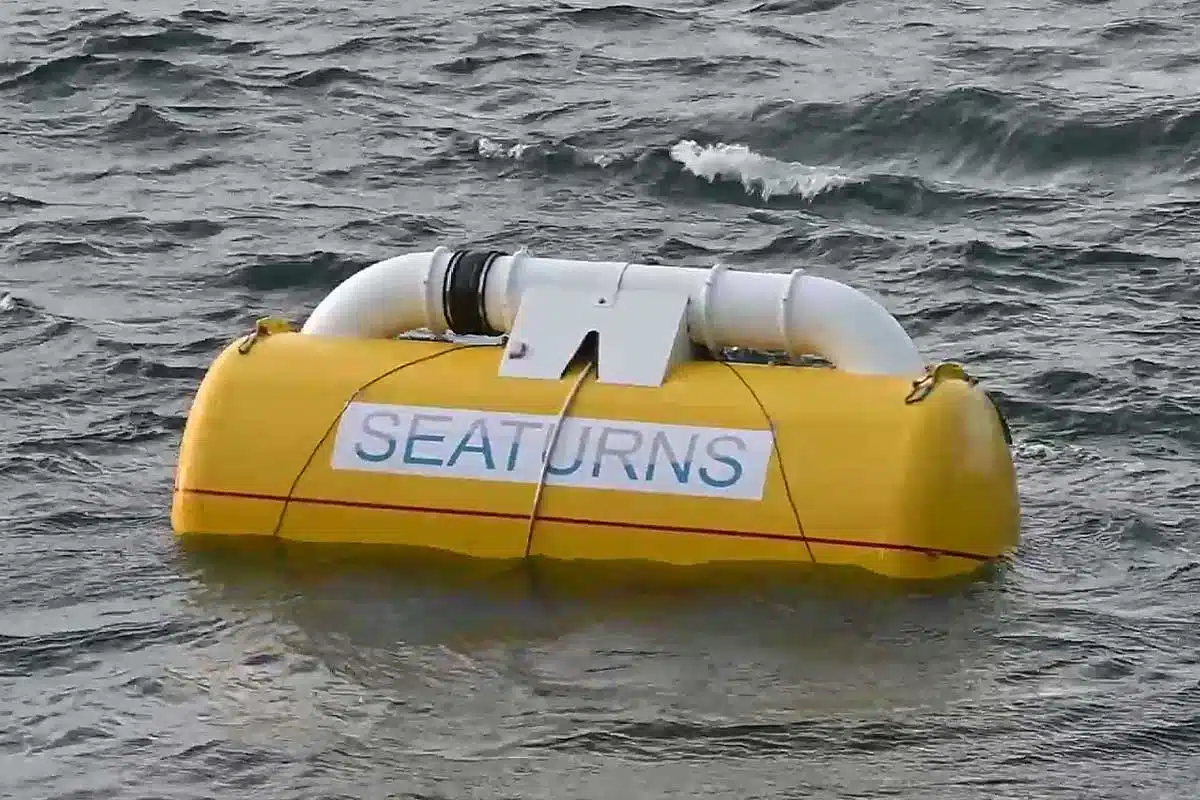

Seaturns Technology Transforms Wave Motion into Electricity, Providing a Clean and Renewable Alternative for Energy Generation in Maritime Environments
Wave motion emerges as a promising solution for the production of renewable energy. According to the World Energy Council (WEC), this source can supply up to 10% of the global electricity demand.
Different technologies have been developed to capture this energy, among them the cylindrical float Seaturns, successfully tested at the port of Brest by the French company of the same name.
Tests of Resistance and Efficiency
The Bordeaux company installed its float at the port of Brest for 16 months to assess its performance and resistance. The tests were conducted in partnership with the French research institute Ifremer.
-
Brazil Aims to Become a Global Exporter of Green Hydrogen, the Clean Fuel Set to Generate Billions

-
Brazil to Hold First Offshore Wind Energy Auction, Aiming to Become the Country’s New Hydropower
-
Brazil to Hold First Auction for Batteries to Store Solar and Wind Energy from the Northeast
-
Brazilian scientists are simultaneously advancing two research projects on clean hydrogen and driving solutions that could transform the energy matrix, enhance industrial competitiveness, and accelerate large-scale emission reduction targets.



During this period, the device faced extreme conditions, including the passing of Storm Ciaran through Brittany. According to Gabriel Canteins, the director of innovation at Seaturns, the equipment demonstrated stability and energy efficiency. He emphasized that the higher the waves, the greater the electricity production.
The estimated power of the cylindrical float ranges between 100 and 200 kW. These results demonstrate the potential of the device to provide clean and renewable energy on a large scale. The technology could represent a significant advancement in the diversification of the global energy matrix.
Impact of Marine Life on Performance
In addition to climate resistance, researchers also assessed the impact of marine life on the float’s operation. Mollusks, algae, and crustaceans attached to the submerged part and anchoring lines of the equipment.
However, according to Martin Träsch, an engineer at Ifremer, these conditions did not significantly affect the movements of the device. The stability of the float in light of this factor is an important advancement for its practical application.
In the tests conducted, the company used a scaled-down prototype. This model allowed for adjustments before the construction of a larger and final version. The technical feasibility of the project was confirmed even in the face of the natural challenges of the marine environment.
Next Steps: Expansion and Deployment
With the success of the tests in Brest, Seaturns plans to move on to a new phase of the project. The company intends to develop a model that is 14.5 meters long, 7.5 meters high, and 42 tons. This demonstrator will be installed in Saint-Nazaire, in the Pays de la Loire region, in July of this year.
According to Träsch, the new phase will bring additional challenges, including transportation, float filling, and maintenance issues. The project plans to deploy pilot farms composed of rows of ten devices between 2026 and 2029. If this phase is successful, commercialization of the technology will begin in 2030.
Clean Energy for Isolated Regions
Seaturns’ proposal aims to provide clean energy to remote islands and strategic installations, such as hydrogen production units. To facilitate expansion, the company seeks partnerships with industries and intends to raise €2.4 million.
The technology of floats could represent a significant advancement in the energy transition. If deployed on a large scale, it will contribute to the reduction of dependence on fossil fuels and the development of more accessible and efficient renewable sources.
With information from Neozone.