






 Portuguese
  Spanish


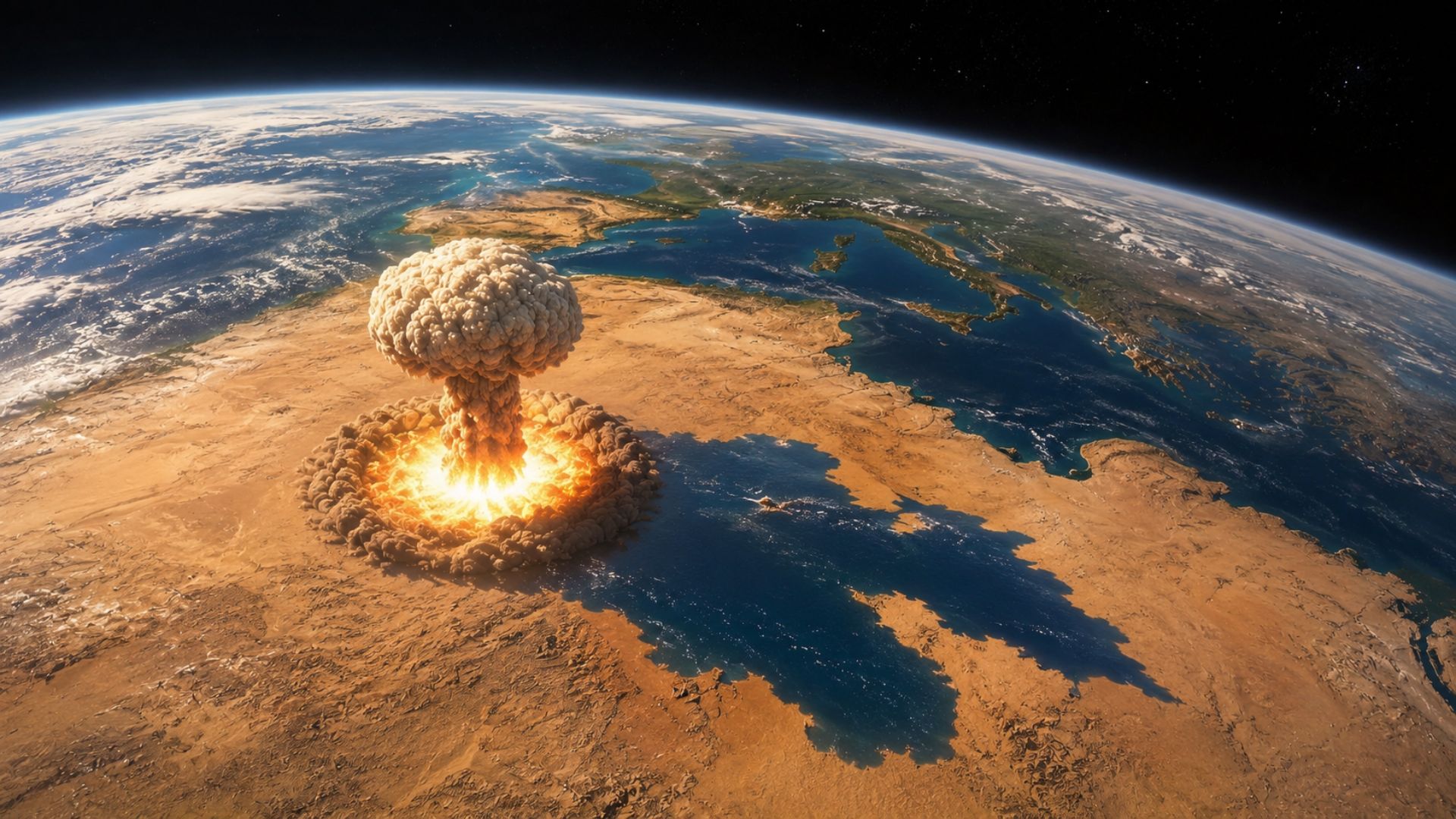


German engineer led a plan between 1964 and 1973 to flood the Qattara Depression in the Egyptian Sahara with water from the Mediterranean; each of the 213 explosions would have a hundred times the power of the Hiroshima bomb, and the plant would reach a peak of 5,800 megawatts.
In the heart of the Sahara, the largest hot desert on the planet, there is a natural crater so deep and so close to the sea that, for almost a century, engineers from various countries have dreamed of filling it with water. The Qattara Depression, in northwestern Egypt, lies 133 meters below sea level and just 55 kilometers from the Mediterranean coast, a geographical combination that has turned this stretch of the Sahara into the target of one of the most daring and disturbing engineering projects of the 20th century.
The most ambitious plan came from the drawing board of German hydraulic engineer Friedrich Bassler, who between 1964 and 1973 proposed opening a canal to the sea and, to speed up the excavation, detonate 213 nuclear bombs in the desert, each with power equivalent to a hundred times the bomb dropped on Hiroshima. The ultimate goal was not destruction, but energy: a plant that would surpass the largest Egyptian hydroelectric plant. The idea was rejected by the Egyptian government, but according to records gathered by Wikipedia, it was never completely abandoned.
The depression in the Sahara that almost became a sea

The Qattara Depression is the second deepest point in all of Africa. At 133 meters below sea level, it is deeper than the lowest point in Europe and the Laguna del Carbón in Argentina, the deepest place in the Americas. In an area of 19,000 square kilometers comparable to the entire El Salvador, only a few hundred people live, concentrated in the Qara oasis and in small isolated settlements in the middle of the Sahara.
-
Engineers Develop Fridge-Sized Machine to Produce 95-Octane Synthetic Fuel from Air and Water, Aiming to Sustain Combustion Engines Without Oil

-
Two-Armed Robot Uses AI to Reassemble Destroyed Pompeii Frescoes, Solving an “Impossible” Puzzle
-
New Law in Brazil Requires Breaks for Type 1 Diabetes Management at Work, School, and Public Exams

-
Scientists Confirm “Greening” of Antarctica: Ice on the World’s Coldest Continent Turns Green as Mosses Multiply Over Tenfold in Four Decades


It is precisely the proximity to the sea that makes the idea technically possible. A 55-kilometer-long canal would be enough to bring water from the Mediterranean to the depression. For comparison, the Suez Canal is 193 kilometers long. The great advantage of the Qattara project is that the water would not need to be pumped: since the depression is below sea level, the liquid would flow on its own, pulled by gravity, towards the interior of the desert.
How the desert would transform into a power plant
The artificial lake in the Sahara would not be a simple body of water. As the region is extremely hot and dry, the water would continuously evaporate, making room for more seawater to continuously enter through the channel. This permanent flow is the secret of the entire project: the moving water would pass through turbines and generate electricity in a stable and uninterrupted manner.
The concept became known as “hydro-solar,” although it did not involve solar panels in the modern sense. The term refers to harnessing the desert sun’s heat, which causes evaporation and keeps the cycle going. According to the feasibility study filed by the United States Department of Energy, the plan combined seawater intake with generation facilities. The plant would achieve a peak capacity of about 5,800 megawatts — much of it coming from a reversible system, a number that would surpass the 2,100 megawatts of the Aswan Dam, the largest in Egypt.
The plan of 213 nuclear bombs in the Sahara
Bassler concluded that excavating the channel with conventional machines would be too expensive and time-consuming. His solution was radical: use 213 nuclear detonations of 1.5 megatons each to open the passage and remove millions of tons of rock in a short time. It may seem crazy by today’s standards, but in the 1960s, nuclear explosions for civil works were taken seriously by Americans and Soviets.
The United States conducted 27 tests in the Plowshare program, and the Soviets carried out 239 detonations under the same concept of “peaceful nuclear explosions,” according to historical documentation gathered by Wikipedia on the project. In 1965, a Soviet explosion created Lake Chagan in Kazakhstan, which remains radioactive to this day. Bassler studied the American test Storax Sedan, from 1962, which created the largest artificial crater in the United States and concluded that the technique would work in the Egyptian desert, provided that about 25,000 people were relocated from the area.
The idea that had already been offered to an American president
Bassler did not invent the concept from scratch. The desire to flood the Qattara Depression is much older: German geographer Albrecht Penck suggested something similar back in 1912, and Briton John Ball detailed the idea in 1927. The proposal even reached the White House desk. In the 1950s, the CIA presented the plan to President Dwight Eisenhower.
According to documents cited by the site Futility Closet, the agency described the future lake as “spectacular and peaceful” and stated that it “would materially alter the climate of the surrounding areas.” Eisenhower refused. Decades later, it was Bassler’s turn to revive the dream with modern engineering airs, only to encounter the same obstacles that haunted the idea from the beginning.
Why Egypt said no
The Egyptian government categorically rejected the nuclear proposal. Detonating 213 bombs, each one hundred times more powerful than the one in Hiroshima, in a country that houses millions of people in the Nile Valley just a few hundred kilometers away, was considered an unacceptable risk, even in the face of economic arguments. Radioactivity was just the beginning of the list of problems.
There was also a little-remembered geological danger: the Red Sea Rift, a tectonically unstable zone, is about 450 kilometers from the site of the explosions, and the shock waves could have unpredictable seismic effects. Add to that the amount of unexploded ammunition from World War II scattered across northern Egypt, which would need to be removed before any work. The combination of radioactive, seismic, and logistical risks buried the nuclear plan in the Sahara but not the desire to transform Qattara into a sea.
The project that returned to the table in the 21st century
The interest in the Qattara Depression never completely disappeared. In April 2023, Egypt announced a new contract to study the feasibility of the project, this time without any mention of nuclear explosions. The region appears in the country’s national clean energy plans, and recent academic studies explore modern paths for the old idea.
The new proposals replace bombs with conventional excavation and aim at current technologies such as floating photovoltaic solar energy, wind energy, and water desalination, according to research published in journals like ScienceDirect. Some even suggest using fresh water from the Nile, instead of saltwater from the Mediterranean, to sustain the future reservoir. What once depended on a nuclear arsenal is now debated as a potential renewable energy hub in the middle of the Sahara.
A desert that was once green


The idea of filling a piece of the world’s largest hot desert with water sounds less absurd when you remember that the Sahara wasn’t always arid. Between 14,000 and 5,000 years ago, the region was lush, with abundant rains, rivers, and lakes. Fossils found in the area reveal that giraffes, elephants, hippos, and rhinos lived there, proof that the desert supported complex ecosystems before drying up.
Natural climate cycles indicate that the Sahara will become green again in a few thousand years. The Qattara project, at its core, merely proposed to anticipate with engineering what nature would eventually do on its own. The difference is that human haste, at that time, was packaged with 213 nuclear bombs — a solution that time has seen fit to retire.
And you, what do you think of this story? Should such a project be resumed with modern technologies, or is it better to leave the desert in peace? Let us know in the comments and tag that friend who loves improbable stories of science and engineering.







Imagine the radioactive dust storm going across the continent to down in the Caribbean and causing generations of cancer into the future. The Sahara desert dist usually drift in the wind through the Caribbean to south and north america, this is spoil capitalist class that think they have a paternalistic role to play by any means to realize their sociopathic academic status in this world.
It should be resumed in order to alleviate chronic water shortage
What are these people thinking, there are animals who live in the desert and these so-called scientists want to destroy nature.