






 Portuguese
  Spanish
  4 min of reading
  0 comments


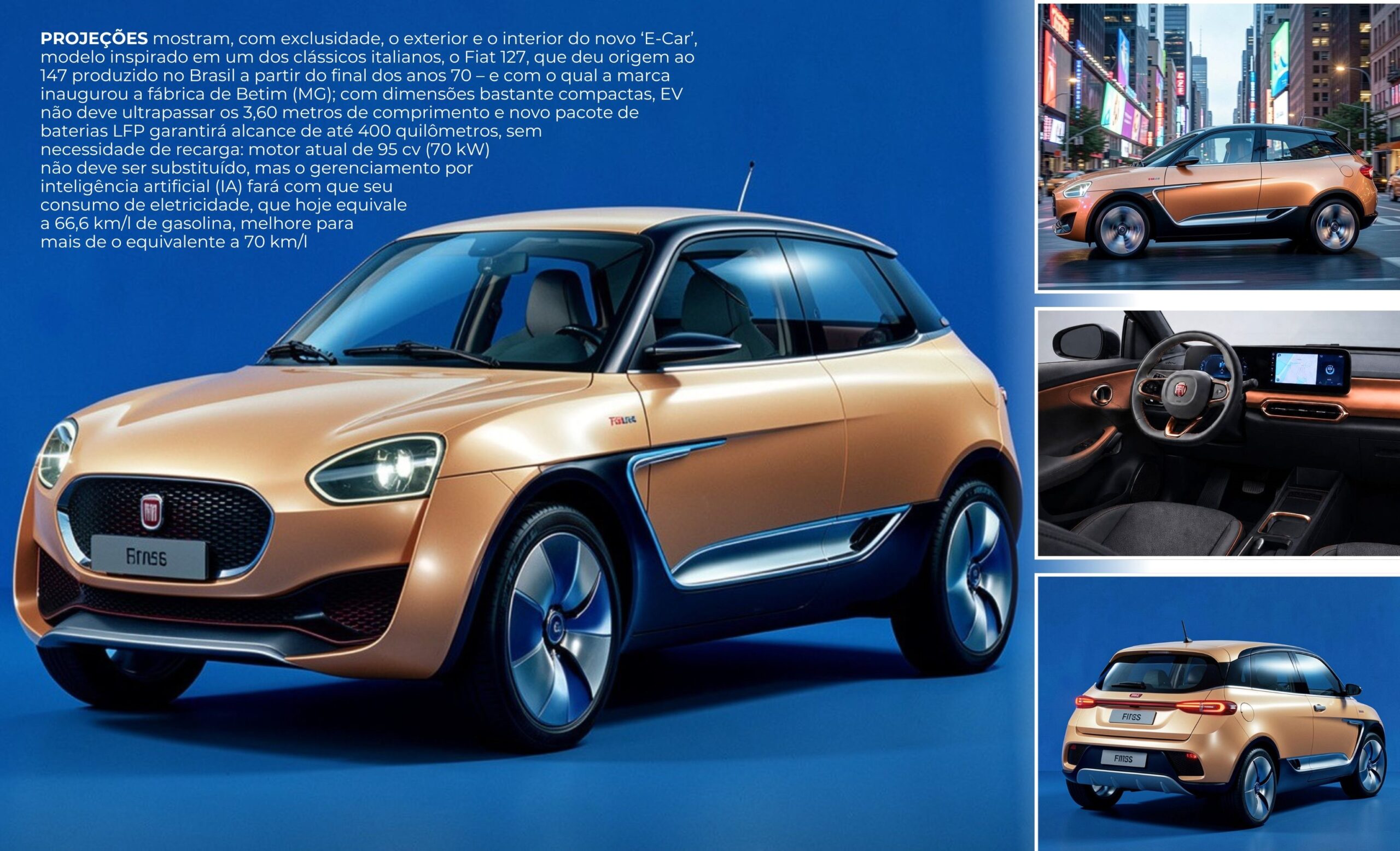
A new compact EV, codenamed ‘E-Car’, is Stellantis’ big bet to restore Fiat to its rightful place in the European market. Initially, the model, which will be a kind of twin to the second generation of the T03 from Leapmotor, will be restricted to Europe. However, nothing prevents it from migrating to other regions. Brazil would have preference in this case, as it is the brand’s second-largest market.
In 2025, Fiat sold more than 530,000 passenger cars and light commercial vehicles in the country. This easily surpassed the 144,000 units sold in Italy and the 118,000 in Turkey. For now, it is known that its launch is scheduled for 2028. Additionally, it will cost less than 17,000 euros in the Old Continent, around 77,000 R$.
Projections obtained exclusively by our report show the exterior and interior of a model inspired by one of the Italian classics, the Fiat 127. This gave rise to the 147 produced in Brazil from the late 70s. With it, the brand inaugurated the Betim (MG) factory.
-
Ferrari’s First Electric Car Divides Fans, Priced at $630,000, Amid Concerns Over Limited Editions; Brand Clarifies It’s Not Just for Future Perks

-
NASA Tests Rover with Lizard-Like Suspension and Independent Wheel Traction, Aiming for Speed Ten Times Faster than Perseverance on Mars

-
Facing high living costs, 33-year-old man converts VW Transporter into a camper van to travel with elderly dogs, saving £1,550 monthly.

-
China Restores Over 13 Hectares of Mangroves in Fujian Using Innovative Tree and Shrub Technique to Combat Waves and Capture Carbon



The version in the images has two doors, differentiating it from the current four-door Leapmotor T03. Besides keeping them apart to avoid cannibalization, the new ‘E-Car’ would reinvent the 127 as an individual mobility option. Thus, it preserves the essence of a subcompact that – like it or not – impacted the habits and lives of many drivers.
Seen from the front, it resembles the first generation of the Brazilian Fiat 147, which few remember. However, most people only remember the second-generation Spazio, which featured wraparound trapezoidal headlights, replacing the original square optical set. At the rear, the vertical (rectangular) lights of the “cousin” 500 give way to a horizontal piece that connects both ends. Additionally, there are two low lights within the bumper.
Subcompacts and inflection
Despite the subcompact segment, where the Ford Ka and the Cinquecento itself were inserted, having practically disappeared in Europe, and compacts losing market share, Fiat hopes to inflect this curve. In this way, it intends to regain leadership among city cars in the Old Continent.
The main feature of the ‘E-Car’ will be a range of up to 400 kilometers without needing to recharge the new LFP (lithium iron phosphate) battery pack. The current 95 hp (70 kW) engine is not expected to be replaced.
However, management by artificial intelligence (AI) will improve its electricity consumption, which today is equivalent to 66.6 km/l of gasoline, to more than the equivalent of 70 km/l. Additionally, recharge times are also expected to decrease significantly.
From the approximately 55 minutes that today guarantee an additional 180 km of range, the recovery from 15% to 80% capacity will take less than 30 minutes. Thus, this would ensure an additional 320 km of autonomy.
Streamlined interior
Inside, the finish promises superior materials to those used today in the Panda – I personally believe that this improvement will be limited to visual and tactile fields.
The instrument panel of the projection we bring features a single screen, divided into an instrument cluster and infotainment center, with a very clean layout, without buttons – the controls are on the multifunction steering wheel and the front touch screen. Even the transmission selector has been eliminated from the central console, which displays a tiny handbrake – it is unknown if it’s electric or mechanical.
You don’t need to be a production engineer to notice the economy in every detail. But credit where it’s due: compared to its direct competitors, which will be the new Renault Twingo EV and the future Volkswagen ID.1 (commercial version of the ID. Every1 concept), the Fiat ‘E-Car’ seems fit for the mission of revaluing the brand. This elevates consumer perception beyond economy and efficiency.
With very compact dimensions, the new EV should not exceed 3.60 meters in length, with a volumetric capacity of up to 220 liters in the trunk – which grows to about 800 liters with the rear seatback folded down. In terms of performance, it remains true what electric vehicle owners already know: they are models that accelerate quickly but do not reach astronomical speeds. Here, one can expect a value around 11.5 seconds for 0 to 100 km/h, and a maximum speed below 140 km/h. Not bad for a small car that, it is worth remembering, will have an electricity consumption equivalent to 70 km/l.
Leapmotor and Brazil
On the industrial side, the ‘E-Car’ will give new life to the Pomigliano factory (Italy), which has an installed capacity to produce 300,000 cars per year. However, according to Italian unions, it only produced 135,000 units in 2025, most of them Pandas.
The end of Citroën C4 production at the Villaverde plant in Madrid (Spain) also opens space for the allocation of another product from the partnership with Leapmotor, in 2028. Regarding Leapmotor, it is important to clarify that Stellantis’ control is limited to a 21% shareholding and two seats on its Board of Directors (chaired by the brand’s founder, Zhu Jiangming).
As for Leapmotor International (LPMI), which is the joint venture we are talking about, Stellantis holds 51% of the shares. This is a majority stake that gives it exclusive rights to appoint the company’s CEO (in this case, Tianshu Xin). Additionally, it can manufacture, export, and sell Leapmotor products globally, except in China.
In other words, the fate of the ‘E-Car’ and its possible – although very unlikely – arrival in Brazil is in the hands of Stellantis – aka, Fiat.





Be the first to react!