Portuguese
  Spanish


In The Arctic, A Concrete Structure Serves As The Ultimate Insurance Policy For Agricultural Diversity And The Future Of Global Food.
In the remote archipelago of Svalbard, Norway, stands the Svalbard Global Seed Vault. Commonly referred to as the “Doomsday Vault”, its mission is crucial: to protect the planet’s seed diversity. It operates as a maximum security facility, storing duplicates of seed collections from around the world. This vault represents an essential safeguard for the future of our food against global and local threats.
What Is The Key To Global Survival And Why Is It Essential?
The primary purpose of the seed vault is to serve as a security storage. It is not an ordinary seed bank, but a depository service for the more than 1,700 gene banks that exist. Its creation responds to the vulnerability of these collections. The loss of a crop variety is irreversible, and the vault exists to prevent that from happening.
The need for a facility like this arises from many threats. Although often associated with global disasters, its most common use is to protect collections from routine issues. Problems such as mismanagement, equipment failures, or accidents can destroy local seed banks. A simple malfunction in a freezer, for example, can ruin an entire collection. Besides its practical function, the vault is a powerful symbol of international cooperation, where shared survival overcomes geopolitics. The project is a partnership between the Norwegian government, the NordGen gene bank, and the Crop Trust organization.
-
Shorter Workdays and 14-Month Parental Leave: How Brazilian Women in Norway Experience a New Standard of Quality of Life

-
Neymar’s New Yacht Features Helipad, 800m² Space, and Six Suites After Rare Conversion, Set to Appear Off Brazil’s Coast

-
Psychologist in Brazil’s Acre Calls Alligator by Name, Shares Unlikely Bond Story
-
Baby born healthy after being frozen as an embryo for 31 years, showcasing the reach of scientific advancements

The Engineering Behind The Seed Vault That Is The Key To Human Survival
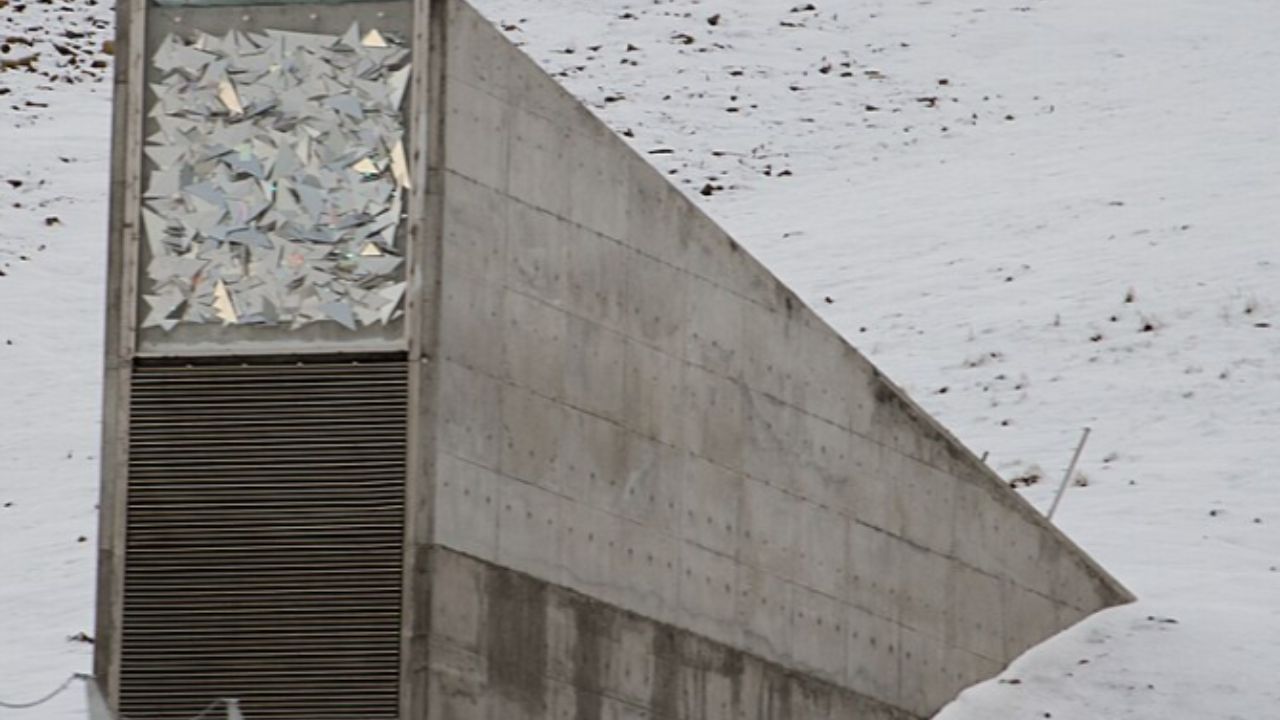
The location of the seed vault on Spitsbergen Island was a strategic choice. The region is remote but accessible. Geologically, the area is stable and has low humidity, ideal conditions for preservation. Norway’s political stability was also a decisive factor.
The structure is a marvel of engineering. The vault was dug over 100 meters deep into solid rock. To protect against the effects of climate change, it was built 130 meters above sea level, safe from flooding. The structure was also designed to withstand earthquakes of up to 10 on the Richter scale. Its iconic entrance, a monolith of concrete and steel, is adorned by the art piece “Perpetual Repercussion”, which uses lights and mirrors to mark the vault’s location, transforming the entrance into a beacon of hope and precaution.
How Do Seeds Remain Viable For Centuries?
The longevity of the seeds is ensured by a dual-layer strategy. First, an artificial refrigeration system maintains the internal temperature at the international standard of -18°C. This system is powered by local energy and has emergency generators.
The second layer of protection is the natural permafrost of the mountain. The rock surrounding the vault has a stable temperature between -3°C and -4°C, functioning as a natural freezer. Even if the refrigeration system fails completely, the permafrost would keep the seeds frozen. It is estimated that it would take centuries for the internal temperature to reach 0°C. The seeds are sealed in three-layer aluminum foil packages, which limit access to oxygen and minimize aging.
A Treasure Of Agricultural Diversity
The seed vault was designed on a monumental scale. With three underground chambers, it has the capacity to store 4.5 million samples, equivalent to 2.5 billion seeds. Currently, its collection already exceeds 1.3 million samples, making it the most diverse collection in the world.
The project includes participation from 129 depositors from almost every country. The collection ranges from staple foods like corn, rice, and wheat to varieties of eggplant, lettuce, and potato. Despite the large volume, only one of the three storage chambers is in use, demonstrating that the vault is a living library, continually growing to protect the world’s genetic diversity.
Who Really Controls The Seeds?
The success of the vault that is the key to human survival depends on its operational model. It operates under the “black box” principle. The Norwegian government owns the facility, but the depositing gene banks retain full ownership of their seeds. The deposit of samples does not represent a legal transfer of genetic material.
The depositors are the only ones who can access and withdraw their seeds. No researcher or farmer can request samples directly from the Svalbard vault. To encourage participation, the storage service is free. The effectiveness of this system has already been proven: Syria was the first country to make a withdrawal, after its seed bank in Aleppo became inaccessible due to the war. This event proved that the seed vault is an essential and functional tool for protecting humanity’s agricultural heritage in the present.