






 Portuguese
  Spanish


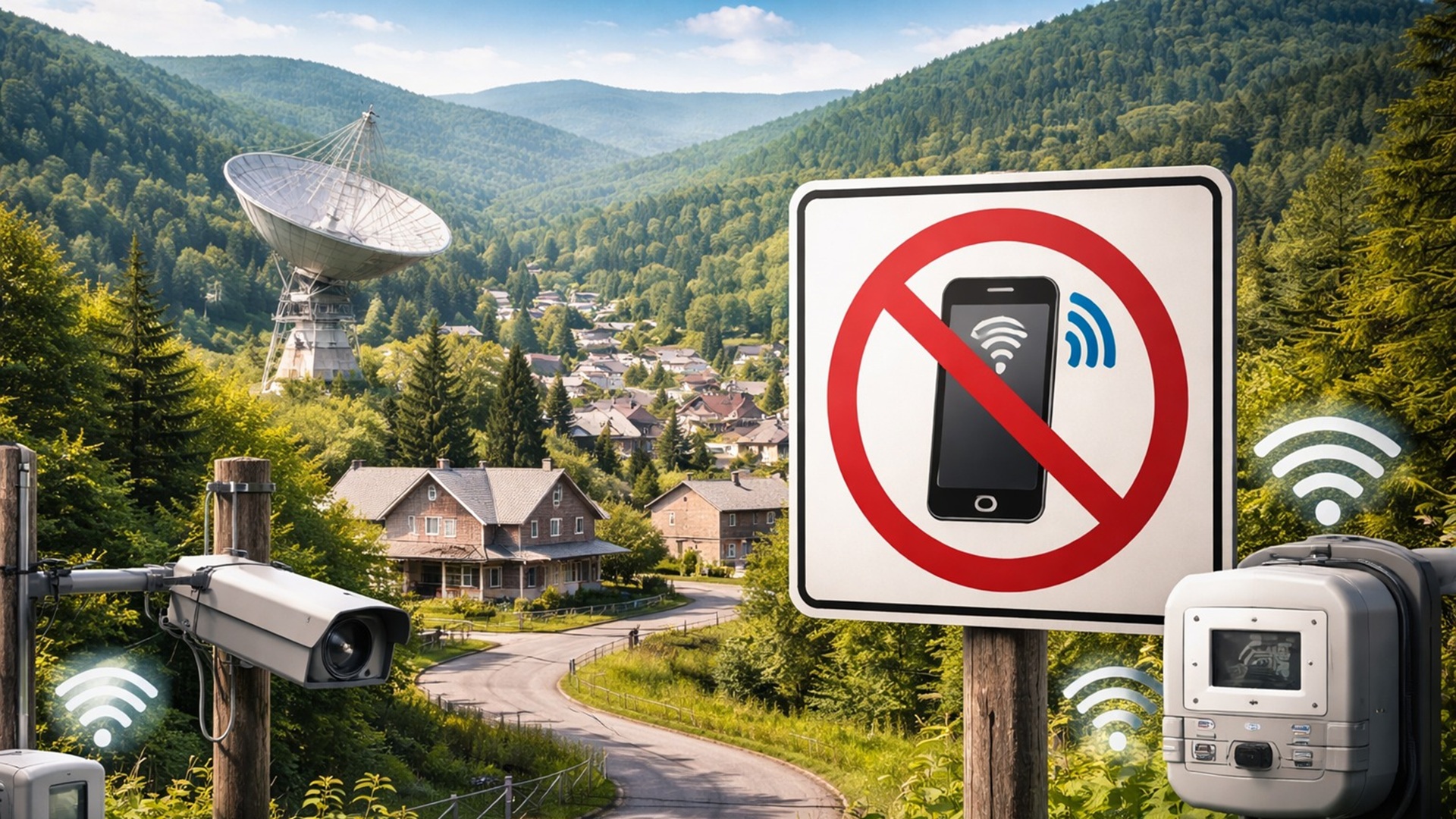


Located in the Center of the National Radio Quiet Zone, Green Bank, in West Virginia, Lives Under Rules That Restrict Electromagnetic Signals, Shaping the Local Economy Since the 1970s and Transforming Technological Isolation into a Central Part of the Routine, Identity, and Social Tensions of the Community
Located in the mountainous interior of West Virginia, Green Bank is known as the quietest town in the United States not by cultural choice, but by technical and scientific imposition. Daily life without cell phones, radios, or wireless signals was documented in a report by RocaNews, which traveled through the region and spoke with residents to understand what it is like to live practically off the grid in the 21st century.
What Is the National Radio Quiet Zone and Why Does It Exist
Green Bank lies at the center of the National Radio Quiet Zone, an area of approximately 13,000 square miles that covers parts of Virginia, West Virginia, and Maryland. Within this perimeter, radiofrequency emissions are monitored, restricted, or completely prohibited, especially as one moves toward the core of the zone.
The creation of the area dates back to the 1950s, when radio astronomy was emerging as a strategic field of scientific research.
-
16-Year-Old from Brazil’s Sertão Wins Young Scientist Award for AI Predicting Rainfall with 94.5% Accuracy to Aid Farmers

-
Netherlands Reports First Child Euthanasia Case Since Rule Expansion for Minors

-
Brazilian Innovator Survives Homemade Submarine Dive in Paraty Despite Hatch Leak and False Oxygen Alarm
-
China Develops Custom 140-Ton Electric Mining Truck with 770 kWh Swappable Battery, Deploys 290 Units in Xinjiang’s Largest Zinc Mine



The Appalachian Mountains provided natural isolation against external interference, creating ideal conditions for capturing extremely weak signals from deep space. At the same time, the United States government was seeking secure locations for sensitive military communication installations.
The Observatory That Redefined the Region’s Destiny
At the center of this zone, the Green Bank Observatory was established, housing some of the largest radio telescopes in the world.
Its main instrument, the Green Bank Telescope, occupies about 2.3 acres, an area equivalent to more than two football fields, and dominates the local landscape.
Within the observatory’s perimeter, the use of electronic devices is severely limited. Digital cameras, cell phones, and smartwatches are prohibited outside specific areas.
Monitoring vehicles constantly patrol the region’s roads to identify irregular emissions that may compromise scientific observations.
The Journey to Absolute Silence
The team from RocaNews began their journey in Falls Church, Virginia, one of the most connected areas on the planet and considered the world’s capital of data centers.
The contrast becomes evident along the road: after hours of traveling through winding roads, isolated farms, and small villages, the cell signal simply disappears.
The interruption is abrupt. Navigation apps stop working, audiobooks get cut off mid-sentence, and phones display only emergency calls.
Even miles away from Green Bank, the absence of connectivity is already total, reinforcing the feeling of transitioning to another time.
Economy in Decline and Communities That Resist
Before the imposition of technological restrictions, the region experienced a period of relative prosperity. Sawmills, tanneries, coal mining, and forestry sustained entire towns until the mid-20th century.
Starting in the 1970s and 1980s, the shutdown of these activities led to significant economic and population decline.
Residents interviewed report that job opportunities have become scarce, forcing many young people to leave the area. Those who remain depend on pensions, public jobs, local services, or manual labor.
The technological silence, for some, is secondary to the economic silence that has settled over the years.
Life Without a Cell Phone: Privilege or Limitation
The absence of cell phones divides opinions. Some residents consider digital isolation a benefit. Sleeping without interruptions, living without constant notifications, and maintaining more direct relationships are cited as advantages.
Others, however, highlight practical difficulties, especially in emergencies or when searching for opportunities outside the region.
Technology is not entirely banned. Landlines are common, internet connections via cable are allowed with authorization and monitoring, and some household equipment, like microwaves, can be used as long as they do not emit interference above established limits. When a device causes noise, technical teams may require adjustments or replacements.
The Refuge for Those Seeking to Live Off the Grid
Green Bank also attracts people from other parts of the United States and the world who deliberately seek a lifestyle off the grid.
Among them are individuals who claim to suffer from electromagnetic hypersensitivity, believing that radio waves and wireless signals cause physical symptoms.
Although there is no scientific consensus on this condition, the town has become one of the few places where these individuals believe they can live with reduced exposure to electromagnetic fields.
The presence of this group adds a unique social layer to the already unusual local dynamics.
The Contrast Between Cutting-Edge Science and Rural Routine
One of the most striking aspects portrayed by RocaNews is the contrast between the simple lives of residents and the presence of one of the planet’s most sensitive scientific and military infrastructures. Many residents know little about the work being done at the observatory and rarely have contact with the scientists working there.
While giant antennas capture signals from distant galaxies and support cutting-edge research, the daily life around continues to be marked by mechanic workshops, small restaurants, family farms, and nearly empty roads. Silence, in this context, is both technological and social.
A Concentrated Portrait of Rural America
Green Bank is not just a scientific curiosity. It serves as a condensed portrait of the profound transformations experienced by rural communities in the United States.
The isolation imposed by technology adds to economic decline, population aging, and the feeling that progress has bypassed the Appalachian Mountains.
In the end, the quietest town in the country reveals stories of resistance, adaptation, and loss. In a place where signals do not circulate, it is the memories, local ties, and the landscape that keep communication alive, even when the modern world seems incapable of reaching these hills.







Eu sofro hipersensibilidade infrasom ,ondas eletromagnéticas eram a 1a hipótese,parece ser infrasom..mas ainda não acharam aparelhos p detectar qual equipamento próximo a minha casa emite o q me causa taquicardia,parece um choque continuo .horrível. tenho vários cães mas 2 sentem muito. Ficam estressados,choram. Passa um período tem .parece ser do inversor de muitas placas solares de um sítio em frente ou de um transformador do poste de praia..muito potente. A Coelba ,Cia de eletricidade nada fez. Já fui a tudo. Del meio ambiente,sec. Meio ambiente. Vou vender a casa e sair. Só Deus sabe o q é passar por isso QUERO DESCOBRIR C EQUIPE DE Físicos DA UNIV LOCAL P Ajudar BEBÉS,PESSOAS E Q NAO SABEM O Q SE Passa E VAO SER TRATADAS COMO DOENTES E NAO É. É UM PROBLEMA EXTERNO.É PRECISO LEIS P DETECTAR ESTES Fenômenos E CESSA_LOS. AJUDEM POR FAVOR
email moto8pio@gmail.com
Yes beathfull, I love……!
E triste e nos com essas tecnologias que cada dia tira nosso sono e nossa paz,ajuda numa partes mas acabam com outras como , Nossa saúde.uns sabem usar e outros não.