






 Portuguese
  Spanish


In 2013, UTEC (Universidad de Ingeniería y Tecnología), the engineering university of the city of Lima, capital of Peru, showed the world a street billboard capable of transforming air humidity into drinking water, and the number was surprising: in about three months, between the end of 2012 and the beginning of 2013, that advertising panel produced almost 9,500 liters of clean water in the middle of the desert region, in one of the driest areas on the planet.
According to ArchDaily, the project was created by UTEC in partnership with the advertising agency Mayo DraftFCB and managed to accumulate 9,450 liters of water in its first three months of operation, taking advantage of the curious fact that Lima combines almost no rain with extremely high air humidity, around 98%. The panel was designed to generate about 96 liters per day using a set of generators that capture vapor from the air, a condenser, and charcoal filters, with the treated liquid flowing through pipes to a tank at the base of the structure, where any resident could open a tap and fill a bucket.
The choice of location was no accident. The Peruvian capital is nestled in a coastal desert and is considered one of the driest major cities in the world, only behind places like Cairo, with an annual rainfall volume barely exceeding a few millimeters. At the same time, the air blowing from the ocean keeps humidity high for much of the year, creating a cruel paradox: there is plenty of vapor suspended in the air but a lack of clean water in many people’s taps. It was in this contrast that the institution saw a rare opportunity to combine engineering, advertising, and a concrete need, proving that a simple roadside billboard could stop selling just an image and deliver something real to the surrounding population.
One of the driest capitals in the world, surrounded by humidity
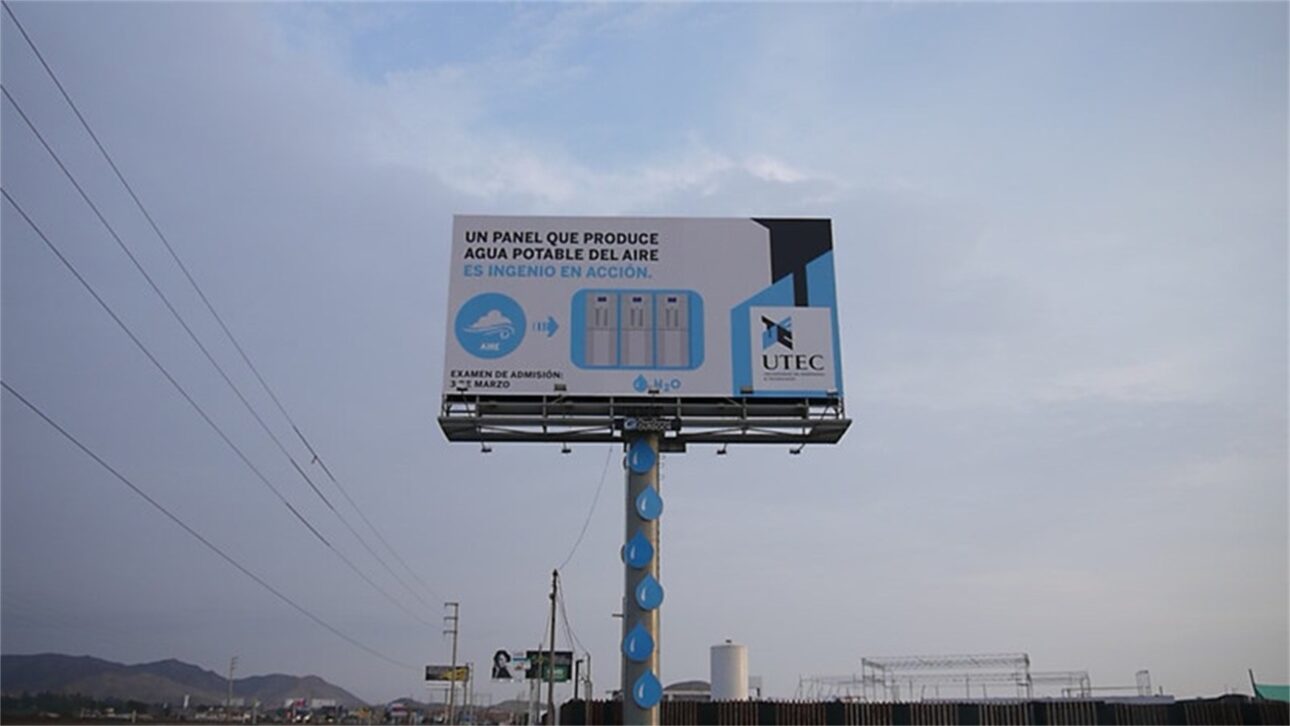
Lima carries a contrast that seems like a contradiction. The city is on a coastal desert, a strip of sand running along the Pacific, where rain is almost a rare event. For much of the year, the sky is covered by a gray mist, but this fog almost never turns into real rain. The result is an arid city where millions of people live with a lack of treated water, relying on water trucks and improvised solutions to have the basics for daily life.
-
The coast of Pernambuco has more than a dozen deliberately sunken ships at the bottom of the sea, and what started as a junkyard has become one of the largest wreck diving parks in Brazil, a refuge for turtles and schools of fish.

-
A woman left São Paulo to help her 88-year-old father in the hinterland of Paraíba, found the abandoned family farm, switched cassava and cattle for organic fruits, and harvested 24 tons of melon and watermelon in the semi-arid region, proving that tradition, irrigation, and planning can transform forgotten land into a sustainable business.

-
A network of cameras created to hunt down stolen cars recorded over 1 million alerts in a single American city in one year, overwhelmed the police, and forced the department to disable precisely the feature that was supposed to be the system’s strong point.

-
Young people from Minas created a robot without screws or metal parts, betting on a strong and flexible structure to compete against a thousand teams in Houston and took Brazil to the top of world robotics for the first time; Sofia, 15, also made history with an unprecedented leadership award.




At the same time, this same city is enveloped by a constant mist. The air rising from the ocean carries vapor all the time, and the relative humidity in the Peruvian capital reaches close to 98% on many days. In other words, the water is there, suspended, invisible, without falling. It’s like being inside a soaked sponge without being able to squeeze even a glass. This was the starting point of the idea: if the vapor was already in the air, it just needed a way to collect it and turn it into something drinkable.
The paradox of the humid desert is not exclusive to Lima, but few places bring together the two extremes so markedly. The city practically receives no rain and yet breathes air densely humid from the sea. For residents of the poorest neighborhoods, this detail of nature always seemed like a useless irony. The UTEC panel was born precisely to turn this logic on its head and show that desert vapor could indeed quench the thirst of those living nearby.
How a common billboard became a water-making machine
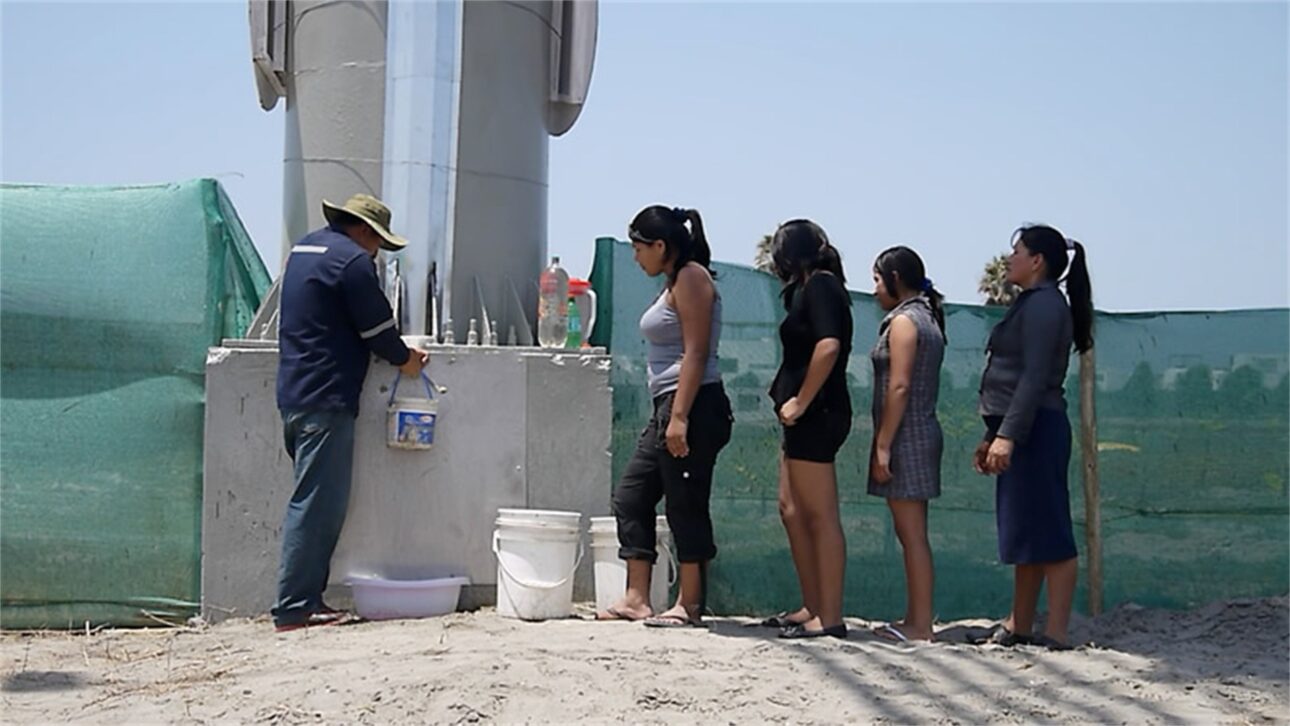
At first glance, it was a billboard like any other: a large metal structure planted by a dusty road in the Bujama region, on the southern coast of the country. The difference was behind the canvas. Instead of just holding a poster, the panel concealed an engineering system designed to capture air humidity and return it already in liquid, clean form, to those passing by.
The operation, at its core, mimicked what happens when a cold bottle “sweats” on a hot day. The structure drew in humid air, cooled this air in a condenser, and forced the vapor to turn into droplets. These droplets then passed through filters, including a charcoal filter, to remove impurities and make everything safe to drink. Each step happened hidden inside the panel, without the public seeing the “magic” from the outside.
In total, there were five generators working together, and each one managed to produce about 20 liters per day. The treated liquid flowed through small ducts to a tank at the base of the structure, where there was a faucet available for passersby. Anyone could come with a container and take free water, drawn directly from the air that previously was just lost there, without any use.
Almost 9,500 liters in three months: the panel’s numbers
The fact that made the project go around the world was the volume. In about three months of operation, between the end of 2012 and the beginning of 2013, the billboard produced approximately 9,450 liters of potable water. It’s equivalent to thousands of large bottles, literally drawn from the air of a city where it almost never rains.
On average, this amounted to around 96 to 100 liters per day, enough to supply dozens of families with drinking and cooking water. In a desert where every liter counts, this volume stopped being a technical detail and became a symbol. It showed that vapor, treated with the right engineering, could yield a good volume in a useful scale, not just in a lab test.
It’s important to put these numbers in the right context. The panel did not solve Lima’s water crisis alone, nor was that the promise. What it did was prove a concept: in such an environment, humid, it is possible to harvest water from the air continuously, cheaply, and accessibly. The count of almost 9,500 liters became living proof that the idea worked outside the lab, in the dust of the road, in front of anyone who wanted to see.
From air humidity to the faucet: the path of each drop
It’s worth following the path of a single drop to understand why the panel impressed so many people. It all starts with the humid air of Lima entering the system. Since the incoming air is very humid, it already comes loaded with vapor, which facilitates the entire process. Without this abundant and humid air from the coastal desert, none of this would work.
Inside the panel, this air encounters a condenser that lowers the temperature and turns the vapor into liquid water, just like dew forms on plants early in the morning. The newly formed liquid is not yet ready to drink, so it goes through a series of filters. The charcoal filter plays a central role in removing smell, taste, and impurities, ultimately delivering a clean and transparent liquid.
After being filtered, it is stored in tanks within the structure and channeled to the tap at the base of the panel. The final gesture is the simplest of all: someone opens the tap and fills the bucket. All the complex engineering is hidden so that the resident’s experience is as mundane as possible, fetching the clean liquid as if filling a glass from a street fountain. This simplicity at the end was one of the reasons the project went viral so quickly.
The engineering college behind the idea
The brain behind the project was UTEC, the Universidad de Ingeniería y Tecnología, a relatively new engineering college in Lima that wanted to introduce itself to the country. It’s worth visiting the institution’s official UTEC website. At the time, the university was opening its enrollment period and needed to attract the attention of future students in a competitive market.
Instead of a common advertisement, UTEC decided to practically demonstrate what engineering could do for society. It partnered with the agency Mayo DraftFCB and transformed a billboard into a public experiment, capable of solving, albeit on a small scale, a real water problem in a desert city. The message was direct: this is what engineers trained here can build for the world.
The move combined discourse and action. By setting up a panel that drew vapor from the air itself, the college proved its motto of changing the world through engineering without needing to say it in words. For candidates, seeing a panel delivering potable water in the midst of aridity was worth more than any brochure about the course curriculum.
Advertising that became a public service
UTEC’s panel is often remembered as one of the cases where advertising went beyond just selling and started providing a service. Instead of a billboard that merely occupied space in the desert landscape, the panel offered something tangible to those living nearby: a tap from which clean water flowed, every day, for free.
This type of action earned the campaign a flood of awards and reports around the world. Technology, architecture, design, and advertising sites echoed the idea, and the panel became a case study in courses and lectures. The combination was irresistible: an urgent human problem, the lack of water, solved by a simple and visual insight, a billboard planted in the middle of a dusty road.
But the impact went beyond marketing. For the families living around that stretch of road, the liters that came out of the panel were tangible. In a place where getting clean water is hard work, having a free source near home changed the routine, even if the volume didn’t solve everything. That vapor that had always been there, in the desert air, finally became a real utility.
The legacy of the billboard that harvests water from the air


More than a decade later, the Lima billboard is still mentioned whenever someone talks about extracting water from the air. The technology to capture moisture and condense it wasn’t born there, but it was that roadside billboard that popularized the idea to the general public by combining engineering, desert, and an accessible tap in one place.
After that, UTEC still invested in other experimental billboards along the same lines, such as a billboard designed to purify the city’s polluted air. The logic was the same: use the ordinary structure of a street billboard to forcibly solve an environmental problem of the city itself and, in the process, showcase what engineering is capable of.
Today, equipment that generates water from air humidity exists in various formats, from household machines to large-scale projects for desert regions. Many of these devices follow the same principle as that Peruvian billboard: where there is enough vapor in the air, there is water waiting to be harvested. The UTEC case helped plant this seed in the minds of many people and many engineers.
And it leaves a challenge for the future: if a single billboard was capable of extracting almost 9,500 liters of water from the air of a desert, how many thirsty cities around the world are now surrounded by invisible water waiting for someone willing to collect it?


